Stock Analysis · ZhongAn Online P & C Insurance Co. Ltd (ZZHGF)
Overview
ZhongAn Online P & C Insurance is a China-based digital insurer. It was created to sell insurance mainly through online channels and partner platforms rather than relying on a traditional branch network. The company focuses on technology-driven property and casualty insurance, but its business mix is broader than the name may suggest: it also earns money from health-related insurance, consumer finance-related protection, digital lifestyle coverage, and technology services provided to other institutions.
Its revenue base has become more diversified over time. Based on recent annual disclosures, the main operating sources are approximately the following:
- Health insurance and medical-related products: roughly 35% to 40% of gross written premium. This includes medical reimbursement, critical illness, and other health protection products distributed through online ecosystems.
- Digital lifestyle insurance: roughly 25% to 30%. This category covers embedded insurance tied to online consumption scenarios such as travel, e-commerce, shipping return, and other everyday digital transactions.
- Consumer finance-related insurance: roughly 15% to 20%. This includes credit-related and loan facilitation protection products, an area that has seen regulatory pressure in past years.
- Auto and other property & casualty lines: roughly 10% to 15%. This is a smaller contributor than at many traditional insurers.
- Technology and ecosystem services: a smaller but strategically important contribution, generally in the single-digit to low-teens percentage range depending on the period. This includes software, digital insurance infrastructure, and related services for insurers and ecosystem partners.
The broader pattern is that ZhongAn is not simply an online version of a standard insurer. It is closer to a hybrid between an insurer, a distribution platform partner, and an insurance technology provider. That positioning matters because it can support growth beyond pure underwriting, but it also makes results more sensitive to regulation, product mix changes, and the health of China’s digital consumer economy.
Profitability has also been uneven. Revenue has expanded strongly over the last several years, but earnings have swung from profit to loss and back again as claims experience, investment results, and business mix changed. The operating picture therefore looks stronger than a quick glance at headline profit might suggest, yet still less stable than mature global insurers.
The operating flow shows a business that has increased revenue meaningfully since 2021, but with wide variation in how much of that turns into operating income and net income. That is a reminder that scale is no longer the main question; consistency is.
Key Figures
| Metric | Value | Sector ⓘ |
|---|---|---|
| Date | Oct 24, 2026 | |
| Context | ||
| Sector | Financial Services | |
| Industry | Insurance - Property & Casualty | |
| Market Cap ⓘ | $2.53B | |
| Beta ⓘ | 0.90 | |
Value (Cheapness) | ||
| P/E Ratio ⓘ | 25.00 | 12.46 |
| P/B Ratio ⓘ | 0.01 | 1.25 |
| FCF Yield ⓘ | 163.64% | 9.82% |
| Dividend Yield ⓘ | N/A | 2.94% |
| EBIT / EV ⓘ | N/A | 8.11% |
| PEG ⓘ | 1.33 | |
Growth (Business expansion) | ||
| Revenue Growth ⓘ | 16.10% | 9.10% |
| RPS Growth (5Y CAGR) ⓘ | 81.22% | 12.31% |
| EPS Growth (5Y CAGR) ⓘ | N/A | -6.97% |
| BVPS Growth (5Y CAGR) ⓘ | 79.25% | 5.02% |
| Margin Growth (5Y Trend) ⓘ | 0.11% | -4.00% |
| FCF Growth (5Y CAGR) ⓘ | N/A | 4.71% |
| DPS Growth (5Y CAGR) ⓘ | N/A | 8.92% |
Quality (Business durability) | ||
| ROIC (Latest) ⓘ | N/A | 9.18% |
| ROE (Latest) ⓘ | 13.25% | 13.93% |
| ROA (Latest) ⓘ | 6.83% | 1.57% |
| ROIC (5Y Median) ⓘ | 4.38% | 7.80% |
| ROE (5Y Median) ⓘ | 4.63% | 12.15% |
| ROA (5Y Median) ⓘ | 1.55% | 1.28% |
| Net Debt / EBIT (Latest) ⓘ | 0.16 | 1.02 |
| Net Debt / EBIT (5Y Median) ⓘ | 2.54 | 0.72 |
| Net Debt / EBITDA (Latest) ⓘ | 0.16 | 0.88 |
| Operating Margin (Latest) ⓘ | 49.02% | 22.30% |
| Operating Margin (5Y Median) ⓘ | 4.96% | 24.50% |
| Debt to Equity (Latest) ⓘ | 27.85% | 59.34% |
| Profit Margin (Latest) ⓘ | 5.23% | 26.42% |
| Free Cash Flow (Latest) ⓘ | $4.14B | |
Momentum (Price trend) | ||
| 3Y Return ⓘ | -39.79% | +95.73% |
| 12M Return (excl. last month) ⓘ | 0.00% | +17.30% |
| 6M Return ⓘ | 0.00% | +6.07% |
| Price vs. 200-Day MA ⓘ | 0.00% | +5.36% |
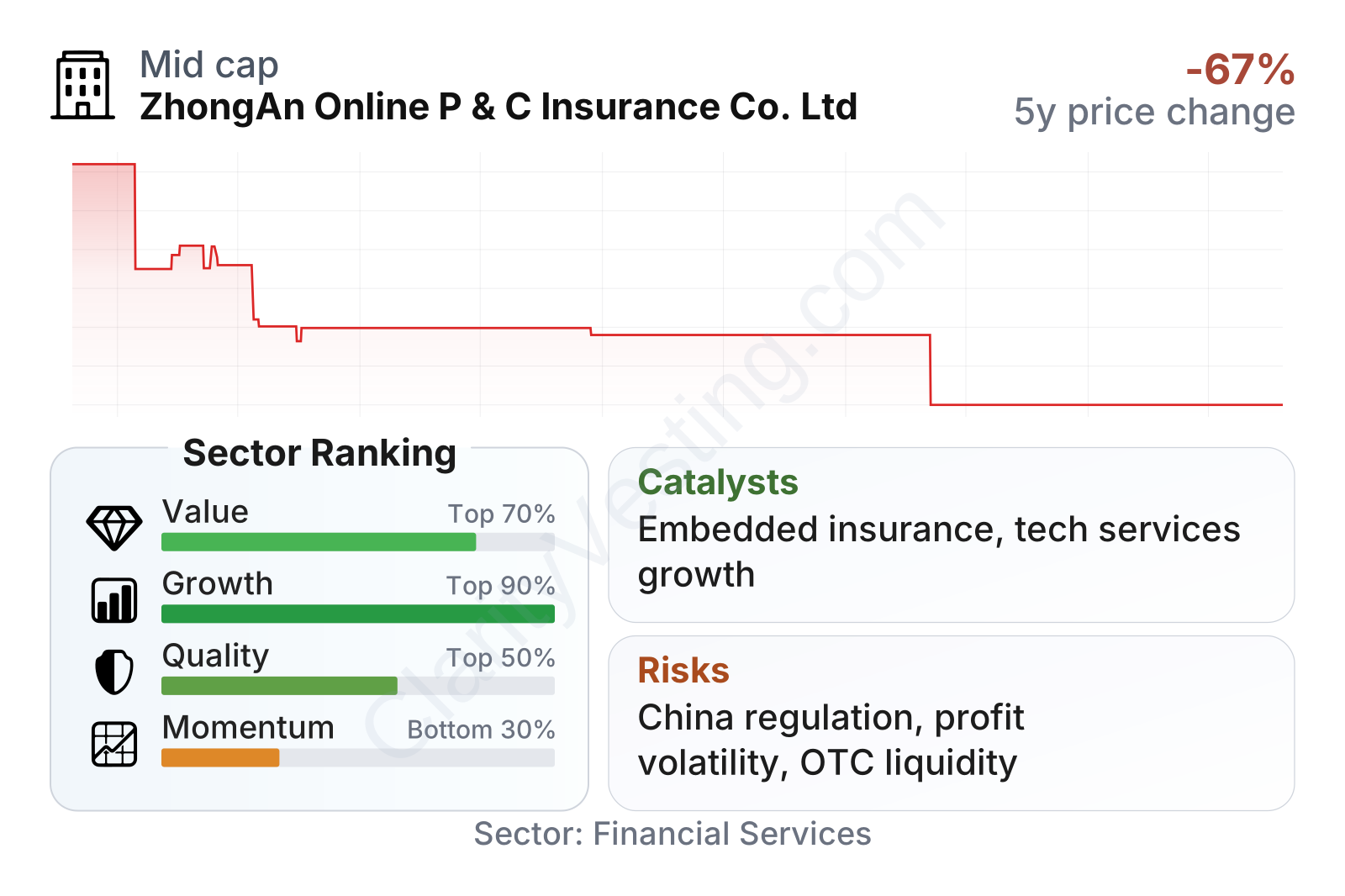
ZhongAn stands out most on growth, where it ranks near the top of its sector. Recent revenue growth is ahead of the industry median, and longer-term expansion in revenue per share and book value per share has been unusually strong. On quality, the picture is mixed but improving: current returns on assets are above sector norms, leverage is moderate, and the latest operating margin is strong, yet the five-year profitability record is much less impressive because of past volatility. On value, the signals are unusual. The earnings multiple is above the sector median, but the price-to-book ratio is far below the industry norm, suggesting the market is discounting either accounting complexity, concern about sustainability, or company-specific risk. Momentum is clearly weak, reflecting a long share price decline and limited recent recovery.
Growth
ZhongAn operates in a segment with attractive long-term logic. Insurance penetration in China still has room to deepen in specialized and embedded products, and digital distribution continues to reshape how policies are sold. The company’s model fits that trend well because it was built around online customer acquisition, partner platforms, data-driven pricing, and fast product iteration. Those capabilities are more relevant in small-ticket, high-frequency insurance than in traditional agency-driven insurance markets.
The strategy also makes sense in another way: management has increasingly emphasized healthier product mix, underwriting discipline, and technology output rather than chasing volume at any cost. That matters because some of ZhongAn’s earlier expansion was tied to consumer finance and ecosystem categories that later faced tighter rules or changing economics. A more balanced mix centered on health, lifestyle, and technology services could make future growth more durable, even if it is not as explosive as earlier phases.
The long-term rise in book value per share, despite a setback in 2022, suggests the company has rebuilt underlying equity after a difficult period. That supports the idea that the business is progressing from experimental scale-up to a more mature operating model, although the extremely large recent jump should be treated carefully until it is confirmed as fully sustainable in future reporting.
A meaningful catalyst is ZhongAn’s position in embedded insurance. As more products are sold within e-commerce, health care, travel, mobility, and consumer service platforms, insurers that can integrate quickly into partner ecosystems gain an advantage. ZhongAn has been building around that concept from the start. Another catalyst is the company’s technology arm, which can extend its reach beyond its own balance sheet by serving other insurers or institutions. If that segment keeps growing, it may improve the market’s view of ZhongAn as more than a cyclical underwriter.
Recent company communications have also highlighted continued focus on AI, digital claims handling, and ecosystem-based distribution. Those themes are important because they can support lower operating friction, better customer retention, and wider product reach. For a digital insurer, stronger automation is not just a branding point; it can influence claims costs and operating efficiency directly.
Risks
This article is for informational purposes only and does not constitute financial advice. Some content is AI-generated. See Disclaimer


