Stock Analysis · Scancell Holdings plc (SCNLF)
Overview
Scancell Holdings plc is a clinical-stage biotechnology company focused on cancer immunotherapy. In simple terms, it is developing treatments designed to help the immune system recognize and attack cancer. Its pipeline is built around three main technology platforms: ImmunoBody, which targets tumor-specific immune responses; Moditope, which is aimed at modified tumor proteins that may help the immune system distinguish cancer cells from normal cells; and GlyMab, an antibody platform focused on cancer-associated glycans.
Because Scancell is still in the development stage, it does not have a large, diversified commercial business. Revenue mainly comes from collaboration agreements, licensing-related income, and grants rather than from approved product sales. Based on recent reported patterns, the business mix is heavily concentrated in non-product revenue streams.
- Collaboration and licensing income: approximately 80% to 100% of annual revenue in recent years when present. This can include upfront payments, research support, milestone-related recognition, and other partner-related income.
- Grant and research-related income: a smaller supplementary source, typically tied to scientific programs and external support.
- Product revenue: 0%. The company does not currently market an approved therapy.
This revenue profile matters for long-term analysis: the business is not yet driven by recurring medicine sales, so progress depends more on clinical results, partnership activity, and access to funding than on established commercial demand.
Looking at the cost structure, Scancell spends most of its resources on research and development, which is typical for an early-stage biotech. In the most recent fiscal year, research spending remained the largest expense item by far, while overall revenue stayed modest and losses continued. That is consistent with a company still trying to convert scientific platforms into later-stage assets.
The operating flow shows a business centered on development spending rather than commercialization. Research expense dominates the income statement, while revenue remains limited and uneven from year to year, underscoring how dependent Scancell still is on pipeline progress and external deals.
Key Figures
| Metric | Value | Sector ⓘ |
|---|---|---|
| Date | Oct 23, 2026 | |
| Context | ||
| Sector | Healthcare | |
| Industry | Biotechnology | |
| Market Cap ⓘ | $1.91B | |
| Beta ⓘ | 0.69 | |
Value (Cheapness) | ||
| P/E Ratio ⓘ | N/A | 25.42 |
| P/B Ratio ⓘ | N/A | 3.08 |
| FCF Yield ⓘ | -0.89% | 3.12% |
| Dividend Yield ⓘ | N/A | 1.85% |
| EBIT / EV ⓘ | -15.79% | 0.56% |
| PEG ⓘ | N/A | |
Growth (Business expansion) | ||
| Revenue Growth ⓘ | N/A | 7.50% |
| RPS Growth (5Y CAGR) ⓘ | N/A | 8.60% |
| EPS Growth (5Y CAGR) ⓘ | N/A | -17.73% |
| BVPS Growth (5Y CAGR) ⓘ | N/A | 3.72% |
| Margin Growth (5Y Trend) ⓘ | N/A | -0.57% |
| FCF Growth (5Y CAGR) ⓘ | N/A | 0.96% |
| DPS Growth (5Y CAGR) ⓘ | N/A | 6.69% |
Quality (Business durability) | ||
| ROIC (Latest) ⓘ | N/A | 3.17% |
| ROA (Latest) ⓘ | -223.16% | 2.98% |
| ROIC (5Y Median) ⓘ | -73.67% | 4.56% |
| ROA (5Y Median) ⓘ | -44.33% | 1.87% |
| Net Debt / EBIT (Latest) ⓘ | N/A | 1.34 |
| Net Debt / EBIT (5Y Median) ⓘ | N/A | 1.86 |
| Net Debt / EBITDA (Latest) ⓘ | N/A | 1.00 |
| Net Debt / Assets ⓘ | 113.50% | 5.06% |
| EBITDA / Interest ⓘ | N/A | 9.55 |
| Operating Margin (Latest) ⓘ | N/A | 9.25% |
| Operating Margin (5Y Median) ⓘ | -248.32% | 7.33% |
| Debt to Equity (Latest) ⓘ | -88.01% | 26.68% |
| Profit Margin (Latest) ⓘ | N/A | 3.34% |
| Free Cash Flow (Latest) ⓘ | -$16.96M | |
Momentum (Price trend) | ||
| 3Y Return ⓘ | -15.06% | +51.61% |
| 12M Return (excl. last month) ⓘ | +5.94% | +19.90% |
| 6M Return ⓘ | -0.70% | +10.10% |
| Price vs. 200-Day MA ⓘ | N/A | +6.44% |
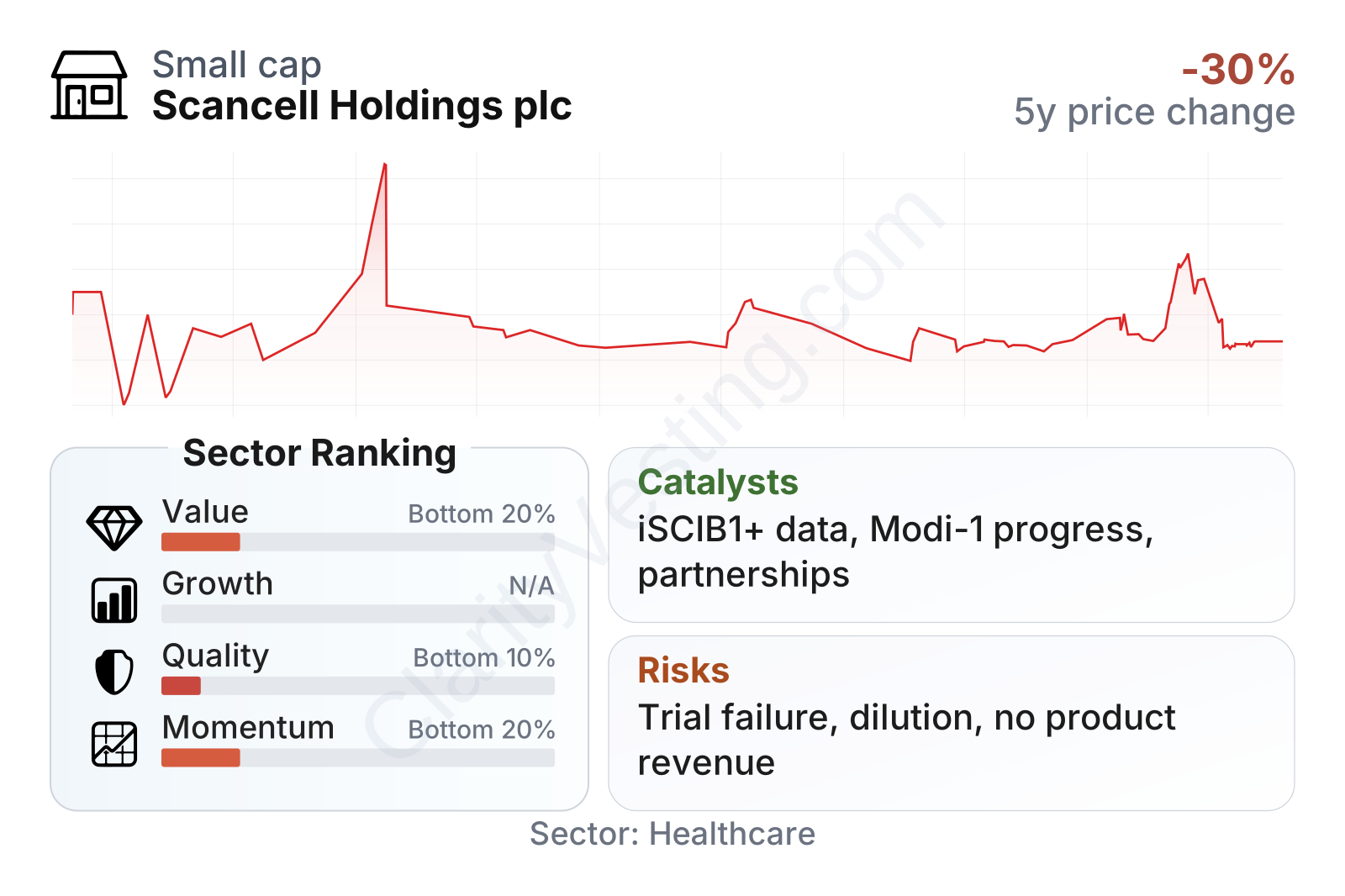
Scancell is a small-to-mid-sized biotech by market value, and its share price history has been relatively restrained over the longer period shown, with only a modest net gain since late 2021. Volatility has not been extreme versus many biotechnology peers, as reflected by a beta below 1, but the stock’s momentum has still trailed much of the healthcare sector over 6 months, 12 months, and 3 years.
The broader financial profile is weak by conventional operating standards, which is normal for a company at this stage but still important. Value metrics rank in the lower end of the sector because the company is loss-making, has negative free cash flow, and cannot be judged on earnings multiples the way profitable drug companies can. Quality metrics also sit near the bottom of the sector, reflecting negative returns on assets and capital, continued operating losses, and a balance sheet that needs to be interpreted carefully because development-stage biotechs often have accounting distortions around equity and financing. The main takeaway is straightforward: the market is valuing future clinical and partnering potential rather than current business performance.
Growth
Scancell operates in one of the most structurally attractive areas in healthcare: cancer immunotherapy. This remains a large and active field because oncology is still one of the biggest categories for drug development, and the medical need is substantial. Companies that can show strong immune responses, acceptable safety, and convincing efficacy in hard-to-treat cancers can create significant value even before commercialization through licensing, co-development, or acquisition interest.
The company’s strategy is coherent for that environment. Rather than relying on a single asset, Scancell has built several platforms that aim to generate multiple candidates across vaccines and antibodies. That platform approach can be valuable if even one program produces strong clinical evidence, because it may also increase the credibility of the underlying science for follow-on assets.
A central growth catalyst is the continued clinical development of its lead immunotherapy candidates, especially programs in melanoma and other solid tumors. In recent company updates, Scancell has highlighted progress in trials involving iSCIB1+ and the Moditope-derived candidate Modi-1, including exploration of combinations with checkpoint inhibitors. Combination use is important because modern cancer treatment often depends on fitting new therapies into existing regimens rather than replacing them outright.
Another meaningful growth lever is partnership potential. For a company without marketed products, a well-structured collaboration can do three things at once: validate the science, provide non-dilutive capital, and shift part of development cost to a larger partner. Scancell has already shown it can attract external interest through antibody-related agreements, which supports the idea that parts of its technology may have value beyond its internally run trials.
Recent developments also matter. Public company communications through 2026 have continued to emphasize pipeline advancement, trial execution, and intellectual property support around its platforms. For a business like Scancell, the most significant opportunities usually do not come from steady quarterly revenue growth; they come from discrete events such as positive trial readouts, dose-expansion data, licensing deals, or advancement into later-stage studies.
Risks
This article is for informational purposes only and does not constitute financial advice. Some content is AI-generated. See Disclaimer