Stock Analysis · Henderson Land (HLDVF)
Overview
Henderson Land Development is a Hong Kong-based property group focused on real estate development, investment properties, and related urban infrastructure. The company is best known for building and selling residential and commercial projects in Hong Kong and mainland China, while also owning recurring-income assets such as shopping space, office buildings, hotels, and utilities-related businesses. For long-term analysis, the most important point is that Henderson Land combines two different economic engines: cyclical property sales, which can move sharply from year to year, and steadier rental and infrastructure income.
Based on the company’s recent annual reporting structure, its revenue sources are led by property development, followed by property leasing, then smaller contributions from utilities and energy, hotel operations, and other activities. Exact percentages can vary materially by project completion timing, but the mix is broadly understood as follows:
- Property development: approximately 60% to 75% of revenue in a typical year. This includes sales of residential units, commercial space, and completed development projects.
- Property leasing: approximately 10% to 20% of revenue. This includes recurring rental income from retail malls, office properties, and other investment properties.
- Utilities and energy-related operations: approximately 10% to 15% of revenue. This generally includes contributions from gas utility interests and related infrastructure holdings associated with the group.
- Hotel operations and other businesses: usually less than 10% combined. These activities add diversification but are not the core driver of the group.
That mix matters because development revenue can be volatile, while leasing and utility-linked income can make the business more resilient. Henderson Land is therefore not a pure homebuilder and not a pure landlord; it sits somewhere in between, with meaningful exposure to Hong Kong real estate values.
Operationally, the recent trend has been mixed. Revenue has stayed around the mid-HK$20 billion range in recent years, but profit has come under pressure as interest expense has climbed and margins have eased from earlier peaks. The business still generates solid operating income, yet financing costs now absorb a larger share of that earnings base than they did a few years ago.
The income flow shows a business that still converts a sizable share of sales into operating profit, but net income has trended lower since 2021 as borrowing costs increased and gross profit narrowed. That pattern is typical of a property company operating through a softer market and a higher-rate environment.
Key Figures
| Metric | Value | Sector ⓘ |
|---|---|---|
| Date | Oct 23, 2026 | |
| Context | ||
| Sector | Real Estate | |
| Industry | Real Estate - Diversified | |
| Market Cap ⓘ | $18.11B | |
| Beta ⓘ | 1.11 | |
Value (Cheapness) | ||
| P/E Ratio ⓘ | 22.00 | 17.85 |
| P/B Ratio ⓘ | 0.01 | 0.87 |
| FCF Yield ⓘ | 134.51% | 7.30% |
| Dividend Yield ⓘ | 33.69% | 4.83% |
| EBIT / EV ⓘ | N/A | 3.78% |
| PEG ⓘ | 0.67 | |
Growth (Business expansion) | ||
| Revenue Growth ⓘ | 80.10% | 5.35% |
| RPS Growth (5Y CAGR) ⓘ | 69.28% | 6.02% |
| EPS Growth (5Y CAGR) ⓘ | 6.30% | -10.65% |
| BVPS Growth (5Y CAGR) ⓘ | 62.15% | 0.43% |
| Margin Growth (5Y Trend) ⓘ | -4.30% | -0.69% |
| FCF Growth (5Y CAGR) ⓘ | 81.98% | 5.40% |
| DPS Growth (5Y CAGR) ⓘ | 66.14% | 5.07% |
Quality (Business durability) | ||
| ROIC (Latest) ⓘ | N/A | 5.69% |
| ROE (Latest) ⓘ | 3.63% | 7.37% |
| ROA (Latest) ⓘ | 2.14% | 2.85% |
| ROIC (5Y Median) ⓘ | 2.23% | 4.26% |
| ROE (5Y Median) ⓘ | 2.86% | 6.04% |
| ROA (5Y Median) ⓘ | 1.71% | 2.45% |
| Net Debt / EBIT (Latest) ⓘ | 6.90 | 7.55 |
| Net Debt / EBIT (5Y Median) ⓘ | 15.90 | 8.26 |
| Net Debt / EBITDA (Latest) ⓘ | 6.58 | 5.26 |
| Net Debt / Assets ⓘ | 25.34% | 37.45% |
| EBITDA / Interest ⓘ | 4.11 | 4.11 |
| Operating Margin (Latest) ⓘ | 38.03% | 33.86% |
| Operating Margin (5Y Median) ⓘ | 38.92% | 37.49% |
| Debt to Equity (Latest) ⓘ | 48.42% | 88.76% |
| Profit Margin (Latest) ⓘ | 20.47% | 18.94% |
| Free Cash Flow (Latest) ⓘ | $24.36B | |
Momentum (Price trend) | ||
| 3Y Return ⓘ | +76.59% | +36.33% |
| 12M Return (excl. last month) ⓘ | -8.12% | +4.32% |
| 6M Return ⓘ | +1.74% | -1.74% |
| Price vs. 200-Day MA ⓘ | +25.28% | -1.42% |
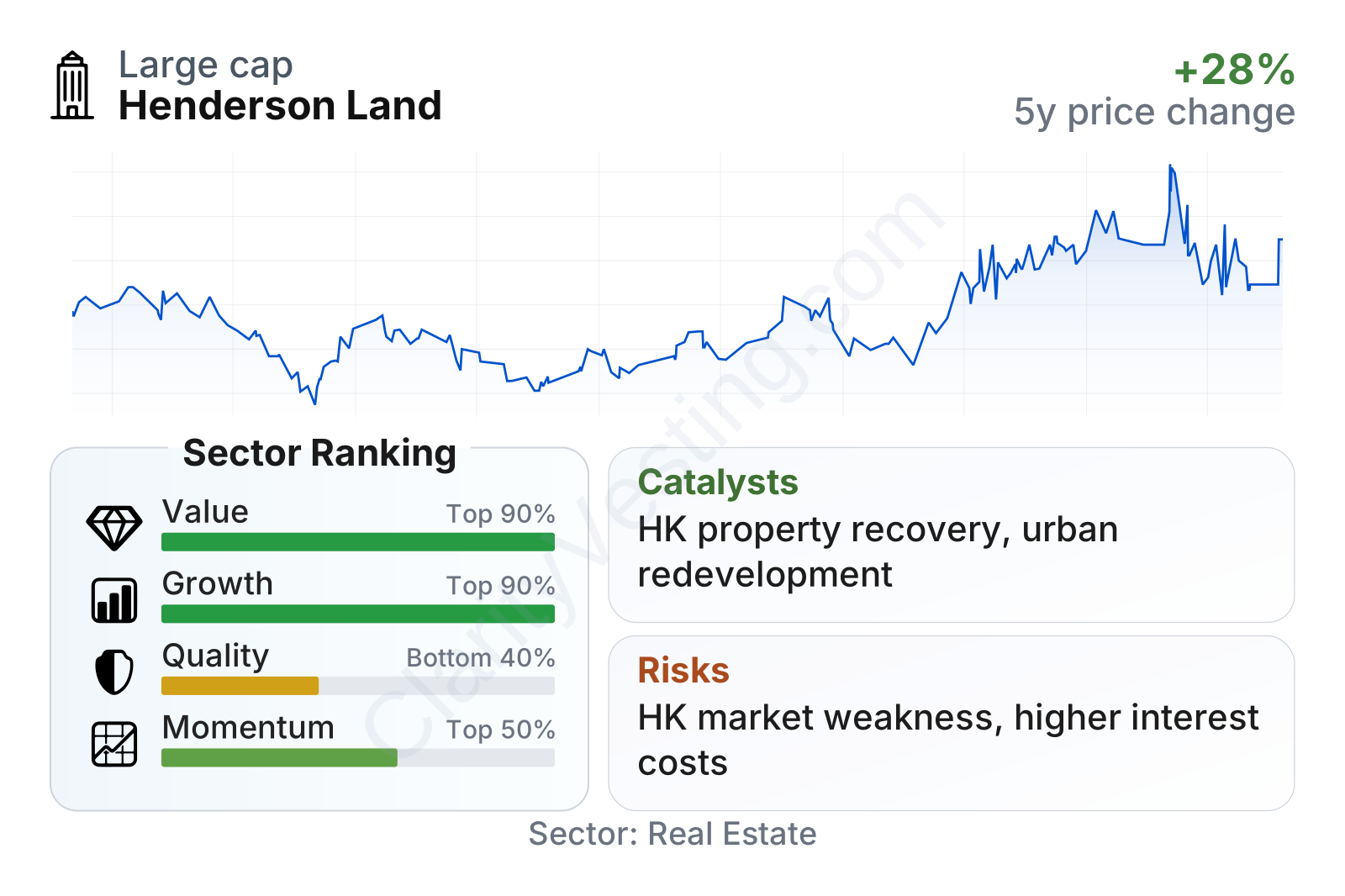
Henderson Land screens as strong on value and growth compared with much of the real estate sector, but weaker on quality. The standout features are its very low price-to-book multiple, unusually high trailing dividend yield, and strong multi-year growth in revenue per share, book value per share, and free cash flow. Against that, returns on equity and assets remain below sector medians, which suggests the company owns a large asset base but is not extracting exceptional profitability from it. Debt looks manageable relative to assets and equity, but earnings still carry meaningful leverage to financing conditions.
The share price has been relatively stable over the past year after recovering from lower levels seen earlier in the cycle. Over a three-year view, the stock has outperformed the median real estate peer, although the shorter-term picture is less decisive.
Growth
Henderson Land operates in a sector that can still grow over the long run, but it is not a simple high-growth industry. Hong Kong and mainland China property markets are mature, capital-intensive, and heavily shaped by interest rates, household confidence, and policy decisions. That means future growth is likely to come less from rapid expansion and more from disciplined land replenishment, premium project execution, redevelopment, and extracting more recurring income from investment properties.
The company’s strategy broadly makes sense for that environment. It has a long history in Hong Kong, a large asset base, and exposure to prime urban locations where land supply is structurally limited. In addition, recurring rental and utility-linked income can help stabilize performance between major development completions. For a long-term view, one of the more important strategic questions is whether Henderson Land can gradually improve the balance between one-off property sales and recurring cash-generating assets.
The long-term revenue-per-share trend is favorable overall, even though annual movements can be uneven because revenue recognition depends on when projects are completed and handed over. That is normal for developers, so a single-year jump or drop should be read carefully rather than as a clean operating trend.
The dividend record has historically looked steady, which fits the profile of an established Hong Kong property group. However, unusually sharp changes in the latest reading should be treated with caution because property-sector distributions can be affected by reporting mechanics, special items, or one-off adjustments. The broader point is that Henderson Land has maintained a meaningful cash return profile, supported by recurring assets and a substantial balance sheet.
A notable catalyst for future growth is any improvement in Hong Kong property sentiment. Lower financing costs, better residential demand, and stronger commercial leasing conditions could lift both transaction activity and asset values. Another potential driver is redevelopment in core urban districts, where Henderson Land has experience assembling sites and creating higher-value projects. If the company continues to recycle capital from mature assets into newer developments or premium commercial properties, that could support both earnings quality and net asset value over time.
Recent company updates have also pointed to project pipeline progress and continued emphasis on major Hong Kong developments. For a company like Henderson Land, visible progress on pre-sales, completions, and leasing-up is often more important than headline expansion because it directly affects cash flow timing and realized profitability.
Risks
This article is for informational purposes only and does not constitute financial advice. Some content is AI-generated. See Disclaimer


