Stock Analysis · ZTE Corp-H (ZTCOF)
Overview
ZTE Corp is a Chinese telecommunications equipment and technology company best known for supplying the hardware and software that help mobile networks operate. Its business spans carrier network infrastructure, enterprise networking products, and consumer devices such as smartphones, fixed wireless terminals, home routers, and related digital products. In simple terms, ZTE sits in the middle of the global data economy: telecom operators use its equipment to build networks, businesses use its connectivity systems, and consumers use some of its devices.
The company’s revenue base is still led by telecom network equipment, with consumer and enterprise activities providing additional support. Based on recent annual disclosures, the revenue mix is approximately:
- Carrier networks: about 55% to 60% of revenue. This includes wireless access products, core networks, transmission systems, and other telecom infrastructure sold mainly to mobile and fixed-line operators.
- Consumer business: about 25% to 30% of revenue. This covers smartphones, mobile broadband devices, fixed wireless access terminals, home gateways, and other personal or household connectivity products.
- Government and corporate business: about 15% to 20% of revenue. This includes servers, storage, data center networking, private networks, industry digitalization solutions, and ICT products for enterprises and public-sector customers.
ZTE’s cost structure shows a business that spends heavily on product development. Over the last several years, research and development has remained a major operating expense, which is typical in telecom equipment where product cycles are fast and technical standards change regularly. Revenue has generally held near the same broad range, but profitability weakened noticeably in the latest annual period as gross profit compressed and operating income fell much faster than sales.
Key Figures
| Metric | Value | Sector ⓘ |
|---|---|---|
| Date | Nov 21, 2026 | |
| Context | ||
| Sector | Technology | |
| Industry | Communication Equipment | |
| Market Cap ⓘ | $14.79B | |
| Beta ⓘ | 0.77 | |
Value (Cheapness) | ||
| P/E Ratio ⓘ | 19.15 | 26.18 |
| FCF Yield ⓘ | 1.57% | 3.74% |
| Dividend Yield ⓘ | 16.51% | 1.32% |
| EBIT / EV ⓘ | 3.51% | 3.92% |
| PEG ⓘ | N/A | |
Growth (Business expansion) | ||
| Revenue Growth ⓘ | 34.00% | 17.95% |
| RPS Growth (5Y CAGR) ⓘ | 2.14% | 8.44% |
| EPS Growth (5Y CAGR) ⓘ | -50.51% | -6.06% |
| Margin Growth (5Y Trend) ⓘ | -6.64% | 0.56% |
| FCF Growth (5Y CAGR) ⓘ | -33.45% | 9.84% |
| DPS Growth (5Y CAGR) ⓘ | 4.58% | 7.96% |
Quality (Business durability) | ||
| ROIC (Latest) ⓘ | 3.25% | 10.05% |
| ROIC (5Y Median) ⓘ | 9.89% | 8.19% |
| Net Debt / EBIT (Latest) ⓘ | 8.04 | 0.61 |
| Net Debt / EBIT (5Y Median) ⓘ | -0.91 | 0.48 |
| Net Debt / EBITDA (Latest) ⓘ | 6.46 | 0.33 |
| Net Debt / Assets ⓘ | 17.24% | 4.20% |
| EBITDA / Interest ⓘ | 2.09 | 13.53 |
| Operating Margin (Latest) ⓘ | 3.55% | 10.59% |
| Operating Margin (5Y Median) ⓘ | 8.97% | 8.53% |
| Debt to Equity (Latest) ⓘ | 76.16% | 34.34% |
| Profit Margin (Latest) ⓘ | 2.90% | 7.54% |
| Free Cash Flow (Latest) ⓘ | $232.24M | |
Momentum (Price trend) | ||
| 3Y Return ⓘ | +9.45% | +26.20% |
| 12M Return (excl. last month) ⓘ | -46.74% | +11.65% |
| 6M Return ⓘ | -7.78% | -4.21% |
| Price vs. 200-Day MA ⓘ | -22.08% | -4.34% |
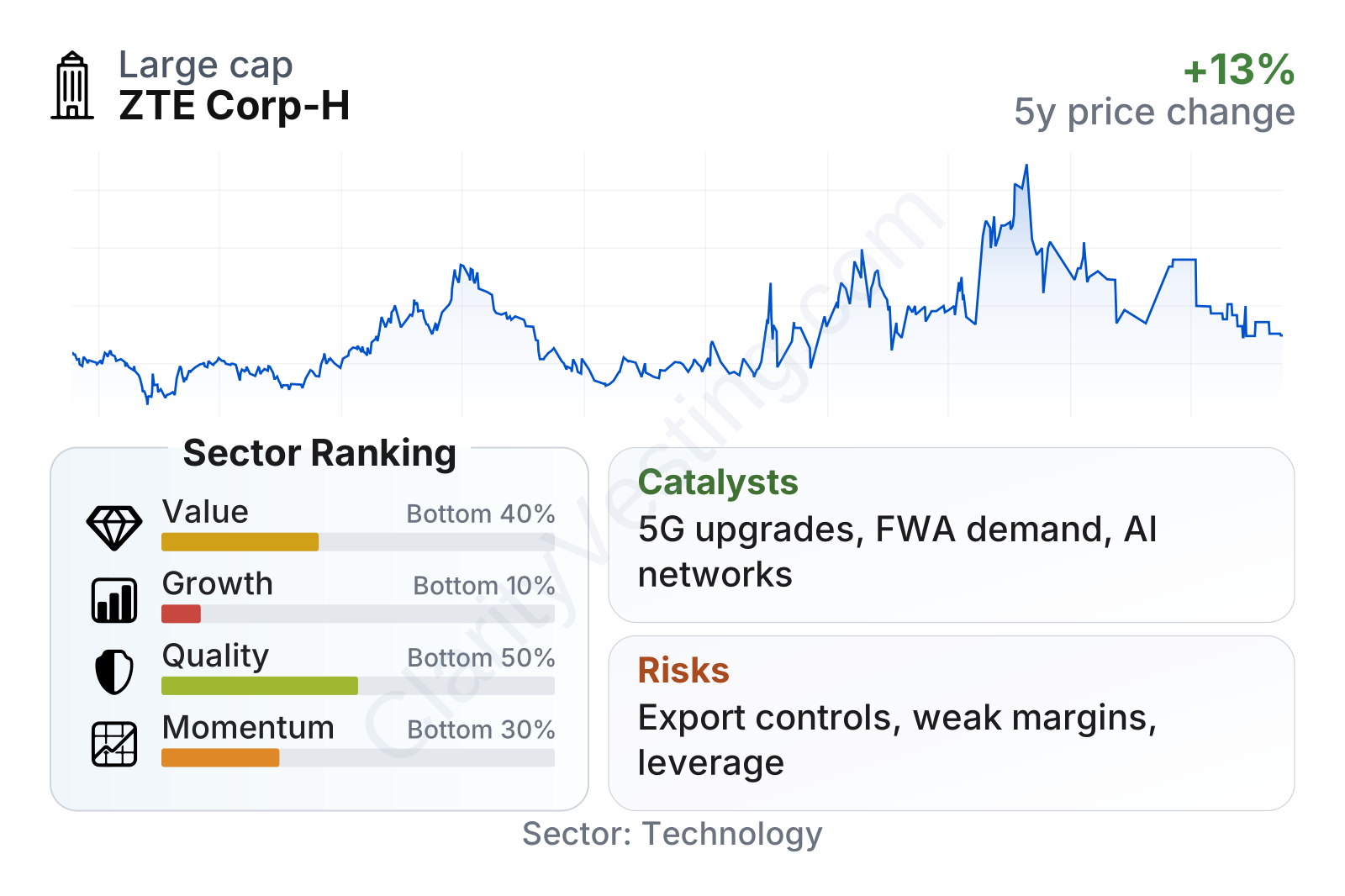
ZTE is a large communication equipment company, but its market behavior has been relatively defensive, with a beta below 1. The stock has been volatile over the last few years, including a strong rise into 2025 followed by a retreat in 2026. In valuation terms, the earnings multiple sits below the sector median, which can look appealing at first glance, but the broader metric mix is less favorable: free cash flow yield is weak, growth rankings are low on a multi-year view, and momentum has been soft. The table points to a company that is not obviously expensive on earnings alone, yet also not scoring strongly on business quality or consistency compared with many technology peers.
One unusual figure is the very high trailing dividend yield. That may reflect the timing of distributions and the stock’s price movements rather than a stable, repeatable income profile, so it is better viewed as a data point than as a defining feature of the investment case.
Growth
ZTE operates in sectors that still have long-term relevance. Mobile data traffic continues to expand, telecom operators are still upgrading networks, fixed wireless access is gaining adoption in some markets, and enterprise customers are investing in private networks, cloud-linked infrastructure, and digital connectivity. Those trends support the broader market in which ZTE competes.
The company’s strategy also makes sense on paper. It combines telecom infrastructure, terminals, and industry solutions, while keeping research and development elevated to remain aligned with technologies such as 5G, all-optical networks, computing infrastructure, and AI-related digital systems. This broad platform can be useful because operators and enterprise customers often prefer suppliers able to provide multiple layers of a network rather than a single component.
Recent revenue momentum has improved sharply on a year-over-year basis, with the latest growth rate standing well above the sector median. That is an encouraging short-term signal. However, the longer picture is less impressive: five-year revenue-per-share growth has been modest, earnings per share have contracted over that period, and operating margin trends have weakened. In other words, recent acceleration exists, but it has not yet fully translated into durable long-term compounding.
Cash generation has also been uneven. Free cash flow has swung between strongly positive and negative periods, which reduces visibility. That matters because telecom equipment can be working-capital intensive, especially when customers are large carriers or government-linked entities with longer payment cycles. For long-term analysis, a more stable cash conversion profile would strengthen the growth case.
As for catalysts, ZTE remains exposed to several practical drivers: continued 5G network expansion, broader use of fixed wireless access equipment, enterprise digitalization projects, and demand for higher-capacity transport and data-center connectivity. The company has also highlighted computing and AI-related infrastructure in its strategic messaging, which could create incremental opportunity if these products gain commercial traction across operator and enterprise markets.
Risks
This article is for informational purposes only and does not constitute financial advice. Some content is AI-generated. See Disclaimer


