Stock Analysis · Vonovia SE (VONOY)
Overview
Vonovia SE is one of Europe’s largest residential real estate companies. Its core business is owning, renting, managing, and developing apartment buildings, with a strong focus on Germany and additional exposure to markets such as Sweden and Austria. In simple terms, Vonovia earns most of its money by collecting rent from a very large housing portfolio and then adds related income from services tied to those buildings.
The business is built around recurring residential income, which tends to be more stable than many other real estate activities because housing demand is persistent. The company also modernizes apartments, improves energy efficiency, develops new housing, and offers property-related services to tenants and third parties.
Based on the company’s recent annual reporting structure, Vonovia’s main revenue sources can be summarized as follows:
- Rental income: about 70% to 80% of total revenue. This is the main engine of the business and comes from leasing residential units, with some contribution from commercial space and parking.
- Value-add and housing-related services: about 10% to 20%. This includes maintenance, modernization, energy-related upgrades, multimedia, and other services connected to the housing stock.
- Recurring sales and development: about 5% to 10%. This covers condominium sales, project development, and selected disposals.
- Care and other activities: a smaller contribution. This includes senior living and related services where applicable.
What stands out is that Vonovia is not just a landlord. It operates at scale, manages buildings internally, and tries to capture more value from maintenance, upgrades, and energy modernization across its portfolio. Over the past few years, however, reported earnings have been heavily affected by property valuation swings and financing costs, which is common in large real estate groups when interest rates move sharply.
The profit path has been unusually volatile. Revenue has remained in the multibillion-euro range, but accounting earnings moved from strong profits to large losses and then back toward recovery as property revaluations, taxes, and interest costs changed. That pattern matters because it shows the difference between the underlying rental business, which is relatively steady, and bottom-line results, which can swing sharply in real estate.
Key Figures
| Metric | Value | Sector ⓘ |
|---|---|---|
| Date | Nov 21, 2026 | |
| Context | ||
| Sector | Real Estate | |
| Industry | Real Estate Services | |
| Market Cap ⓘ | $15.49B | |
| Beta ⓘ | 1.49 | |
Value (Cheapness) | ||
| P/E Ratio ⓘ | 8.53 | 17.59 |
| P/B Ratio ⓘ | N/A | 1.58 |
| FCF Yield ⓘ | 9.40% | 5.76% |
| Dividend Yield ⓘ | 7.73% | 4.81% |
| EBIT / EV ⓘ | 31.15% | 4.97% |
| PEG ⓘ | 24.34 | |
Growth (Business expansion) | ||
| Revenue Growth ⓘ | -0.60% | 5.70% |
| RPS Growth (5Y CAGR) ⓘ | -0.82% | 5.96% |
| EPS Growth (5Y CAGR) ⓘ | N/A | -3.46% |
| BVPS Growth (5Y CAGR) ⓘ | -15.85% | 0.32% |
| Margin Growth (5Y Trend) ⓘ | -112.38% | -0.65% |
| FCF Growth (5Y CAGR) ⓘ | -8.90% | 5.08% |
| DPS Growth (5Y CAGR) ⓘ | -2.97% | 5.00% |
Quality (Business durability) | ||
| ROIC (Latest) ⓘ | 5.46% | 5.13% |
| ROE (Latest) ⓘ | 7.77% | 7.64% |
| ROA (Latest) ⓘ | 1.90% | 3.05% |
| ROIC (5Y Median) ⓘ | 0.32% | 4.20% |
| ROE (5Y Median) ⓘ | -2.09% | 6.03% |
| ROA (5Y Median) ⓘ | -0.65% | 2.41% |
| Net Debt / EBIT (Latest) ⓘ | 9.88 | 7.59 |
| Net Debt / EBIT (5Y Median) ⓘ | 16.25 | 8.34 |
| Net Debt / EBITDA (Latest) ⓘ | 9.43 | 5.43 |
| Net Debt / Assets ⓘ | 45.28% | 38.21% |
| EBITDA / Interest ⓘ | 5.11 | 4.20 |
| Operating Margin (Latest) ⓘ | 67.58% | 34.59% |
| Operating Margin (5Y Median) ⓘ | 4.61% | 37.64% |
| Debt to Equity (Latest) ⓘ | 158.27% | 90.32% |
| Profit Margin (Latest) ⓘ | 29.46% | 20.10% |
| Free Cash Flow (Latest) ⓘ | $1.46B | |
Momentum (Price trend) | ||
| 3Y Return ⓘ | -25.12% | +27.88% |
| 12M Return (excl. last month) ⓘ | -38.82% | +1.16% |
| 6M Return ⓘ | -25.69% | -3.06% |
| Price vs. 200-Day MA ⓘ | -22.25% | -0.73% |
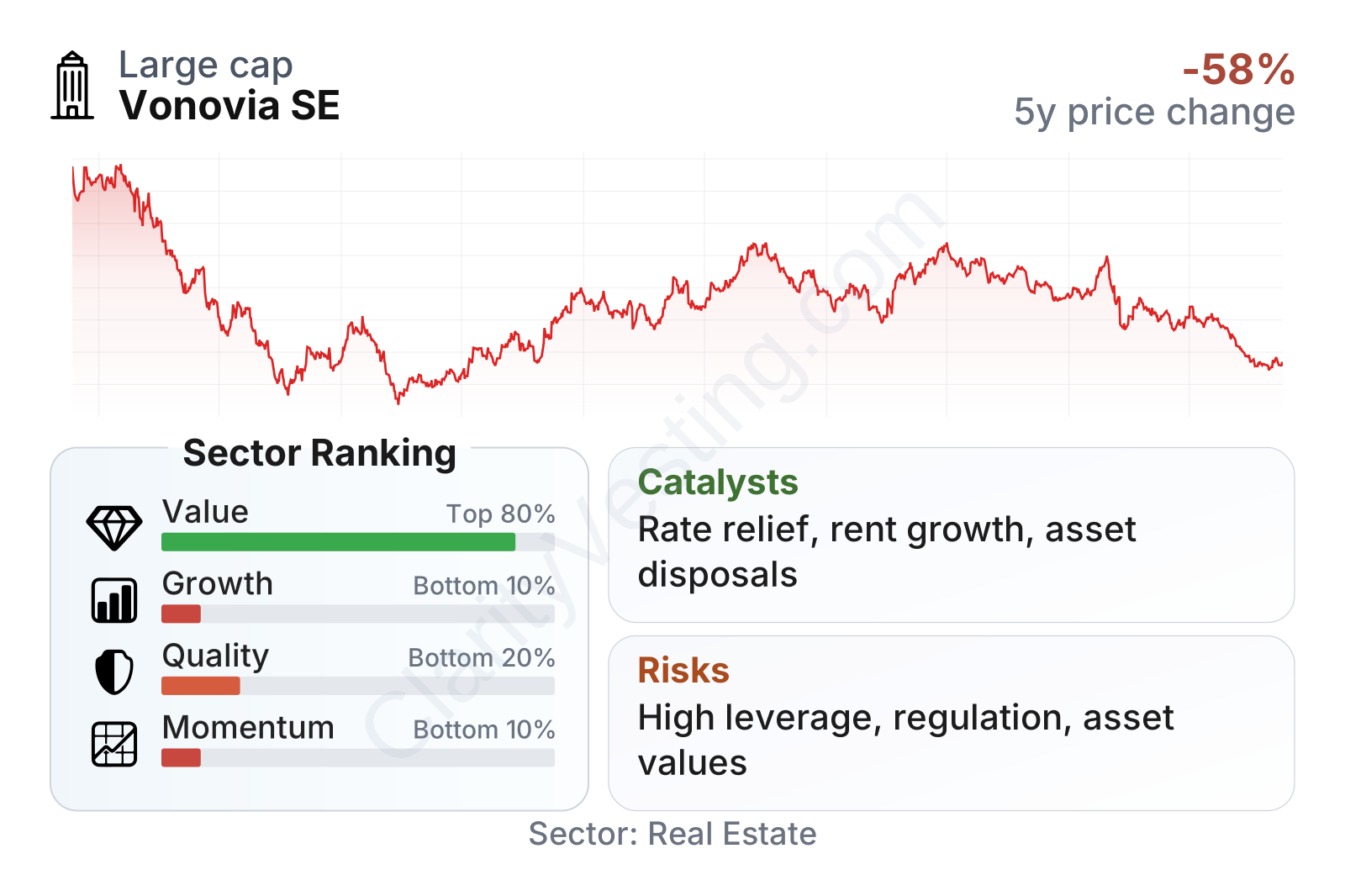
Vonovia is a large-cap real estate company with above-average share price volatility for the sector. On valuation measures, it screens cheaper than many peers, with a low earnings multiple, a strong free cash flow yield, and a dividend yield above the sector median. The weaker side is growth and market performance: revenue growth has been flat to slightly negative, several five-year trends are below the sector median, and the stock has lagged the broader real estate group by a wide margin. Quality is mixed rather than strong, with decent current margins and interest coverage, but leverage remains elevated and long-term profitability trends are not especially robust.
The stock price history reflects the sector’s reset after the rate shock. Shares dropped sharply from 2021 into 2023, then partially recovered before weakening again in 2026. That pattern suggests the market continues to treat Vonovia primarily as an interest-rate-sensitive balance-sheet story rather than a straightforward rent-growth company.
Growth
Vonovia operates in a sector with an important long-term support: housing shortage in major urban areas, especially in Germany. Demand for apartments is helped by limited supply, high construction costs, urbanization, and affordability pressures that make renting more common. Those conditions can support occupancy, rent resilience, and a long runway for renovation and energy-efficiency work.
The company’s strategy makes industrial sense. Its scale allows it to centralize procurement, maintenance, modernization, and financing in a way smaller landlords often cannot. That can improve efficiency and help spread fixed costs over a very large apartment base. In addition, Europe’s push for greener buildings creates a structural reason for renovation spending, and Vonovia’s size gives it the ability to roll out upgrades across many properties.
Revenue per share has been uneven rather than clearly compounding. There was improvement through 2024, followed by a visible pullback in 2025. That does not support a strong growth profile today, but it does suggest the business still has meaningful earnings power if development activity, modernization returns, and financing conditions stabilize.
A practical catalyst is interest rates. Residential property groups with heavy debt loads often see sentiment improve when financing markets calm down, asset values stop falling, and refinancing risk becomes easier to manage. Vonovia has already focused on disposals, balance-sheet discipline, and preserving liquidity, so a friendlier rate environment could have an outsized effect on reported profitability and valuation multiples.
The dividend pattern also shows the recent adjustment period. After a reduction, the payout has been rebuilding. That does not by itself prove growth, but it indicates that cash generation has remained strong enough for management to restore part of the distribution while continuing to manage leverage.
Another possible growth driver is Germany’s housing undersupply. Even if large new developments stay selective in the near term, a tight rental market can still support like-for-like rental growth, lower vacancy, and demand for modernization. In Vonovia’s case, growth is less about rapid expansion and more about extracting better returns from a very large existing portfolio.
Risks
This article is for informational purposes only and does not constitute financial advice. Some content is AI-generated. See Disclaimer