Stock Analysis · ZALANDO SE (ZLNDY)
Overview
Zalando SE is a European online fashion and lifestyle platform. It sells clothing, footwear, accessories, beauty products, and selected sports and designer items through its digital storefronts across many European markets. The company operates with a mix of direct retail, where it buys inventory and resells it, and a platform model, where brands and merchants sell through Zalando’s marketplace and related services.
Its business is usually presented in two main reporting segments: Business-to-Consumer and Business-to-Business. The consumer side is still the core of the company, while the business-facing side is a smaller but strategically important growth engine.
Main sources of revenue can be summarized as follows:
- Business-to-Consumer revenue: approximately 90% to 95% of total revenue in recent years. This includes fashion and lifestyle product sales to end customers, marketplace commissions, and consumer-facing services such as fulfillment and logistics tied to orders.
- Business-to-Business revenue: approximately 5% to 10% of total revenue in recent years. This includes logistics, software, and infrastructure services for brands and retailers, especially through Zalando’s fulfillment and e-commerce enablement offerings.
Within the consumer business, the largest economic driver remains fashion merchandise sold on the platform. The direct retail activity historically represented the biggest share, but Zalando has been pushing harder toward the marketplace model because commissions and service revenue generally require less inventory risk and can support better returns over time.
The company’s cost structure reflects that mix. Revenue has recovered after a weak 2023, while gross profit and operating income improved meaningfully in 2024 versus 2023. At the same time, selling and administrative costs remain substantial, which is typical for a large e-commerce platform that depends on marketing, fulfillment, technology, and customer service.
The broad picture is that Zalando is not a niche startup anymore. It is a scaled European digital commerce platform, but one still working to convert that scale into consistently stronger profitability.
Key Figures
| Metric | Value | Sector ⓘ |
|---|---|---|
| Date | Nov 12, 2026 | |
| Context | ||
| Sector | Consumer Cyclical | |
| Industry | Internet Retail | |
| Market Cap ⓘ | $7.50B | |
| Beta ⓘ | 1.56 | |
Value (Cheapness) | ||
| P/E Ratio ⓘ | 118.08 | 17.68 |
| P/B Ratio ⓘ | N/A | 2.77 |
| FCF Yield ⓘ | 10.56% | 7.35% |
| Dividend Yield ⓘ | N/A | 2.55% |
| EBIT / EV ⓘ | 7.54% | 7.05% |
| PEG ⓘ | 0.49 | |
Growth (Business expansion) | ||
| Revenue Growth ⓘ | 5.10% | 5.10% |
| RPS Growth (5Y CAGR) ⓘ | 3.63% | 8.97% |
| EPS Growth (5Y CAGR) ⓘ | N/A | -12.17% |
| BVPS Growth (5Y CAGR) ⓘ | 6.40% | 5.63% |
| Margin Growth (5Y Trend) ⓘ | -0.74% | -0.17% |
| FCF Growth (5Y CAGR) ⓘ | 36.65% | 5.89% |
| DPS Growth (5Y CAGR) ⓘ | N/A | 10.17% |
Quality (Business durability) | ||
| ROIC (Latest) ⓘ | 11.85% | 11.44% |
| ROA (Latest) ⓘ | 0.65% | 5.57% |
| ROIC (5Y Median) ⓘ | 6.92% | 10.52% |
| ROA (5Y Median) ⓘ | 2.34% | 5.37% |
| Net Debt / EBIT (Latest) ⓘ | 0.24 | 2.06 |
| Net Debt / EBIT (5Y Median) ⓘ | -1.87 | 2.24 |
| Net Debt / EBITDA (Latest) ⓘ | 0.12 | 1.44 |
| Net Debt / Assets ⓘ | 1.39% | 21.11% |
| EBITDA / Interest ⓘ | 14.15 | 9.63 |
| Operating Margin (Latest) ⓘ | 3.86% | 9.14% |
| Operating Margin (5Y Median) ⓘ | 3.36% | 9.64% |
| Debt to Equity (Latest) ⓘ | 52.24% | 71.49% |
| Profit Margin (Latest) ⓘ | 0.45% | 5.35% |
| Free Cash Flow (Latest) ⓘ | $791.85M | |
Momentum (Price trend) | ||
| 3Y Return ⓘ | +35.65% | +21.62% |
| 12M Return (excl. last month) ⓘ | -11.17% | -0.11% |
| 6M Return ⓘ | +37.07% | +1.97% |
| Price vs. 200-Day MA ⓘ | +13.72% | +1.47% |
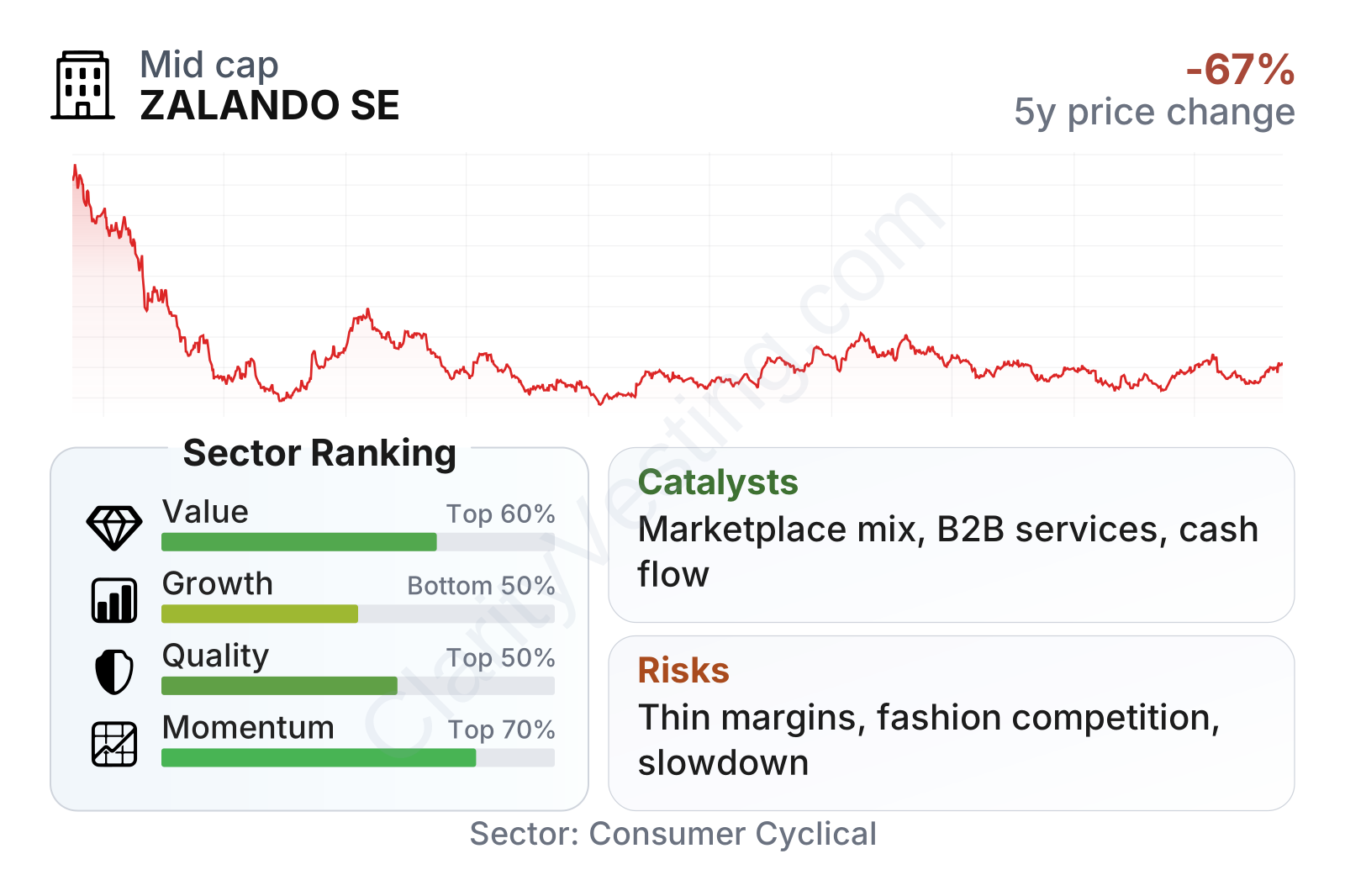
Zalando sits in the mid-to-large range among listed online retail companies, and its share price history shows how sharply sentiment has shifted since the 2021 peak. After a deep correction through 2022 and 2023, the stock has stabilized but remains far below prior highs. The metrics table points to a mixed profile: valuation looks demanding on earnings, cash generation is relatively solid, balance-sheet risk appears controlled, and recent market momentum has improved more than long-term growth rankings.
On a relative basis, the company stands out more for cash flow and balance-sheet discipline than for headline profitability. Free cash flow yield is above the sector median, leverage is below the sector median, and interest coverage is healthy. By contrast, the earnings multiple is very high and margins remain notably thinner than most peers in consumer internet retail.
Growth
Online fashion remains a structurally attractive category, even if it is more mature than it was a few years ago. Consumers continue to shift spending online, brands increasingly want direct access to digital shoppers, and logistics-driven platform models can gain share when they offer convenience, assortment, and fast delivery. In Europe, the market is still fragmented across countries, languages, and local retail habits, which gives a scaled regional player like Zalando room to deepen its position.
Zalando’s strategy for future growth is logical. Management has focused on building an ecosystem rather than only an online store: more marketplace participation, deeper brand relationships, loyalty features, fulfillment services, and business infrastructure for partners. That approach can matter because a marketplace-heavy model can expand assortment without requiring the company to own all the inventory itself.
The recent revenue path shows a clear slowdown in 2022 and 2023, followed by a return to growth in 2024 and stronger gains through much of 2025 and early 2026. The pattern suggests the company has moved past the post-pandemic digestion period, although the latest quarter indicates growth may again be moderating. That makes the next phase less about simple recovery and more about proving that demand, partner services, and order economics can keep improving together.
Cash generation is one of the more encouraging parts of the case. Free cash flow moved from negative territory in 2022 to strongly positive levels afterward, even with some fluctuation. The five-year free-cash-flow growth rate is far ahead of the sector median, which suggests the business has become more disciplined in working capital, cost control, or both. For a company in e-commerce, that is important because accounting profits can look weak while cash performance tells a more durable operational story.
A practical catalyst is the continued expansion of Zalando’s platform services for brands. If more volume shifts from first-party sales to marketplace and fulfillment activities, the company could improve capital efficiency and widen margins over time. Another useful growth lever is its customer ecosystem, including loyalty and cross-category expansion into beauty, sports, and designer offerings, which can raise order frequency and wallet share without needing to enter entirely new geographies.
Recent company communications have also emphasized execution around ecosystem growth, logistics capabilities, and partner solutions. Those initiatives do not guarantee faster growth, but they fit well with the company’s strengths as a pan-European operator with established consumer reach and operational infrastructure.
Risks
This article is for informational purposes only and does not constitute financial advice. Some content is AI-generated. See Disclaimer