Stock Analysis · Zai Lab Ltd (ZLAB)
Overview
Zai Lab Ltd is a biotechnology company focused on bringing innovative medicines to patients in China and other parts of Asia, while also building some of its own drug candidates. Its business model has two sides: it licenses promising therapies from global pharmaceutical partners for commercialization in its markets, and it invests in internal research programs that could become future products. This makes Zai Lab different from a pure early-stage biotech with no revenue, but it also means the company still carries many of the costs and risks of a development-stage business.
Most of Zai Lab’s revenue comes from product sales of commercialized medicines. Based on recent annual reporting, revenue is primarily generated by oncology, autoimmune, infectious disease, and neuroscience products sold in Greater China. The mix can shift as new launches scale and older products mature, but the broad structure is clear:
- Product revenue from commercialized medicines: approximately 95% to 99% of total revenue. This includes sales of therapies such as ZEJULA, Optune, VYVGART, NUZYRA, and other marketed products, depending on the reporting period and launch timing.
- Collaboration and other revenue: approximately 1% to 5% of total revenue. This can include partnership-related payments, service revenue, and other smaller operating items.
Zai Lab’s revenue base has expanded strongly over the last several years as more products were launched, but the company still spends heavily on research, development, and commercialization. That combination explains why revenue has grown meaningfully while earnings remain negative.
The business flow over recent years shows a clear pattern: sales have climbed from roughly $144 million in 2021 to about $460 million in 2025, while operating losses have narrowed considerably. Gross profit has improved with scale, but research and selling expenses remain high as Zai Lab continues to fund new indications, pipeline development, and market expansion.
Key Figures
| Metric | Value | Sector ⓘ |
|---|---|---|
| Date | Oct 03, 2026 | |
| Context | ||
| Sector | Healthcare | |
| Industry | Biotechnology | |
| Market Cap ⓘ | $2.96B | |
| Beta ⓘ | 0.83 | |
Value (Cheapness) | ||
| P/E Ratio ⓘ | N/A | 24.06 |
| P/B Ratio ⓘ | 4.69 | 3.08 |
| FCF Yield ⓘ | -5.50% | 3.07% |
| Dividend Yield ⓘ | N/A | 2.05% |
| EBIT / EV ⓘ | -6.97% | 0.63% |
| PEG ⓘ | N/A | |
Growth (Business expansion) | ||
| Revenue Growth ⓘ | -3.30% | 7.50% |
| RPS Growth (5Y CAGR) ⓘ | 28.27% | 8.70% |
| EPS Growth (5Y CAGR) ⓘ | -35.02% | -18.20% |
| BVPS Growth (5Y CAGR) ⓘ | -18.55% | 3.95% |
| Margin Growth (5Y Trend) ⓘ | N/A | -0.58% |
| FCF Growth (5Y CAGR) ⓘ | -26.68% | 0.88% |
| DPS Growth (5Y CAGR) ⓘ | N/A | 6.80% |
Quality (Business durability) | ||
| ROIC (Latest) ⓘ | -15.99% | 3.29% |
| ROA (Latest) ⓘ | -16.85% | 3.02% |
| ROIC (5Y Median) ⓘ | -28.50% | 4.75% |
| ROA (5Y Median) ⓘ | -29.66% | 1.93% |
| Net Debt / EBIT (Latest) ⓘ | N/A | 1.33 |
| Net Debt / EBIT (5Y Median) ⓘ | N/A | 1.83 |
| Net Debt / EBITDA (Latest) ⓘ | N/A | 0.99 |
| Net Debt / Assets ⓘ | -32.84% | 5.33% |
| EBITDA / Interest ⓘ | N/A | 9.63 |
| Operating Margin (Latest) ⓘ | -41.09% | 9.25% |
| Operating Margin (5Y Median) ⓘ | -140.27% | 7.80% |
| Debt to Equity (Latest) ⓘ | 41.94% | 28.99% |
| Profit Margin (Latest) ⓘ | -41.86% | 3.60% |
| Free Cash Flow (Latest) ⓘ | -$162.52M | |
Momentum (Price trend) | ||
| 3Y Return ⓘ | +7.01% | +37.48% |
| 12M Return (excl. last month) ⓘ | -23.56% | +20.85% |
| 6M Return ⓘ | +25.37% | +9.73% |
| Price vs. 200-Day MA ⓘ | +25.25% | +4.69% |
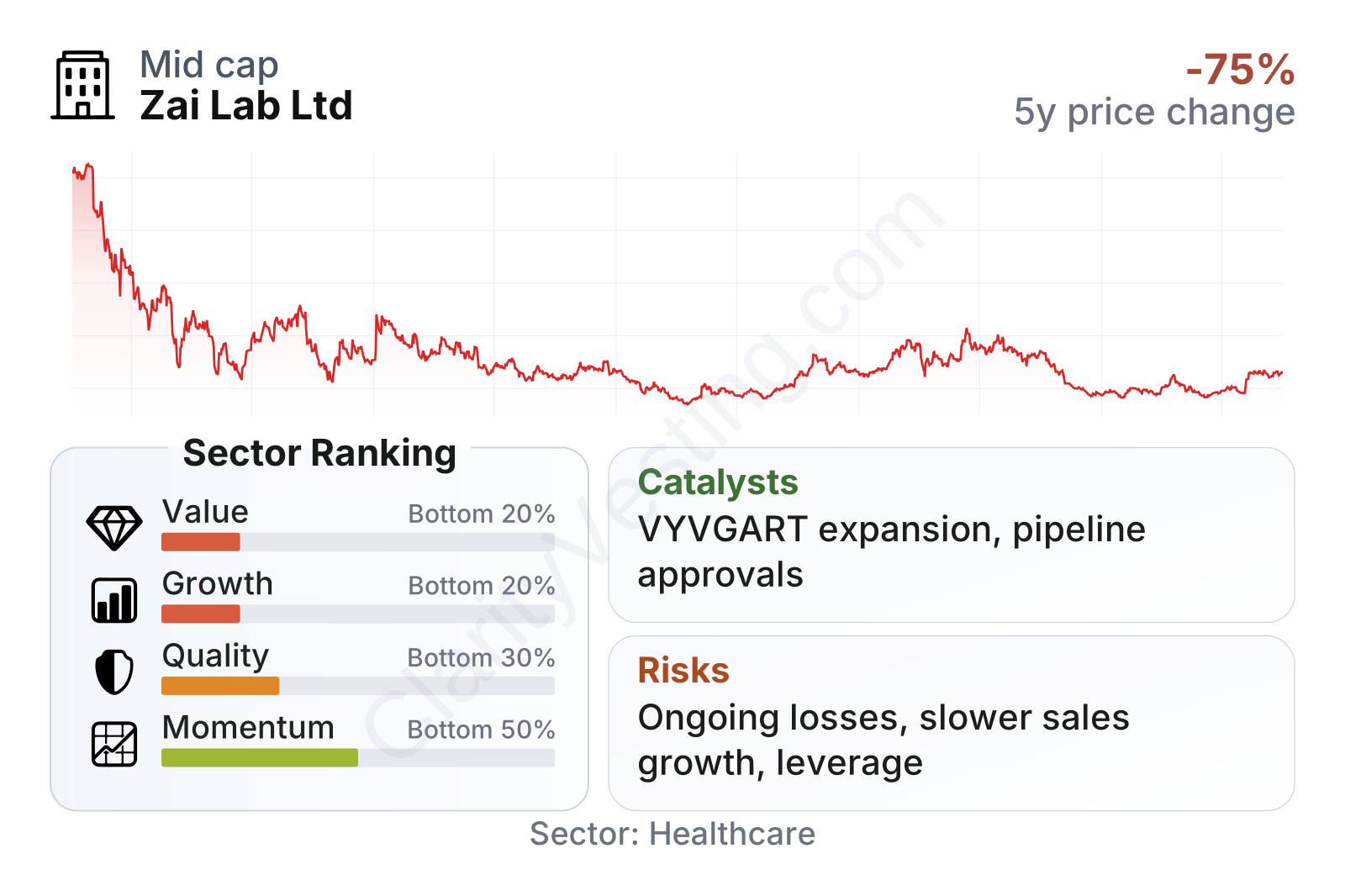
Zai Lab sits in the mid-cap range and has shown lower share-price volatility than many biotech names, but the stock history has still been highly uneven. After trading above $100 in late 2021, the shares fell sharply over the following years and have only partly recovered. The latest factor snapshot looks mixed: valuation, quality, and current growth rank in the lower part of the healthcare peer group, while momentum has improved recently. The main reason is straightforward: the market is recognizing better operating progress, but profitability and cash generation still lag well behind more mature peers.
Growth
Zai Lab operates in a sector with long-term structural growth. Demand for innovative therapies in China and broader Asia should continue to expand because of aging populations, rising cancer incidence, improving diagnosis, and greater access to advanced medicines. That industry backdrop is supportive, especially for companies that can localize global innovation and build regulatory, commercial, and medical capabilities in the region.
Zai Lab’s strategy makes sense on paper. Instead of relying only on internal discovery, it combines in-licensed assets with selective in-house development. This approach can accelerate product launches and reduce some scientific risk compared with a company betting everything on one early research platform. It also gives Zai Lab several possible growth engines at once: broader adoption of existing products, approvals in new indications, and additional launches from partnered or internal programs.
Revenue growth has been strong over the longer term, even though the most recent year-over-year trend has cooled and turned slightly negative in the latest quarterly readings. That slowdown matters, but it comes after a period of very rapid expansion. Over five years, revenue per share growth has been far stronger than the sector median, which suggests the company has already proven it can build a meaningful commercial base. The key question now is not whether Zai Lab can grow at all, but whether it can restart steadier growth from a larger base while controlling expenses.
Cash burn has improved significantly from earlier periods. Free cash flow remains negative, but the deficit is much smaller than it was a few years ago. That points to a company moving closer to self-funding, though it has not reached that point yet. For a long-term view, this trend is important because sustained revenue growth without progress in cash flow would weaken the business case over time. So far, the direction has been favorable even if the destination has not yet been reached.
Recent company updates have reinforced the idea that future growth depends on execution across multiple products rather than a single breakthrough event. Expansion of VYVGART in autoimmune diseases, ongoing uptake of Optune in oncology, and progress in the broader pipeline are among the more visible drivers. Additional label expansions, regulatory approvals, and improved reimbursement access in China could all create meaningful upside to revenue if they translate into wider patient adoption.
Risks
This article is for informational purposes only and does not constitute financial advice. Some content is AI-generated. See Disclaimer