Stock Analysis · Zealand Pharma A/S (ZLDPF)
Overview
Zealand Pharma A/S is a Danish biotechnology company focused on peptide-based medicines. In simple terms, it develops drug candidates that mimic or modify natural hormones and signaling molecules in the body. Its main focus today is metabolic disease, especially obesity and related conditions, while it also has programs in rare disease and gastrointestinal disorders. The company does not yet operate like a large commercial pharmaceutical business with broad recurring product sales. Instead, its economics are still driven mainly by partnerships, licensing arrangements, milestone payments, and collaboration income tied to its drug pipeline.
That business model matters for long-term analysis because Zealand’s revenue can be unusually uneven from one year to the next. A large payment from a partner can make one year look extremely strong, while the following year may look weak even if the underlying pipeline is progressing.
The main revenue sources appear to be:
- Collaboration and license revenue: likely the dominant source, historically well above 50% and at times close to all reported revenue. This includes upfront payments, milestone payments, and income recognized under partnerships with larger pharmaceutical companies.
- Royalties: a smaller source, tied to partnered products. This is likely a low-percentage contributor compared with collaboration revenue, but it can provide some recurring income.
- Other operating income: limited and not usually a major driver.
Zealand’s pipeline is centered on programs such as petrelintide, an amylin analog for obesity, and combination approaches designed to improve weight loss and tolerability. The company’s strategy is to advance promising programs far enough to capture high value, while also using partnerships to help fund development and lower the burden of building a fully integrated commercial organization too early.
The multi-year income flow also shows how partnership-driven biotech accounting can distort the surface picture. Revenue was modest for several years, dropped sharply in 2024, then surged in 2025 due to a major collaboration-related step-up. At the same time, research and development spending expanded materially, showing that cash is still being directed toward pipeline building rather than steady operating profits.
Key Figures
| Metric | Value | Sector ⓘ |
|---|---|---|
| Date | Nov 21, 2026 | |
| Context | ||
| Sector | Healthcare | |
| Industry | Biotechnology | |
| Market Cap ⓘ | $2.38B | |
| Beta ⓘ | 0.47 | |
Value (Cheapness) | ||
| P/E Ratio ⓘ | 5.24 | 25.50 |
| P/B Ratio ⓘ | N/A | 4.14 |
| FCF Yield ⓘ | -9.45% | 2.68% |
| Dividend Yield ⓘ | N/A | 1.52% |
| EBIT / EV ⓘ | 166.47% | 2.99% |
| PEG ⓘ | N/A | |
Growth (Business expansion) | ||
| Revenue Growth ⓘ | -92.00% | 7.10% |
| RPS Growth (5Y CAGR) ⓘ | 108.31% | 8.61% |
| EPS Growth (5Y CAGR) ⓘ | N/A | -10.82% |
| BVPS Growth (5Y CAGR) ⓘ | 75.82% | 3.59% |
| Margin Growth (5Y Trend) ⓘ | N/A | -0.63% |
| FCF Growth (5Y CAGR) ⓘ | N/A | 1.59% |
| DPS Growth (5Y CAGR) ⓘ | N/A | 6.65% |
Quality (Business durability) | ||
| ROIC (Latest) ⓘ | 17.91% | 5.62% |
| ROA (Latest) ⓘ | 17.16% | 2.70% |
| ROIC (5Y Median) ⓘ | -39.04% | 4.51% |
| ROA (5Y Median) ⓘ | -39.99% | 1.78% |
| Net Debt / EBIT (Latest) ⓘ | -1.00 | 1.33 |
| Net Debt / EBIT (5Y Median) ⓘ | N/A | 2.00 |
| Net Debt / EBITDA (Latest) ⓘ | -0.99 | 0.99 |
| Net Debt / Assets ⓘ | -14.45% | 6.14% |
| EBITDA / Interest ⓘ | 69.14 | 9.65 |
| Operating Margin (Latest) ⓘ | 61.14% | 9.28% |
| Operating Margin (5Y Median) ⓘ | -257.99% | 7.24% |
| Debt to Equity (Latest) ⓘ | 2.81% | 28.47% |
| Profit Margin (Latest) ⓘ | 67.21% | 3.67% |
| Free Cash Flow (Latest) ⓘ | -$225.21M | |
Momentum (Price trend) | ||
| 3Y Return ⓘ | -23.67% | +38.93% |
| 12M Return (excl. last month) ⓘ | -52.54% | +13.18% |
| 6M Return ⓘ | -34.97% | +10.51% |
| Price vs. 200-Day MA ⓘ | -30.19% | +3.72% |
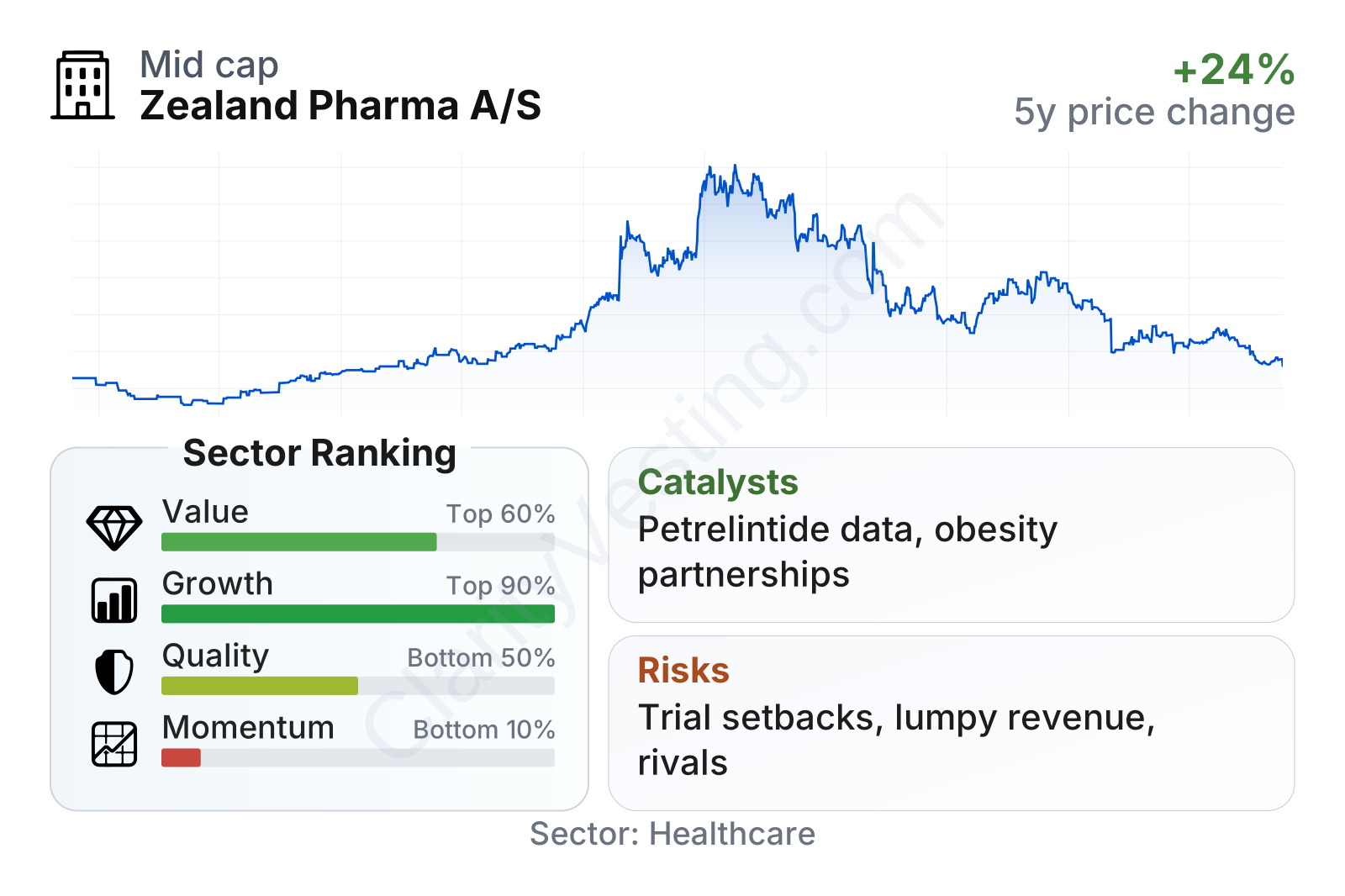
Zealand is a mid-sized biotech by market value, and its share price history has been highly volatile. The stock climbed dramatically into 2024, then gave back a meaningful part of those gains through 2025 and 2026. That pattern is common in development-stage biotech, where valuation often swings with clinical updates, partnership news, and changing expectations around obesity treatments.
The metrics table paints a mixed picture. On traditional value measures, the stock can look inexpensive, but those readings are heavily influenced by one-off partnership economics rather than stable, repeatable earnings. Growth factors rank very well over a longer horizon, yet recent year-over-year revenue has been sharply negative because revenue recognition is lumpy. Quality measures are split: the balance sheet is unusually strong for biotech, but profitability has only recently turned positive and may not be durable in the same form. Momentum is clearly weak, reflecting the large pullback from prior highs.
Growth
Zealand operates in one of the most attractive areas of global drug development: obesity and metabolic disease. This is a large and expanding market with strong medical need, rising diagnosis rates, and growing willingness from health systems and pharmaceutical partners to invest in better treatments. That gives the company exposure to a sector with long runway potential, especially if newer therapies can improve weight loss, muscle preservation, convenience, or side-effect profiles.
The company’s strategy broadly makes sense in that context. Rather than trying to compete head-on with the largest players using a broad commercial platform, Zealand is focusing on differentiated peptide medicines and using partnerships to accelerate development. Its most important internal growth engine is petrelintide, which management has positioned as a next-generation amylin therapy for weight management. Combination development could become especially important because the obesity market is increasingly moving toward regimens that balance efficacy and tolerability.
Reported revenue growth has been highly irregular. There were extreme surges followed by steep declines, which is typical when milestone and licensing payments dominate the top line. That means revenue growth alone is not the best indicator of underlying business progress. For Zealand, pipeline advancement, partner interest, and trial outcomes matter more than smooth annual sales trends at this stage.
Cash generation has also been uneven. Free cash flow was deeply negative for years, then swung sharply positive before moving back into a less clearly repeatable pattern. That again points to the importance of deal-driven cash inflows. The encouraging part is that Zealand has shown it can attract large external funding when its assets are viewed as valuable, which reduces financing pressure compared with many small biotech peers.
A major recent opportunity is the company’s strengthening position in obesity. Public company updates in 2025 and 2026 highlighted continued progress around petrelintide and broader metabolic programs. The obesity field remains one of the hottest partnering areas in pharma, so positive clinical differentiation could have outsized strategic value. For a company of Zealand’s size, additional data that supports best-in-class potential, combination use, or improved tolerability would be a meaningful catalyst.
Risks
This article is for informational purposes only and does not constitute financial advice. Some content is AI-generated. See Disclaimer


