Stock Analysis · Zip Co Limited (ZIZTF)
Overview
Zip Co Limited is an Australian digital payments company best known for its buy now, pay later offerings. It lets consumers split purchases into installments while giving merchants a way to increase checkout conversion and basket size. The business operates through consumer finance products, merchant services, and related platform activity, with its largest markets in Australia, New Zealand, and the United States.
Its revenue model is typical of the installment-payments industry: Zip earns money from merchants that accept its payment option, from consumers through certain fees and interest-bearing products, and from other transaction-related income. Based on the company’s recent annual reporting, revenue is primarily generated from transaction and service-related activities rather than from a traditional banking spread.
The main revenue sources can be summarized as follows:
- Merchant revenue: approximately 50% to 60% of revenue in recent periods. This mainly includes merchant fees paid when customers use Zip at checkout.
- Consumer revenue: approximately 25% to 35%. This typically includes account fees, interest on certain products, and other customer charges where applicable.
- Other income and operating revenue: approximately 10% to 20%. This can include interchange, servicing, and other payments-platform related items.
What matters for long-term analysis is that Zip is no longer just a fast-growth fintech trying to win users at any cost. Recent results show a business that has been shifting toward tighter underwriting, higher-quality receivables, and more disciplined operating expenses. Revenue has grown strongly over the last several years, while profitability has moved from deep losses to positive net income.
The multi-year financial flow shows a clear turnaround. Revenue and gross profit have risen steadily since fiscal 2022, while operating losses have been reversed into operating profit. Interest expense also appears far lower in the most recent year, which materially improved net income. That combination suggests the business is benefiting from scale, cost control, and a cleaner funding profile than during its earlier expansion phase.
Key Figures
| Metric | Value | Sector ⓘ |
|---|---|---|
| Date | Oct 17, 2026 | |
| Context | ||
| Sector | Financial Services | |
| Industry | Credit Services | |
| Market Cap ⓘ | $1.83B | |
| Beta ⓘ | 3.31 | |
Value (Cheapness) | ||
| P/E Ratio ⓘ | 24.42 | 12.26 |
| P/B Ratio ⓘ | 1.91 | 1.23 |
| FCF Yield ⓘ | -7.58% | 10.40% |
| Dividend Yield ⓘ | N/A | 3.02% |
| EBIT / EV ⓘ | N/A | 8.14% |
| PEG ⓘ | N/A | |
Growth (Business expansion) | ||
| Revenue Growth ⓘ | 20.50% | 9.35% |
| RPS Growth (5Y CAGR) ⓘ | 10.42% | 12.19% |
| EPS Growth (5Y CAGR) ⓘ | N/A | -9.53% |
| BVPS Growth (5Y CAGR) ⓘ | 1.38% | 4.99% |
| Margin Growth (5Y Trend) ⓘ | 39.03% | -3.86% |
| FCF Growth (5Y CAGR) ⓘ | -42.23% | 4.81% |
| DPS Growth (5Y CAGR) ⓘ | 2.96% | 8.79% |
Quality (Business durability) | ||
| ROIC (Latest) ⓘ | N/A | 9.49% |
| ROE (Latest) ⓘ | 28.37% | 13.90% |
| ROA (Latest) ⓘ | 5.26% | 1.55% |
| ROIC (5Y Median) ⓘ | 2.25% | 7.86% |
| ROE (5Y Median) ⓘ | 1.23% | 12.17% |
| ROA (5Y Median) ⓘ | 0.11% | 1.30% |
| Net Debt / EBIT (Latest) ⓘ | 6.07 | 0.96 |
| Net Debt / EBIT (5Y Median) ⓘ | 7.40 | 0.73 |
| Net Debt / EBITDA (Latest) ⓘ | 4.71 | 0.92 |
| Operating Margin (Latest) ⓘ | 15.87% | 22.30% |
| Operating Margin (5Y Median) ⓘ | 10.85% | 24.63% |
| Debt to Equity (Latest) ⓘ | 409.17% | 58.56% |
| Profit Margin (Latest) ⓘ | 8.71% | 26.57% |
| Free Cash Flow (Latest) ⓘ | -$138.29M | |
Momentum (Price trend) | ||
| 3Y Return ⓘ | +779.35% | +88.33% |
| 12M Return (excl. last month) ⓘ | -43.00% | +19.38% |
| 6M Return ⓘ | +28.51% | +4.75% |
| Price vs. 200-Day MA ⓘ | -13.53% | +3.50% |
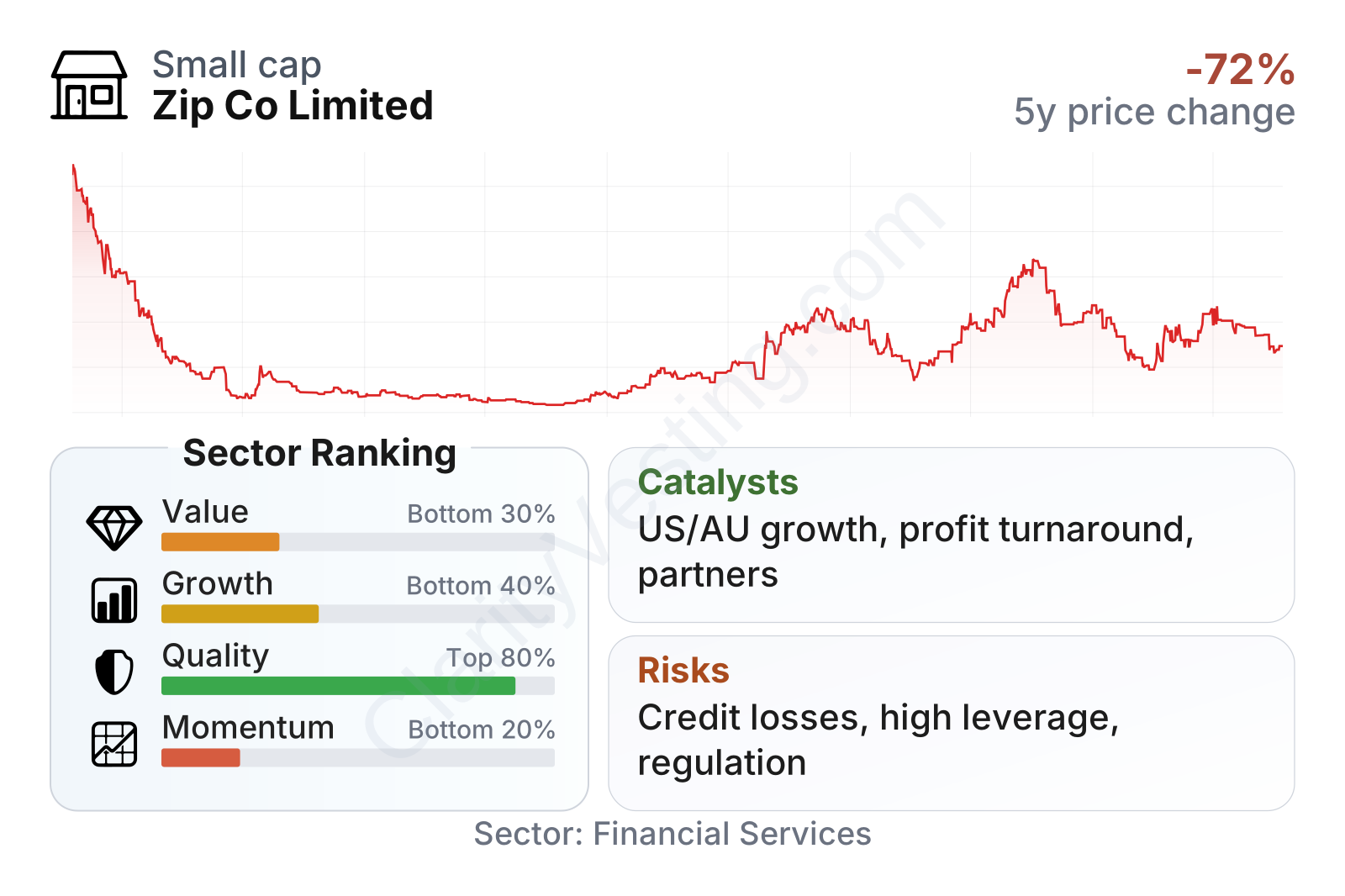
Zip’s profile is mixed. Growth in recent revenue remains stronger than the sector median, and profitability ratios such as return on equity and return on assets have improved to levels above many peers. At the same time, leverage remains elevated, free cash flow is still negative, and the valuation multiples shown in the table are not especially low compared with the broader credit-services group. Share-price behavior has also been highly volatile, with large swings over the last few years that reflect both changing sentiment toward fintech and company-specific execution risk.
The stock’s beta above 3 reinforces that volatility point. This is not unusual for a smaller listed payments company, but it does mean market moves can be amplified. The company’s market value places it in the smaller end of listed financial-services businesses, where operational improvements can have a large effect on valuation, but setbacks can also be punished quickly.
Growth
Zip operates in a segment that still has room to expand. Digital checkout finance continues to benefit from e-commerce adoption, mobile payments, and consumer preference for flexible payment tools. In markets like Australia and the United States, installment products are now more established than they were a few years ago, and the question has shifted from adoption to which platforms can grow while keeping losses and funding costs under control.
Zip’s current strategy is more credible than its earlier phase of aggressive expansion. Management has emphasized focusing on core geographies, improving credit quality, lowering costs, and scaling partnerships rather than chasing broad international reach. That approach fits the current environment, where investors and counterparties have become much more sensitive to profitability and balance-sheet discipline than to raw transaction growth.
A key catalyst is the company’s improving earnings profile. Revenue increased to above A$1.3 billion in fiscal 2026, continuing a strong multi-year rise. The business has also moved from losses in fiscal 2022 and 2023 to positive net income in fiscal 2025 and stronger profitability in fiscal 2026. That matters because the market often re-rates payment companies when growth is paired with durable profits rather than subsidized volume.
Another support factor is the recovery in book value per share after a sharp drop earlier in the cycle.
Book value per share fell heavily during the company’s reset period, then rebuilt over the following years and is now above its 2022 level. That does not remove risk, but it does indicate that recent earnings have started to restore balance-sheet value rather than erode it.
Recent company updates have also pointed to continued traction in transaction volumes, receivables quality, and product development. Strategic partnerships with merchants and payment ecosystems remain important because they can lower customer acquisition costs and embed Zip into more online and in-store checkouts. For a company in this category, distribution is a major growth driver.
Risks
This article is for informational purposes only and does not constitute financial advice. Some content is AI-generated. See Disclaimer


