Stock Analysis · ZIM Integrated Shipping Services Ltd (ZIM)
Overview
ZIM Integrated Shipping Services Ltd is a global container shipping company. In simple terms, it helps move goods between countries by sea, using container vessels and related logistics services. ZIM focuses on transporting consumer goods, industrial products, and raw materials across major trade routes, including the Pacific, Atlantic, intra-Asia, Latin America, and cross-Suez lanes. The company is known for operating an asset-light model compared with some larger rivals, relying heavily on chartered vessels rather than owning most of its fleet.
ZIM’s revenue is overwhelmingly generated by containerized cargo transportation and closely related services. In practice, the business is driven mainly by freight rates, container volumes, and the mix of trade routes served. Based on company reporting structure and industry disclosures, the main revenue sources can be summarized as follows:
- Containerized shipping services: about 90% to 95% — ocean freight paid by customers to move containers across international routes. This is the core business and the main driver of earnings volatility.
- Ancillary and logistics-related services: about 5% to 10% — demurrage, detention, inland transport coordination, documentation, and other shipping-related charges tied to the movement of cargo.
ZIM does not have the broad diversification of a large integrated logistics group. That means results tend to follow the shipping cycle quite closely. Over the last several years, revenue and profitability moved sharply with freight markets: exceptional profits during the post-pandemic shipping boom, a deep downturn in 2023, then a strong rebound in 2024 followed by normalization in 2025 and mixed conditions into 2026. The business flow also shows this cyclicality clearly, with revenue and operating profit recovering from 2023 lows but staying far below the extraordinary peak reached in 2021-2022.
Key Figures
| Metric | Value | Sector ⓘ |
|---|---|---|
| Date | Oct 17, 2026 | |
| Context | ||
| Sector | Industrials | |
| Industry | Marine Shipping | |
| Market Cap ⓘ | $3.67B | |
| Beta ⓘ | 1.16 | |
Value (Cheapness) | ||
| P/E Ratio ⓘ | 26.46 | 22.10 |
| P/B Ratio ⓘ | 0.93 | 1.97 |
| FCF Yield ⓘ | 38.77% | 6.38% |
| Dividend Yield ⓘ | 3.85% | 1.94% |
| EBIT / EV ⓘ | 8.94% | 4.79% |
| PEG ⓘ | N/A | |
Growth (Business expansion) | ||
| Revenue Growth ⓘ | 8.90% | 9.30% |
| RPS Growth (5Y CAGR) ⓘ | -10.73% | 7.81% |
| EPS Growth (5Y CAGR) ⓘ | -86.69% | -13.06% |
| BVPS Growth (5Y CAGR) ⓘ | -3.61% | 6.14% |
| Margin Growth (5Y Trend) ⓘ | -37.87% | 0.88% |
| FCF Growth (5Y CAGR) ⓘ | -24.57% | 11.01% |
| DPS Growth (5Y CAGR) ⓘ | -1.31% | 9.48% |
Quality (Business durability) | ||
| ROIC (Latest) ⓘ | 12.91% | 10.84% |
| ROA (Latest) ⓘ | 1.29% | 5.41% |
| ROIC (5Y Median) ⓘ | 78.17% | 9.38% |
| ROA (5Y Median) ⓘ | 21.76% | 4.95% |
| Net Debt / EBIT (Latest) ⓘ | 6.55 | 2.08 |
| Net Debt / EBIT (5Y Median) ⓘ | 1.14 | 2.27 |
| Net Debt / EBITDA (Latest) ⓘ | 2.20 | 1.39 |
| Net Debt / Assets ⓘ | 40.09% | 19.28% |
| EBITDA / Interest ⓘ | 4.24 | 9.58 |
| Operating Margin (Latest) ⓘ | 10.13% | 10.50% |
| Operating Margin (5Y Median) ⓘ | 31.79% | 10.29% |
| Debt to Equity (Latest) ⓘ | 136.88% | 65.48% |
| Profit Margin (Latest) ⓘ | 2.15% | 6.67% |
| Free Cash Flow (Latest) ⓘ | $1.42B | |
Momentum (Price trend) | ||
| 3Y Return ⓘ | +421.28% | +61.68% |
| 12M Return (excl. last month) ⓘ | +128.88% | +12.58% |
| 6M Return ⓘ | +13.07% | 0.00% |
| Price vs. 200-Day MA ⓘ | +15.61% | +0.02% |
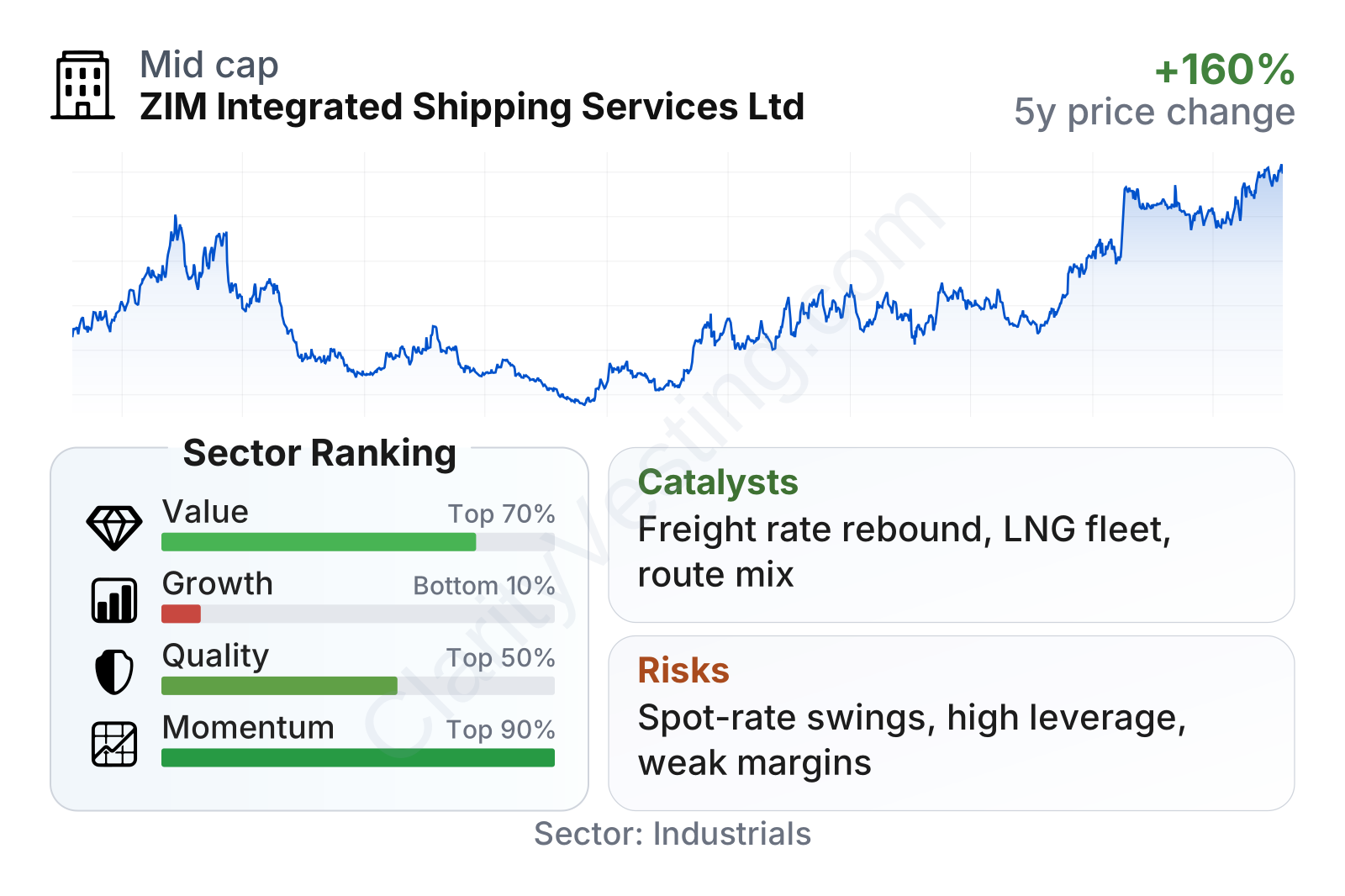
ZIM is a mid-sized public shipping company with a stock that has been highly volatile over the last few years. The latest metrics show a mixed profile. On valuation, the company screens better than much of the sector on cash flow-based measures and trades below sector norms on price-to-book, but earnings-based valuation is less obviously cheap because current profits are much lower than at the cycle peak. On quality, returns on invested capital remain respectable, yet leverage is clearly above the sector median. Growth metrics are the weakest area, reflecting how hard the post-2022 shipping downturn hit the company’s longer-term averages. Momentum remains strong, which fits the stock’s sharp rebound from earlier lows.
Growth
Long-term growth for ZIM depends less on a steady expansion trend and more on whether the company can position itself well within a cyclical but still essential industry. Global container shipping is not a fast-growing sector every year, but it remains structurally important because world trade still depends heavily on maritime transport. Over time, container demand usually rises with consumption, manufacturing, and trade flows, especially in Asia-related corridors. That gives ZIM exposure to a business with long-term relevance, even if short-term results can swing dramatically.
ZIM’s strategy is distinctive. The company has emphasized an asset-light fleet structure, digital tools, and niche trade lane positioning rather than trying to match the scale of the largest carriers. That approach can help in two ways: it may allow faster adjustment of capacity when markets change, and it can reduce the amount of capital tied up in ship ownership. ZIM has also invested in LNG-powered vessels, which could improve fuel efficiency and regulatory readiness as environmental standards tighten across global shipping.
Revenue growth has been highly uneven. The company experienced explosive expansion during the freight-rate spike of 2021-2022, then a sharp contraction in 2023 as shipping prices normalized, followed by a strong rebound in 2024 and softer comparisons afterward. The latest year-over-year reading is back in positive territory, but the broader pattern shows that growth is market-driven rather than steady and predictable.
Free cash flow remains one of the more constructive elements in the current profile. Even after coming down from earlier extremes, cash generation has stayed meaningful in absolute terms. That matters because shipping companies need financial flexibility to handle weak rate environments, vessel commitments, and working-capital swings. A free-cash-flow yield well above the sector median also suggests the market is still applying a discount for cyclicality rather than rewarding the company for consistency.
A key catalyst for future expansion is any sustained period of stronger freight rates on the routes where ZIM is active, especially transpacific and other major east-west lanes. Another potential support comes from supply discipline across the industry: if vessel supply growth, port congestion, rerouting pressures, or fuel regulation keep capacity tighter than expected, ZIM can benefit disproportionately because small changes in rates often have large effects on profits. Recent company updates have also highlighted network adjustments and commercial initiatives intended to improve route mix and service quality rather than simply chase volume.
Risks
This article is for informational purposes only and does not constitute financial advice. Some content is AI-generated. See Disclaimer


