Stock Analysis · Zhejiang Expressway Co. Ltd (ZHEXF)
Overview
Zhejiang Expressway Co. Ltd is a Chinese infrastructure operator best known for owning and operating toll roads and expressways in Zhejiang Province, one of China’s more economically active regions. The business is built around transportation assets that collect toll income from passenger and freight traffic, giving the company a relatively straightforward operating model: traffic volume and road usage drive revenue, while costs are tied to maintenance, administration, and financing.
In addition to its core expressway operations, the company has also had meaningful exposure to supporting businesses linked to transportation and capital allocation. Based on recent annual reporting and segment disclosures, revenue sources can be summarized approximately as follows:
- Toll road operations: about 55% to 70% of revenue in a typical year. This includes toll collection from key expressway assets and remains the economic backbone of the group.
- Securities and investment-related operations: about 15% to 30%. This can include income tied to financial services or investment activities held within the broader corporate structure.
- Service areas, advertising, and ancillary operations: about 5% to 15%. These activities are smaller but still connected to road traffic and roadside commercial usage.
- Other operations: usually a low-single business share when disclosed separately, depending on the year and accounting presentation.
The overall picture is of a medium-sized listed infrastructure company whose earnings are still primarily shaped by regulated transport assets, even if reported revenue can be influenced by non-road activities. Over the last several years, total revenue has generally trended upward, and profitability has remained solid, although the mix can shift from year to year.
The business has shown a pattern of stable revenue generation and durable net income, with financing costs remaining meaningful but manageable. One notable point is that revenue has risen over time, while net income has stayed within a fairly consistent range, suggesting that growth has not translated into equally strong earnings expansion.
Key Figures
| Metric | Value | Sector ⓘ |
|---|---|---|
| Date | Nov 21, 2026 | |
| Context | ||
| Sector | Industrials | |
| Industry | Infrastructure Operations | |
| Market Cap ⓘ | $4.51B | |
| Beta ⓘ | 0.18 | |
Value (Cheapness) | ||
| P/E Ratio ⓘ | 6.08 | 20.77 |
| P/B Ratio ⓘ | N/A | 3.20 |
| FCF Yield ⓘ | -30.03% | 4.98% |
| Dividend Yield ⓘ | 54.11% | 1.88% |
| EBIT / EV ⓘ | N/A | 6.24% |
| PEG ⓘ | N/A | |
Growth (Business expansion) | ||
| Revenue Growth ⓘ | 53.20% | 9.60% |
| RPS Growth (5Y CAGR) ⓘ | -2.50% | 7.69% |
| EPS Growth (5Y CAGR) ⓘ | -11.32% | -5.74% |
| BVPS Growth (5Y CAGR) ⓘ | -31.70% | 6.13% |
| Margin Growth (5Y Trend) ⓘ | -6.99% | 0.72% |
| FCF Growth (5Y CAGR) ⓘ | 7.59% | 11.01% |
| DPS Growth (5Y CAGR) ⓘ | 3.50% | 9.09% |
Quality (Business durability) | ||
| ROIC (Latest) ⓘ | N/A | 10.48% |
| ROA (Latest) ⓘ | 1.70% | 5.38% |
| ROIC (5Y Median) ⓘ | 6.53% | 9.45% |
| ROA (5Y Median) ⓘ | 2.65% | 4.91% |
| Net Debt / EBIT (Latest) ⓘ | N/A | 2.12 |
| Net Debt / EBIT (5Y Median) ⓘ | 4.99 | 2.28 |
| Net Debt / EBITDA (Latest) ⓘ | -1.36 | 1.42 |
| Net Debt / Assets ⓘ | -3.96% | 19.19% |
| EBITDA / Interest ⓘ | 4.74 | 10.09 |
| Operating Margin (Latest) ⓘ | N/A | 10.44% |
| Operating Margin (5Y Median) ⓘ | 40.31% | 10.29% |
| Debt to Equity (Latest) ⓘ | 230.87% | 66.48% |
| Profit Margin (Latest) ⓘ | 24.46% | 6.98% |
| Free Cash Flow (Latest) ⓘ | -$1.35B | |
Momentum (Price trend) | ||
| 3Y Return ⓘ | +48.34% | +48.25% |
| 12M Return (excl. last month) ⓘ | -15.71% | +10.31% |
| 6M Return ⓘ | -14.89% | +0.15% |
| Price vs. 200-Day MA ⓘ | -1.44% | 0.00% |
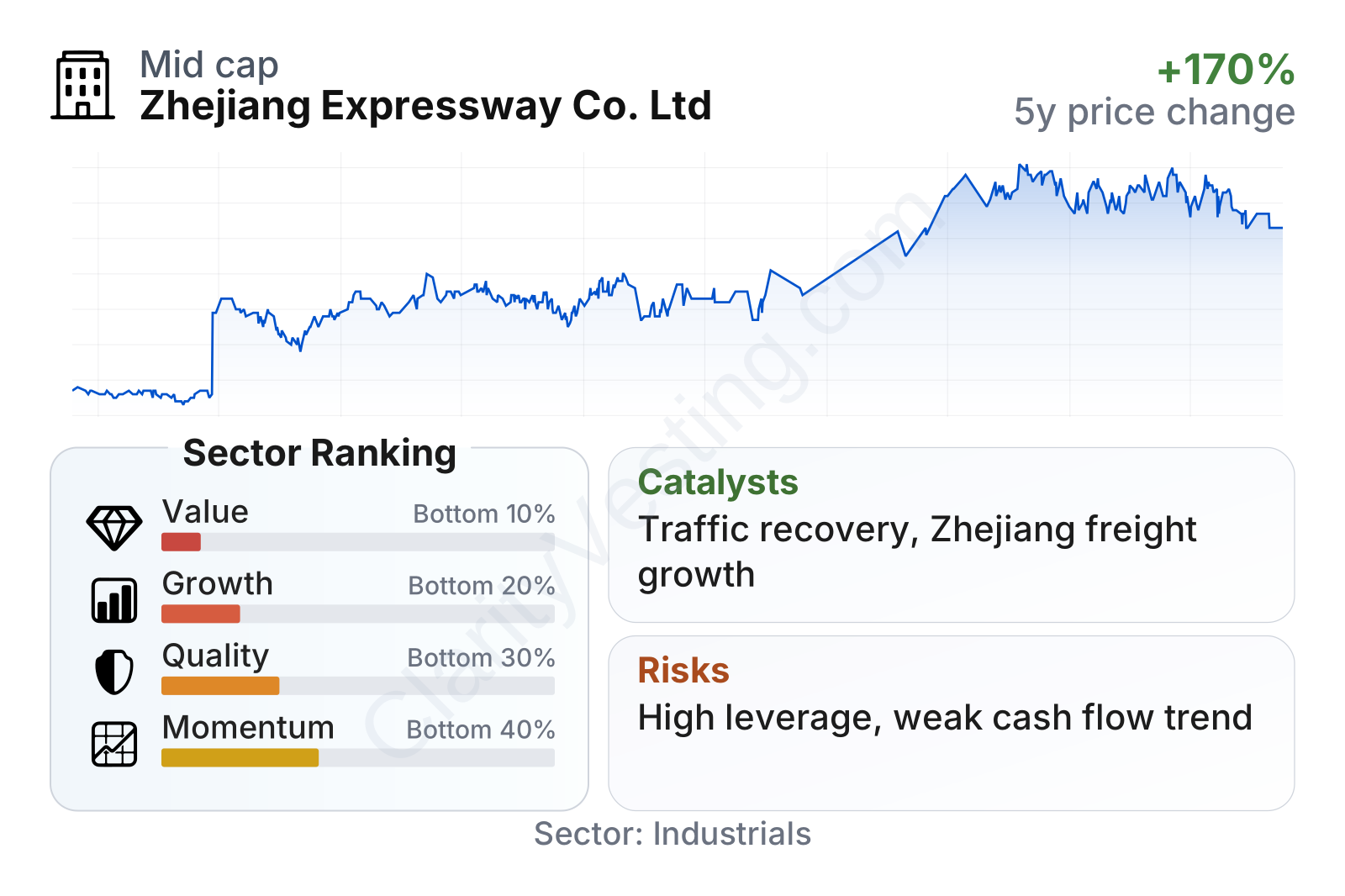
The market is valuing Zhejiang Expressway at a low earnings multiple relative to the broader industrial infrastructure group, while the dividend yield is exceptionally high on a trailing basis. At the same time, the overall factor profile is weaker than the sector in several areas: growth ranks near the bottom of the peer group, quality is below average, and recent share-price momentum has also lagged. The combination points to a company that looks inexpensive on headline valuation, but not without important operating and balance-sheet questions behind that discount.
The stock has also been less volatile than most equities, as reflected by its very low beta. That can happen with mature infrastructure names, especially when cash distributions are a central part of the equity case and trading activity is relatively subdued.
Growth
Zhejiang Expressway operates in a sector that is mature rather than fast-growing. Toll roads are essential infrastructure, and long-term demand is usually linked to regional economic activity, logistics flows, car ownership, and freight transportation. Zhejiang Province remains one of China’s stronger commercial regions, which supports the relevance of the company’s core assets. That said, this is not a business where explosive expansion should be the default expectation. Growth tends to come from traffic recovery, tariff structure, asset optimization, acquisitions, and selective expansion into adjacent activities.
The company’s strategy still makes industrial sense for long-term development because expressway assets can produce durable cash earnings over many years when traffic demand is healthy. In addition, road operators can benefit from regional trade growth and from policy support for transport infrastructure. The latest revenue trend has been better than the company’s longer-term record, with recent year-over-year growth running ahead of the sector median, indicating some renewed business momentum after a weaker multiyear period.
Recent revenue growth has improved noticeably, with the latest reported periods showing positive year-over-year expansion around the high-teens to low-20% range. That is a stronger short-term signal than the company’s five-year pattern, where revenue per share and earnings per share have both been under pressure. In other words, near-term activity has picked up, but the longer arc still looks uneven.
A more cautious point comes from cash generation. Infrastructure companies can report healthy accounting profits while cash flow swings because of capital spending, concession-related outlays, working capital movement, or investment activity. Zhejiang Expressway’s trailing free cash flow recently turned negative after being positive in earlier periods, which weakens the case for calling the current upswing a fully established trend.
The drop from strongly positive free cash flow to negative territory is an important development. It does not automatically signal business deterioration, since infrastructure spending can be lumpy, but it does mean recent growth has not been matched by equally strong cash conversion. For a company often viewed through its income-generation profile, that is a key item to watch.
As for catalysts, the most credible ones are continued recovery in road traffic, stronger freight movement in eastern China, and potential benefits from asset optimization or a more favorable revenue mix. Public company materials in recent periods also point to continued attention on expressway operations and associated assets, which supports the idea that management remains focused on the group’s core earnings engine.
Risks
This article is for informational purposes only and does not constitute financial advice. Some content is AI-generated. See Disclaimer


