Stock Analysis · Zenas BioPharma Inc (ZBIO)
Overview
Zenas BioPharma is a clinical-stage biotechnology company focused on developing immune-based medicines for autoimmune and inflammatory diseases. In simple terms, it is trying to build treatments for conditions in which the body’s immune system attacks healthy tissue. That puts the company in a part of healthcare where the medical need is large, but where commercial success depends heavily on clinical trial results, regulatory approvals, and the ability to finance years of research before product sales become meaningful.
At this stage, Zenas does not appear to operate like an established drug company with diversified commercial sales. Its financial profile is still dominated by research spending rather than recurring product revenue. Based on recent public filings and reported financials, revenue has been limited and irregular, which is typical for a development-stage biotech relying on collaboration-related payments rather than broad medicine sales.
The main revenue sources are currently concentrated and small in absolute terms.
- Collaboration, licensing, or other upfront/partner-related revenue: approximately 100% of reported revenue in recent periods when revenue was recognized. This can include milestone payments, licensing arrangements, or similar agreements tied to development programs.
- Product revenue: approximately 0% at this stage, as the company does not yet appear to have a broadly commercialized medicine generating recurring sales.
The broader financial picture shows a business spending heavily on research and development while generating only limited top-line contribution. That is not unusual in biotechnology, but it means the investment case depends far more on pipeline progress than on current operating profitability.
The business mix highlights how strongly the company is tilted toward R&D. Research spending has risen sharply over time, while revenue has stayed low and uneven, reinforcing that Zenas is still in the value-creation phase rather than the harvesting phase of its life cycle.
Key Figures
| Metric | Value | Sector ⓘ |
|---|---|---|
| Date | Oct 17, 2026 | |
| Context | ||
| Sector | Healthcare | |
| Industry | Biotechnology | |
| Market Cap ⓘ | $1.62B | |
| Beta ⓘ | -0.88 | |
Value (Cheapness) | ||
| P/E Ratio ⓘ | N/A | 24.79 |
| P/B Ratio ⓘ | 6.49 | 3.08 |
| FCF Yield ⓘ | -13.95% | 3.15% |
| Dividend Yield ⓘ | N/A | 1.94% |
| EBIT / EV ⓘ | -28.84% | 0.57% |
| PEG ⓘ | N/A | |
Growth (Business expansion) | ||
| Revenue Growth ⓘ | -100.00% | 7.45% |
| RPS Growth (5Y CAGR) ⓘ | N/A | 8.61% |
| EPS Growth (5Y CAGR) ⓘ | -49.88% | -17.81% |
| BVPS Growth (5Y CAGR) ⓘ | N/A | 3.72% |
| Margin Growth (5Y Trend) ⓘ | N/A | -0.62% |
| FCF Growth (5Y CAGR) ⓘ | N/A | 1.04% |
| DPS Growth (5Y CAGR) ⓘ | N/A | 6.77% |
Quality (Business durability) | ||
| ROIC (Latest) ⓘ | -90.06% | 3.24% |
| ROA (Latest) ⓘ | -94.63% | 3.01% |
| ROIC (5Y Median) ⓘ | N/A | 4.60% |
| ROA (5Y Median) ⓘ | -71.66% | 1.89% |
| Net Debt / EBIT (Latest) ⓘ | N/A | 1.34 |
| Net Debt / EBIT (5Y Median) ⓘ | N/A | 1.84 |
| Net Debt / EBITDA (Latest) ⓘ | N/A | 1.00 |
| Net Debt / Assets ⓘ | 27.51% | 5.45% |
| EBITDA / Interest ⓘ | N/A | 9.64 |
| Operating Margin (Latest) ⓘ | -4157.37% | 9.27% |
| Operating Margin (5Y Median) ⓘ | -3131.18% | 7.38% |
| Debt to Equity (Latest) ⓘ | 157.67% | 28.58% |
| Profit Margin (Latest) ⓘ | N/A | 3.59% |
| Free Cash Flow (Latest) ⓘ | -$225.97M | |
Momentum (Price trend) | ||
| 3Y Return ⓘ | N/A | +42.80% |
| 12M Return (excl. last month) ⓘ | +45.47% | +18.50% |
| 6M Return ⓘ | +20.67% | +7.57% |
| Price vs. 200-Day MA ⓘ | +2.84% | +5.12% |
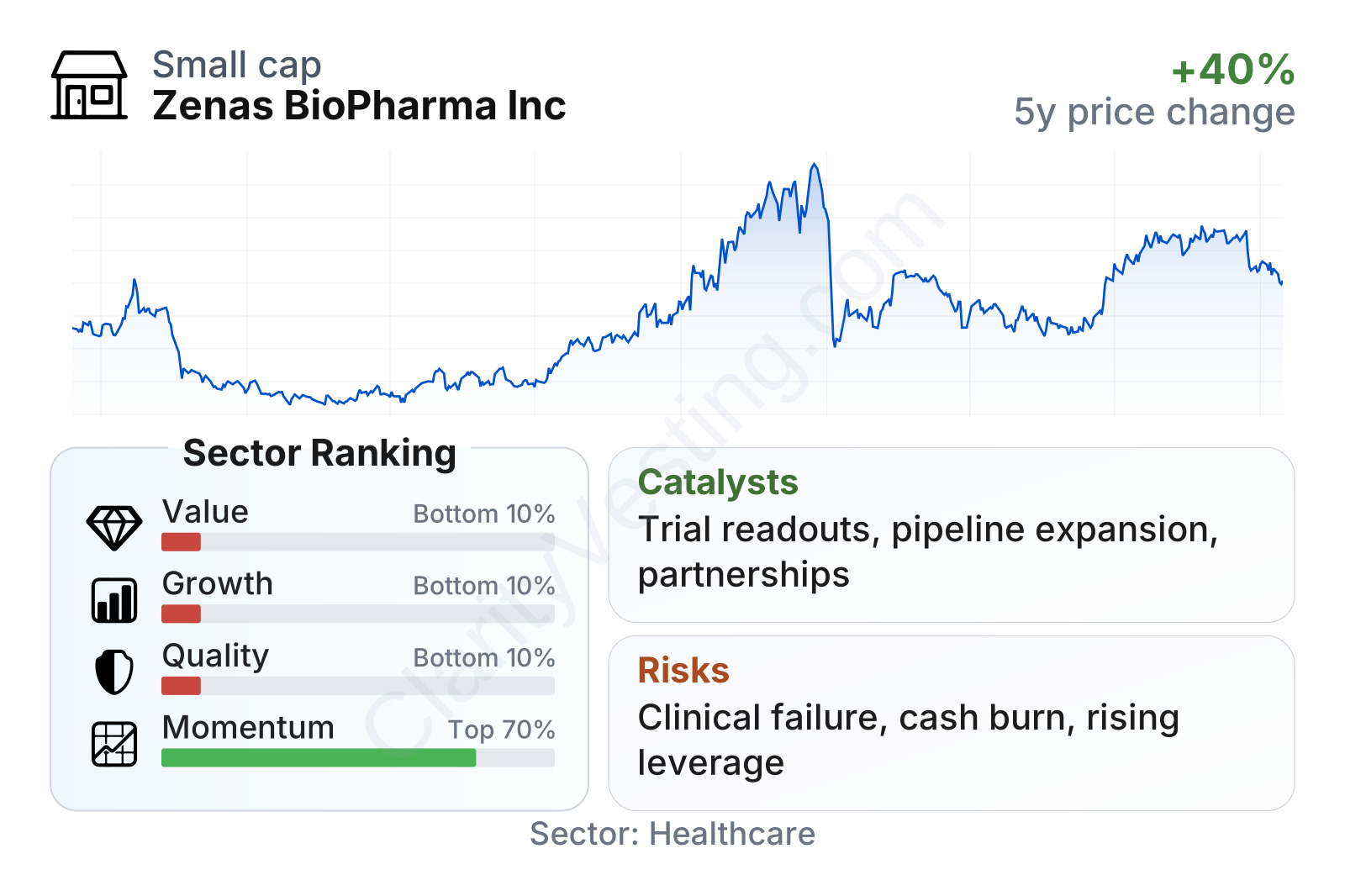
Zenas is a mid-sized biotech by market value, but its operating profile remains that of an early commercial or pre-commercial company. The stock has shown strong momentum over the last year despite very weak value, quality, and growth factor rankings relative to the broader healthcare sector. That combination usually means the market is reacting to pipeline expectations rather than current fundamentals.
On valuation-related measures, the company screens as expensive compared with sector norms, especially on price-to-book, while cash generation and operating earnings remain deeply negative. Quality metrics are also weak, with negative returns on assets and invested capital and operating margins far below sector medians. In short, the stock market is assigning meaningful value to future drug development potential, not to present-day profitability.
Growth
Zenas operates in one of the more attractive long-term areas of healthcare. Autoimmune and inflammatory diseases remain large markets because many patients do not respond well enough to existing treatments, lose response over time, or face safety and convenience tradeoffs. Companies that can show better efficacy, better tolerability, or more targeted immune modulation can create substantial value, even without becoming the largest player in the field.
The company’s strategy appears logical for this sector. Rather than trying to compete broadly across many disease areas at once, it is centered on a pipeline approach where a small number of lead assets are advanced in indications with meaningful unmet need. For a biotech at this stage, that focus matters: it helps direct capital toward the programs most likely to drive partnership interest, pivotal development, or eventual commercialization.
A major growth catalyst in biotech is usually clinical progress, and that is especially true here. For Zenas, future value creation is likely to come from trial readouts, regulatory interactions, expansion into additional disease indications, and any partnership activity that can validate its science while bringing in non-dilutive funding. A positive data release can change the market’s view quickly, which helps explain why the shares have been volatile but also capable of strong rebounds.
One important limit to the growth case is cash burn. Free cash flow remains deeply negative and has worsened over the latest trailing period, showing that progress still requires substantial external funding. In practical terms, the company may be building scientific value, but that value has not yet translated into a self-funding business model.
Recent market action suggests that investors have been paying close attention to pipeline-related developments and the possibility of meaningful upside from successful execution. In this industry, even a single well-received clinical update can materially improve access to capital, partnership options, and perceived strategic value.
Risks
This article is for informational purposes only and does not constitute financial advice. Some content is AI-generated. See Disclaimer


