Stock Analysis · Zimmer Biomet Holdings Inc (ZBH)
Overview
Zimmer Biomet Holdings is a large orthopedic and musculoskeletal medical device company. It designs and sells products used mainly in joint replacement, trauma care, spine procedures, sports medicine, dental reconstruction, and robotic-assisted surgery. Its customers are primarily hospitals, ambulatory surgery centers, and orthopedic surgeons. The company’s role in healthcare is fairly easy to understand: it provides implants, surgical tools, and enabling technologies that help patients regain mobility after arthritis, injury, or degenerative disease.
The business is still centered on reconstructive orthopedics, especially knees and hips, which remain the foundation of revenue. Based on the company’s recent annual reporting structure, the main revenue sources can be summarized approximately as follows:
- Knees: about 35% of revenue. This includes primary knee implants, partial knees, revision knees, and related surgical components.
- Hips: about 27%. This covers hip implants for primary and revision procedures.
- S.E.T. and Extremities: about 17%. This segment includes sports medicine, foot and ankle, trauma, shoulder, and related biologics.
- Technology & Data, Bone Cement and Surgical: about 10%. This includes robotic systems, navigation, enabling software, and other surgical products.
- Spine and Thoracic: about 6%. This covers spinal implants and related systems.
- Dental: about 5%. This includes dental implants and digital dentistry solutions.
Geographically, the company generates most of its sales in the Americas, with meaningful contributions from Europe, the Middle East and Africa, and Asia-Pacific. That broad footprint matters because procedure demand is tied to aging populations in many developed markets, while emerging markets can add another layer of volume growth over time.
From a business model standpoint, Zimmer Biomet benefits from recurring procedure demand rather than one-time consumer purchases. A patient needing a knee or hip replacement is not making a discretionary technology upgrade in the same way a consumer replaces a phone. That gives the company a more durable demand base, although procedure timing can still be influenced by hospital staffing, reimbursement, and broader economic conditions.
The long-term operating picture shows a business with gradually rising revenue over recent years, but with profitability that has moved around more than sales. Gross profit remains substantial, while selling and administrative costs take a large share of revenue. That is common in medical devices, where surgeon support, sales coverage, training, and regulatory requirements are important parts of the model.
Key Figures
| Metric | Value | Sector ⓘ |
|---|---|---|
| Date | Oct 03, 2026 | |
| Context | ||
| Sector | Healthcare | |
| Industry | Medical Devices | |
| Market Cap ⓘ | $16.94B | |
| Beta ⓘ | 0.47 | |
Value (Cheapness) | ||
| P/E Ratio ⓘ | 21.56 | 24.06 |
| P/B Ratio ⓘ | 1.35 | 3.08 |
| FCF Yield ⓘ | 10.80% | 3.07% |
| Dividend Yield ⓘ | 1.05% | 2.05% |
| EBIT / EV ⓘ | 5.03% | 0.63% |
| PEG ⓘ | 0.57 | |
Growth (Business expansion) | ||
| Revenue Growth ⓘ | 4.80% | 7.50% |
| RPS Growth (5Y CAGR) ⓘ | 6.30% | 8.70% |
| EPS Growth (5Y CAGR) ⓘ | -12.59% | -18.20% |
| BVPS Growth (5Y CAGR) ⓘ | 1.51% | 3.95% |
| Margin Growth (5Y Trend) ⓘ | 3.29% | -0.58% |
| FCF Growth (5Y CAGR) ⓘ | 2.25% | 0.88% |
| DPS Growth (5Y CAGR) ⓘ | 0.18% | 6.80% |
Quality (Business durability) | ||
| ROIC (Latest) ⓘ | 5.35% | 3.29% |
| ROA (Latest) ⓘ | 3.49% | 3.02% |
| ROIC (5Y Median) ⓘ | 5.91% | 4.75% |
| ROA (5Y Median) ⓘ | 3.17% | 1.93% |
| Net Debt / EBIT (Latest) ⓘ | 5.75 | 1.33 |
| Net Debt / EBIT (5Y Median) ⓘ | 6.17 | 1.83 |
| Net Debt / EBITDA (Latest) ⓘ | 3.61 | 0.99 |
| Net Debt / Assets ⓘ | 31.01% | 5.33% |
| EBITDA / Interest ⓘ | 6.78 | 9.63 |
| Operating Margin (Latest) ⓘ | 14.44% | 9.25% |
| Operating Margin (5Y Median) ⓘ | 13.65% | 7.80% |
| Debt to Equity (Latest) ⓘ | 59.24% | 28.99% |
| Profit Margin (Latest) ⓘ | 9.48% | 3.60% |
| Free Cash Flow (Latest) ⓘ | $1.83B | |
Momentum (Price trend) | ||
| 3Y Return ⓘ | -18.69% | +37.48% |
| 12M Return (excl. last month) ⓘ | -5.33% | +20.85% |
| 6M Return ⓘ | -2.75% | +9.73% |
| Price vs. 200-Day MA ⓘ | -3.09% | +4.69% |
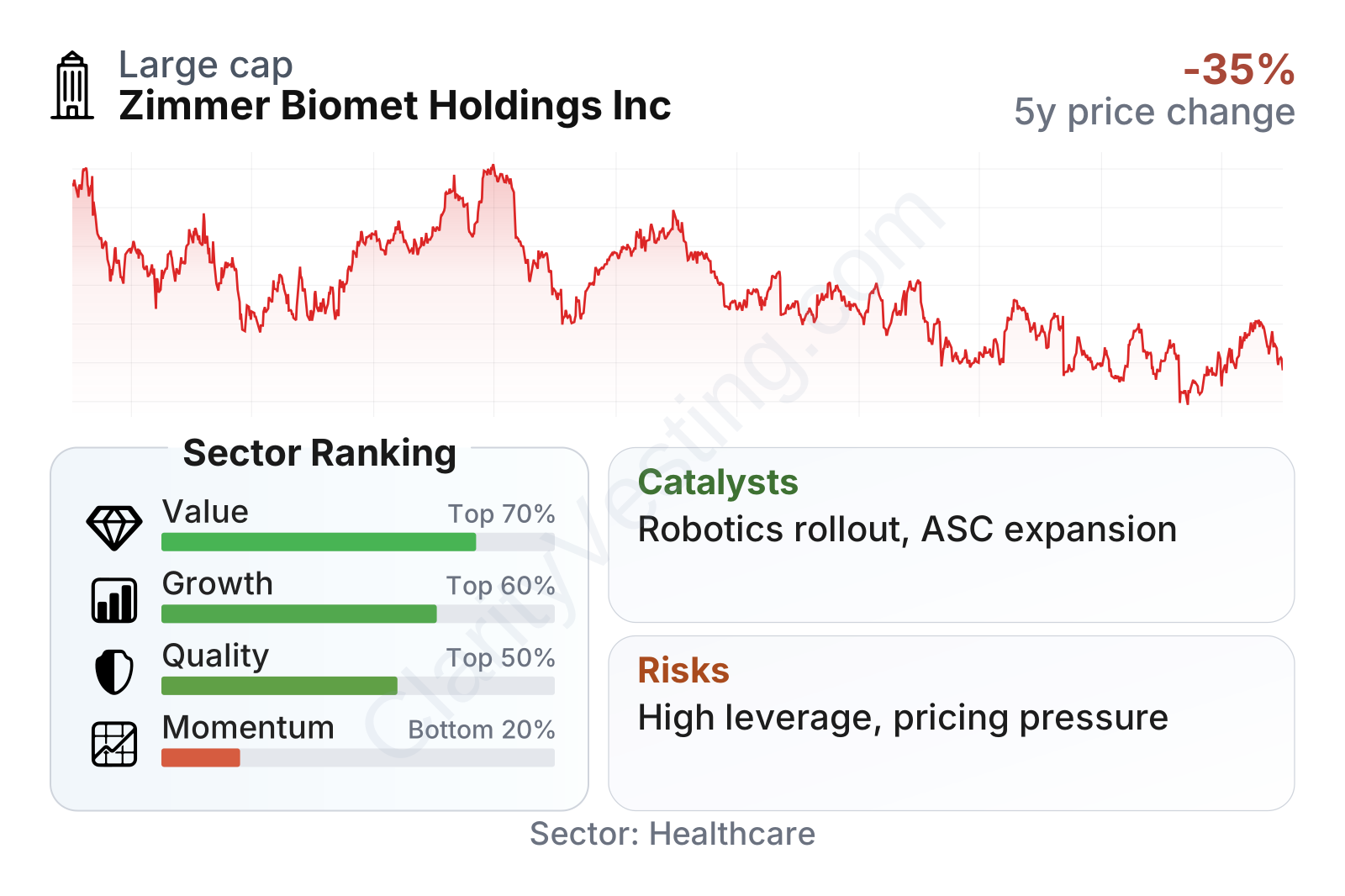
Zimmer Biomet appears to sit in a mixed but understandable position. On valuation and cash generation, it compares well with much of the healthcare equipment group: earnings multiple is slightly below the sector median, price-to-book is clearly lower, and free cash flow yield stands well above the typical peer. Quality is also supported by margins and returns on capital that are above many sector peers. The weaker area is market performance, where the stock has lagged the broader healthcare group over one, three, and shorter trailing periods. In plain terms, the operating business looks steadier than the share price history suggests.
The stock’s beta is low, which means it has historically moved less sharply than the broader market. That can fit the profile of a mature medical device company with established procedure lines, although it does not eliminate company-specific risks.
Growth
Zimmer Biomet operates in a sector with favorable long-term demand drivers. The most important one is demographics: aging populations tend to require more knee, hip, and other musculoskeletal procedures. Obesity, osteoarthritis, and longer life expectancy also support procedure volumes. These are not short-lived themes. They create a durable backdrop for joint reconstruction and related surgical technologies.
The company’s strategy also makes sense in that context. It is not trying to reinvent itself far away from its core franchise. Instead, it is building around its strongest positions in knees and hips by adding robotics, navigation, data tools, and workflow software. That approach can deepen surgeon relationships and potentially make Zimmer Biomet’s implants more attractive when hospitals choose a broader platform rather than a single product.
Revenue growth has not been explosive, but it has been consistently positive in recent periods, with year-over-year gains mostly in the mid-single-digit to high-single-digit range after a more uneven period earlier in the cycle. That pattern fits a mature medical technology company: dependable procedure-driven growth rather than rapid expansion. It also suggests the company has been recovering procedure demand and executing reasonably well across its portfolio.
Cash generation is one of the more encouraging features. Free cash flow has improved materially over the last several years and now sits well above earlier levels. For a long-term business assessment, that matters because strong cash flow supports debt reduction, dividends, acquisitions, and ongoing product development. It also gives management more flexibility if procedure volumes soften temporarily.
A notable catalyst is the continued rollout of enabling technologies around robotic-assisted surgery and digital operating room tools. In orthopedics, hospitals often look for systems that can improve precision, workflow, and surgeon adoption. If these platforms gain traction, they can help not only through direct equipment revenue but also by reinforcing implant sales in core categories. Another potential opportunity comes from ambulatory surgery centers, where more orthopedic procedures are gradually shifting as techniques and equipment improve.
Recent company updates have also emphasized portfolio simplification and focus on higher-priority franchises. If management can combine steady implant demand with higher attach rates for robotics, planning software, and outpatient-friendly solutions, growth could become more balanced across the portfolio rather than relying mainly on traditional joint replacement.
Risks
This article is for informational purposes only and does not constitute financial advice. Some content is AI-generated. See Disclaimer


