Stock Analysis · Yanzhou Coal Mining Company Limited (YZCAY)
Overview
Yanzhou Coal Mining Company Limited, now commonly operating under the Yankuang Energy name in its corporate materials, is a large Chinese energy and mining group. Its core business is coal: mining, processing, transporting, and selling thermal coal and, to a lesser extent, other coal products. The company also has supporting activities in coal chemicals, power, equipment manufacturing, logistics, and trading. For U.S. investors, YZCAY is the American depositary receipt linked to the Hong Kong-listed shares of the group.
The business is still primarily driven by coal production and coal sales. Based on the company’s recent annual disclosures and business structure, the revenue mix is centered on a few major sources:
- Coal mining and coal sales: approximately 70% to 85% of revenue. This includes domestically produced coal sold to utilities, industrial customers, and other users, as well as various coal grades depending on the mine and region.
- Coal trading and logistics-related activity: approximately 10% to 20%. This generally includes purchased coal resold to customers, transportation, port, and supply-chain services tied to bulk commodities.
- Coal chemicals and related products: approximately 5% to 10%. This area can include methanol and other chemical products produced from coal feedstock.
- Electricity, equipment manufacturing, and other businesses: usually below 10% combined. These operations help support the broader industrial chain but are not the main earnings driver.
That revenue structure matters because it makes the company much more exposed to coal prices, Chinese energy demand, and domestic production policy than to a broad mix of independent businesses. The operating profile has also become less favorable since the exceptional profit period in 2022: revenue has remained sizable, but profits have compressed as coal market conditions normalized. The multi-year financial flow also shows a clear pattern of strong gross profit generation, followed by a marked decline in operating income and net income after the 2022 peak.
Key Figures
| Metric | Value | Sector ⓘ |
|---|---|---|
| Date | Nov 11, 2026 | |
| Context | ||
| Sector | Energy | |
| Industry | Thermal Coal | |
| Market Cap ⓘ | $14.67B | |
| Beta ⓘ | 0.60 | |
Value (Cheapness) | ||
| P/E Ratio ⓘ | 8.17 | 13.13 |
| P/B Ratio ⓘ | N/A | 1.82 |
| FCF Yield ⓘ | -0.39% | 8.37% |
| Dividend Yield ⓘ | 5.20% | 3.49% |
| EBIT / EV ⓘ | 12.60% | 9.05% |
| PEG ⓘ | 0.90 | |
Growth (Business expansion) | ||
| Revenue Growth ⓘ | 8.40% | 26.55% |
| RPS Growth (5Y CAGR) ⓘ | 23.35% | 6.66% |
| EPS Growth (5Y CAGR) ⓘ | N/A | -7.58% |
| BVPS Growth (5Y CAGR) ⓘ | -6.89% | 5.85% |
| Margin Growth (5Y Trend) ⓘ | -3.79% | 0.61% |
| FCF Growth (5Y CAGR) ⓘ | -56.01% | 3.10% |
| DPS Growth (5Y CAGR) ⓘ | 17.51% | 16.54% |
Quality (Business durability) | ||
| ROIC (Latest) ⓘ | 10.32% | 11.64% |
| ROA (Latest) ⓘ | 2.78% | 6.10% |
| ROIC (5Y Median) ⓘ | 16.22% | 10.30% |
| ROA (5Y Median) ⓘ | 6.00% | 5.44% |
| Net Debt / EBIT (Latest) ⓘ | 2.24 | 1.54 |
| Net Debt / EBIT (5Y Median) ⓘ | 1.20 | 1.82 |
| Net Debt / EBITDA (Latest) ⓘ | 2.24 | 0.94 |
| Net Debt / Assets ⓘ | 13.24% | 15.43% |
| EBITDA / Interest ⓘ | 7.61 | 9.78 |
| Operating Margin (Latest) ⓘ | 18.24% | 16.67% |
| Operating Margin (5Y Median) ⓘ | 21.04% | 20.55% |
| Debt to Equity (Latest) ⓘ | N/A | 48.84% |
| Profit Margin (Latest) ⓘ | 7.88% | 9.78% |
| Free Cash Flow (Latest) ⓘ | -$57.47M | |
Momentum (Price trend) | ||
| 3Y Return ⓘ | +43.81% | +56.26% |
| 12M Return (excl. last month) ⓘ | +20.94% | +45.45% |
| 6M Return ⓘ | -18.56% | -3.86% |
| Price vs. 200-Day MA ⓘ | -6.38% | +0.51% |
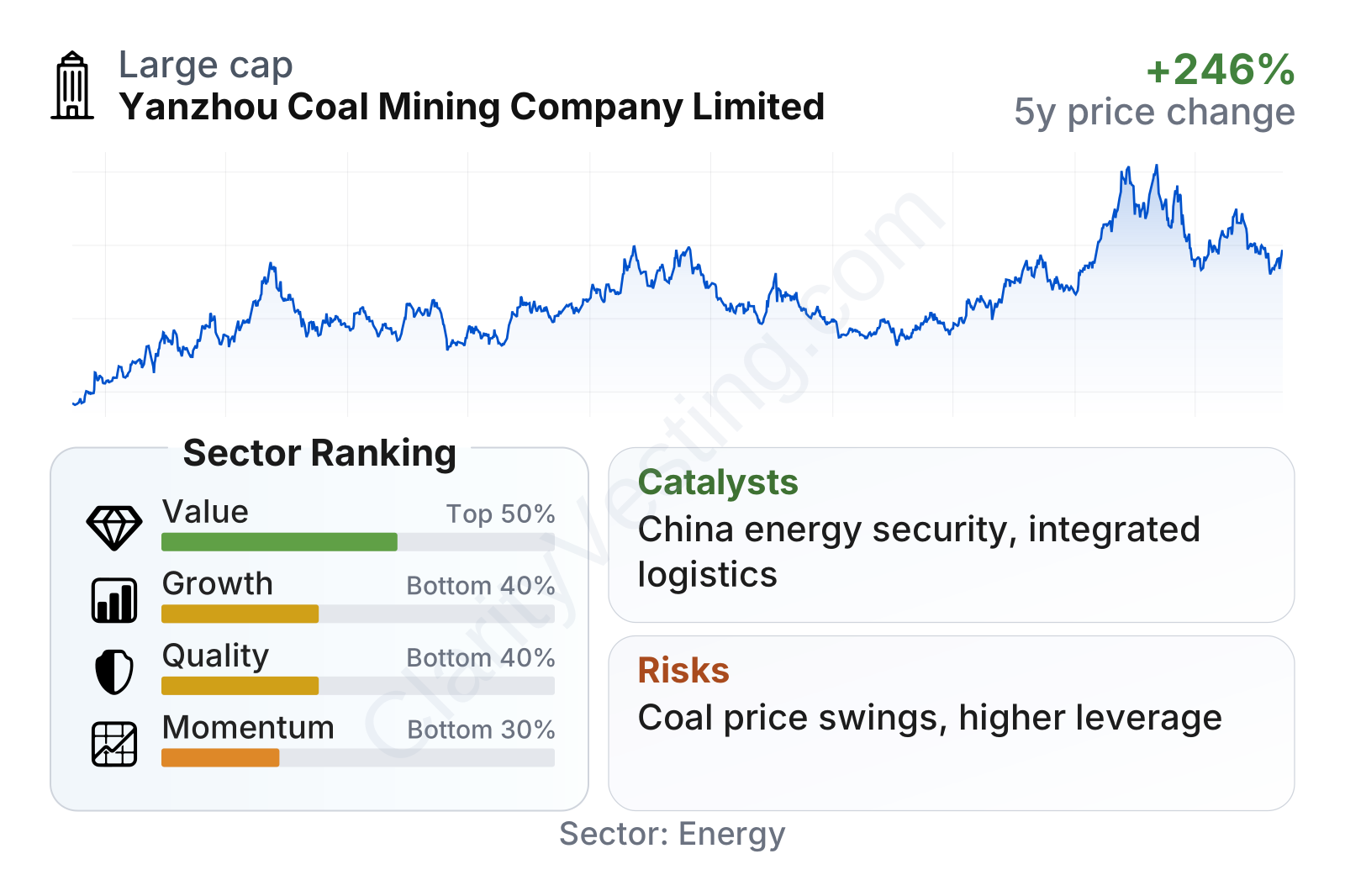
Yanzhou Coal remains a large-cap energy company with relatively low share-price volatility, reflected in a beta around 0.6. On valuation, the earnings multiple is below the sector median, while EBIT relative to enterprise value looks stronger than average. The picture is less favorable on cash generation and broader business quality: recent free cash flow has turned slightly negative, leverage has moved above many sector peers, and current profitability metrics sit below stronger operators in the energy space. Growth signals are mixed. Long-term revenue per share has expanded well over five years, but recent growth, margin trends, and book value progression have weakened enough to leave the company in the lower part of the sector on growth and quality rankings.
Growth
Coal is not a classic structural growth industry in the way that software, semiconductors, or renewable infrastructure can be. For long-term analysis, it is better described as a strategically important but cyclical sector. In China, coal still plays a central role in power generation, grid stability, industrial activity, and energy security. That gives major domestic coal producers an enduring role even as the country expands wind, solar, nuclear, and power storage capacity. In other words, the sector may not enjoy steady secular growth, but it can remain economically important for years because energy security and baseload power still matter.
For Yanzhou Coal specifically, the growth logic is based less on a global energy transition theme and more on three practical drivers: maintaining large-scale low-cost reserves, expanding the integrated coal-to-transport-to-customer chain, and using related businesses such as chemicals and logistics to smooth part of the commodity cycle. This strategy is coherent for the company’s industrial base. It does not remove coal price volatility, but it does give the group more ways to capture value across production, distribution, and processing.
Recent growth has been uneven rather than consistently upward. Revenue has posted rebounds and contractions over short periods, which is typical for a commodity producer exposed to changing benchmark prices and demand patterns. On a five-year basis, revenue per share growth has been strong, but the latest year-over-year revenue growth is well below the sector median. That suggests the company is no longer benefiting from the unusually favorable pricing environment that lifted many coal producers in 2022.
Cash generation tells a similar story. Free cash flow was very strong during the earlier upswing, then swung negative before partially recovering. That is important because long-term compounding in commodity businesses depends less on one strong year of earnings and more on repeated cycles of durable cash generation after capital spending. Yanzhou Coal still has the scale to produce substantial cash in supportive markets, but the recent pattern shows that this is not a smooth or highly predictable trajectory.
One notable catalyst is policy support for domestic energy security in China. Large domestic miners can benefit when authorities prioritize dependable coal supply, stable power markets, and controlled reliance on imports. Another possible growth support is continued integration of rail, port, and trading capabilities, which can improve customer reach and operating efficiency. Recent corporate updates have also pointed to continued investment in smart mining, efficiency upgrades, and industrial-chain coordination, which are sensible operational steps even if they do not transform the underlying industry.
Risks
This article is for informational purposes only and does not constitute financial advice. Some content is AI-generated. See Disclaimer