Stock Analysis · Yue Yuen Industrial Holdings (YUEIY)
Overview
Yue Yuen Industrial Holdings is one of the world’s largest athletic and casual footwear manufacturers. The group is best known for making shoes for major global brands rather than selling most products under its own name. Its manufacturing network is concentrated in Asia, with large operations in countries such as China, Vietnam, Indonesia, and other regional sourcing and production hubs. Through its subsidiary Pou Sheng, it also has a large retail and distribution business focused on sportswear in Greater China.
That business mix matters because Yue Yuen is not a pure branded consumer company. A large part of its economics comes from contract manufacturing, where scale, efficiency, customer relationships, and production execution are more important than marketing. The retail and distribution arm adds a second earnings stream, but it also exposes the group to consumer demand swings in China.
Based on recent annual reporting, the company’s revenue mainly comes from two broad areas:
- Manufacturing business: about 65% to 70% of revenue. This includes athletic shoes, casual shoes, outdoor footwear, and related products made for global brands.
- Retailing and distribution business: about 30% to 35% of revenue. This mainly covers the distribution and sale of sportswear and footwear through physical stores and digital channels, largely through Pou Sheng in Greater China.
The broad revenue flow over the last several years shows a business with fairly stable sales around the low-$8 billion range, but with meaningful swings in profitability. Revenue recovered after the pandemic period, while operating income and net income improved more sharply in 2024 before becoming less even in 2025, which suggests margins remain sensitive to product mix, utilization, labor costs, and retail conditions.
The overall picture is a high-volume manufacturer with relatively thin margins. Sales have stayed resilient, but earnings have moved around much more than revenue, which is typical for labor-intensive consumer supply chains.
Key Figures
| Metric | Value | Sector ⓘ |
|---|---|---|
| Date | Oct 03, 2026 | |
| Context | ||
| Sector | Consumer Cyclical | |
| Industry | Footwear & Accessories | |
| Market Cap ⓘ | $2.57B | |
| Beta ⓘ | 0.80 | |
Value (Cheapness) | ||
| P/E Ratio ⓘ | 9.09 | 17.04 |
| P/B Ratio ⓘ | 0.64 | 1.61 |
| FCF Yield ⓘ | 27.06% | 9.02% |
| Dividend Yield ⓘ | 10.35% | 2.75% |
| EBIT / EV ⓘ | 9.96% | 6.69% |
| PEG ⓘ | N/A | |
Growth (Business expansion) | ||
| Revenue Growth ⓘ | -2.20% | 5.60% |
| RPS Growth (5Y CAGR) ⓘ | -1.39% | 9.04% |
| EPS Growth (5Y CAGR) ⓘ | -7.51% | -17.44% |
| BVPS Growth (5Y CAGR) ⓘ | 0.26% | 5.73% |
| Margin Growth (5Y Trend) ⓘ | 1.63% | -0.26% |
| FCF Growth (5Y CAGR) ⓘ | 15.86% | 4.91% |
| DPS Growth (5Y CAGR) ⓘ | -46.38% | 10.48% |
Quality (Business durability) | ||
| ROIC (Latest) ⓘ | N/A | 12.38% |
| ROA (Latest) ⓘ | N/A | 5.54% |
| ROIC (5Y Median) ⓘ | 5.95% | 10.63% |
| ROA (5Y Median) ⓘ | 3.59% | 5.44% |
| Net Debt / EBIT (Latest) ⓘ | 2.04 | 2.16 |
| Net Debt / EBIT (5Y Median) ⓘ | 1.00 | 2.31 |
| Net Debt / EBITDA (Latest) ⓘ | 0.79 | 1.52 |
| Net Debt / Assets ⓘ | 8.33% | 21.74% |
| EBITDA / Interest ⓘ | N/A | 9.06 |
| Operating Margin (Latest) ⓘ | 2.60% | 9.12% |
| Operating Margin (5Y Median) ⓘ | 5.24% | 9.56% |
| Debt to Equity (Latest) ⓘ | 27.25% | 76.18% |
| Profit Margin (Latest) ⓘ | 3.55% | 5.30% |
| Free Cash Flow (Latest) ⓘ | $694.73M | |
Momentum (Price trend) | ||
| 3Y Return ⓘ | +88.16% | +11.77% |
| 12M Return (excl. last month) ⓘ | +8.07% | +0.61% |
| 6M Return ⓘ | -8.78% | +1.32% |
| Price vs. 200-Day MA ⓘ | -11.24% | -3.47% |
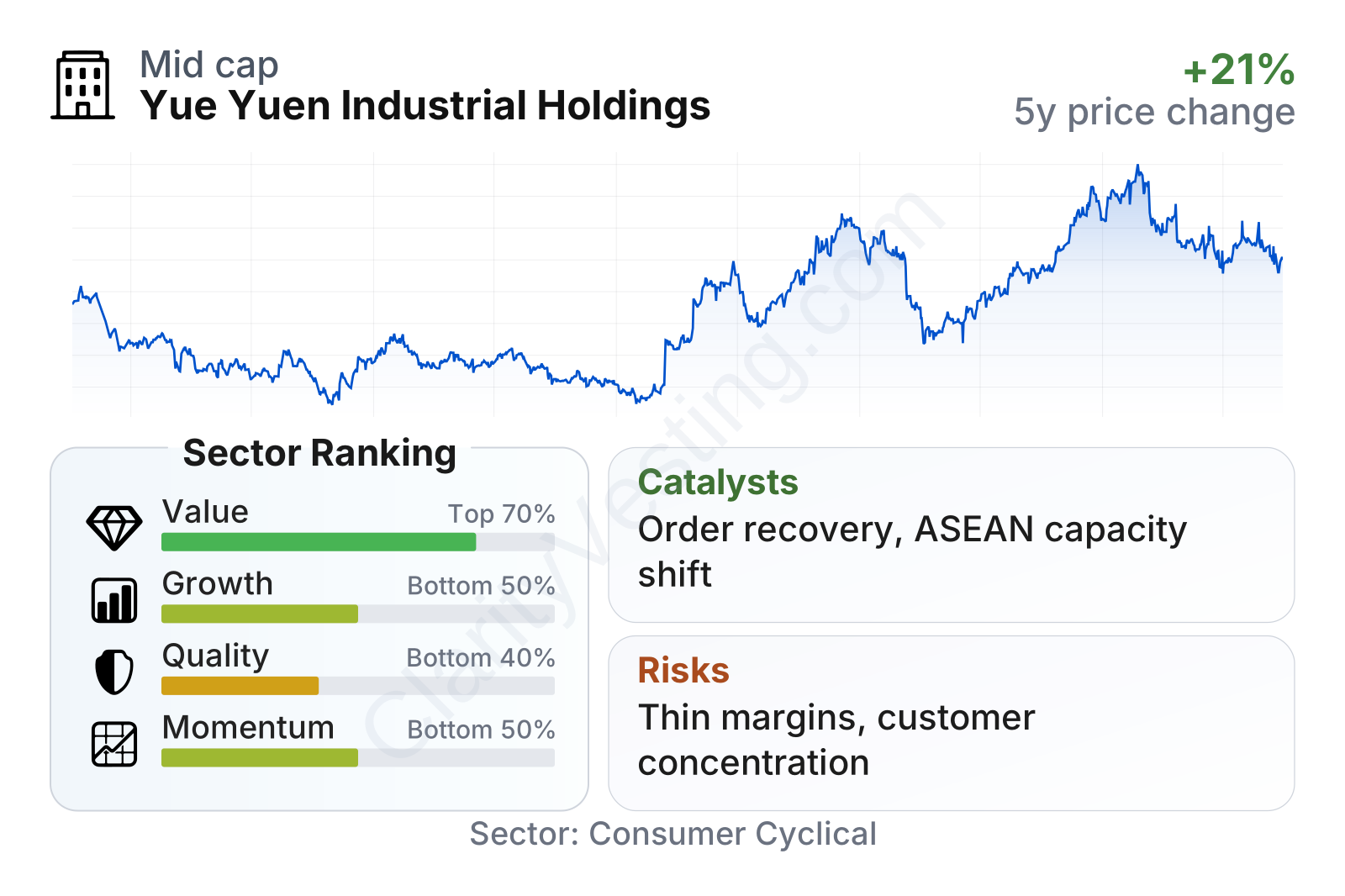
The market profile is that of a mid-sized company with below-market volatility. On valuation, the shares trade at noticeably lower earnings and book multiples than the sector median, while free cash flow yield and dividend yield stand well above typical sector levels. That combination suggests the market is giving more credit to current cash generation than to long-term growth. At the same time, growth and quality indicators are weaker relative to many consumer peers, reflecting modest recent sales momentum and lower profitability.
The stock performance over the past few years has been volatile, with a deep trough in 2023 and early 2024, followed by a strong rebound and then some pullback in 2026. That pattern fits a cyclical manufacturing business whose valuation can change quickly when investors reassess margins, customer orders, and China-related demand.
Growth
Yue Yuen operates in a sector that still has long-term demand drivers. Global athletic footwear and sportswear consumption continues to benefit from health, fitness, casualization, and replacement demand. Even in mature markets, major brands keep refreshing product lines, while emerging markets still offer room for higher per-capita spending. That creates a steady need for large-scale, reliable manufacturing partners.
The company’s strategy is logical for that environment. Its role in the value chain is built on manufacturing scale, geographic diversification, and long-standing relationships with large international brands. For customers, switching a complex footwear program to a new supplier is not simple because product development, molds, materials sourcing, compliance, and delivery schedules all need to line up. This gives Yue Yuen a degree of stickiness, even if it does not own the end brand.
A second growth lever is production relocation within Asia. Global footwear brands have been diversifying sourcing beyond a single country, especially toward Vietnam, Indonesia, and other Southeast Asian locations. Yue Yuen already has a broad regional footprint, so it is in a position to absorb shifts in order allocation better than smaller manufacturers with narrower capacity bases.
The retail and distribution arm can also support future growth if sportswear demand in China and Greater China improves. That business is more consumer-facing and can benefit from store productivity gains, digital integration, and brand mix optimization. In practice, this segment can lift results when local demand is healthy, although it can also be a drag during weaker periods.
One encouraging point in the financial profile is cash generation. Over five years, free cash flow growth has been much stronger than the sector median, even though revenue growth has been softer. That indicates operational discipline and tighter capital management. If management can pair that with steadier margins, future earnings growth could look better than the recent headline sales trend suggests.
Recent company updates have also emphasized order recovery and production normalization after earlier industry disruptions. For a manufacturer like Yue Yuen, better factory utilization can have a large effect on earnings because fixed costs are spread across more output. That operating leverage is one of the clearest upside drivers when demand conditions improve.
Risks
This article is for informational purposes only and does not constitute financial advice. Some content is AI-generated. See Disclaimer