Stock Analysis · Yangzijiang Shipbuilding Ltd (YSHLF)
Overview
Yangzijiang Shipbuilding Ltd is a Singapore-listed shipbuilder whose core business is designing and building commercial vessels in China. The group is best known for making containerships, bulk carriers, and gas-related vessels, and it serves both Chinese and international shipowners. In simple terms, the company earns most of its money by taking orders for new ships, building them over several years, and recognizing revenue as construction progresses.
The business has historically been organized around three main activities: shipbuilding, shipping/logistics-related operations, and investment activities. For long-term analysis, the shipbuilding arm matters the most because it is the main driver of revenue, profit, and backlog visibility.
Based on recent annual disclosures, the revenue mix is heavily concentrated in shipbuilding, with a much smaller contribution from other operations.
- Shipbuilding: approximately 90% to 95% of revenue. This includes the construction and sale of commercial vessels such as containerships, dry bulk carriers, and cleaner-fuel vessel types including dual-fuel and gas-capable ships.
- Shipping and related businesses: approximately 3% to 7% of revenue. This generally includes marine transportation or vessel-related services outside the core shipyard activity.
- Investment and other activities: usually a low-single business share of revenue, but at times more important for profit than for sales. This area has included debt investments and fund-related activities, although the company has increasingly emphasized its industrial operations.
What stands out is that the company is not a diversified industrial conglomerate in practice. It is mainly a shipbuilder, and that makes the investment case closely tied to the global shipbuilding cycle, the size and quality of its orderbook, and its ability to manage costs better than rivals.
Over the last several years, revenue and profit have expanded strongly while operating costs rose much more slowly. That suggests better ship prices, improved product mix, and disciplined overhead rather than growth coming only from volume.
The business flow shows a notable improvement in profitability since 2021: revenue increased steadily, but operating income and net income grew much faster. That usually points to stronger pricing, a better mix of vessels, and improving yard efficiency.
Key Figures
| Metric | Value | Sector ⓘ |
|---|---|---|
| Date | Oct 17, 2026 | |
| Context | ||
| Sector | Industrials | |
| Industry | Aerospace & Defense | |
| Market Cap ⓘ | $15.57B | |
| Beta ⓘ | 0.82 | |
Value (Cheapness) | ||
| P/E Ratio ⓘ | 10.97 | 22.10 |
| P/B Ratio ⓘ | 0.47 | 1.97 |
| FCF Yield ⓘ | 23.34% | 6.38% |
| Dividend Yield ⓘ | 27.34% | 1.94% |
| EBIT / EV ⓘ | N/A | 4.79% |
| PEG ⓘ | 1.42 | |
Growth (Business expansion) | ||
| Revenue Growth ⓘ | 36.20% | 9.30% |
| RPS Growth (5Y CAGR) ⓘ | 16.20% | 7.81% |
| EPS Growth (5Y CAGR) ⓘ | -15.03% | -13.06% |
| BVPS Growth (5Y CAGR) ⓘ | -3.32% | 6.14% |
| Margin Growth (5Y Trend) ⓘ | 20.40% | 0.88% |
| FCF Growth (5Y CAGR) ⓘ | -16.74% | 11.01% |
| DPS Growth (5Y CAGR) ⓘ | 31.79% | 9.48% |
Quality (Business durability) | ||
| ROIC (Latest) ⓘ | N/A | 10.84% |
| ROA (Latest) ⓘ | 28.75% | 5.41% |
| ROIC (5Y Median) ⓘ | 13.59% | 9.38% |
| ROA (5Y Median) ⓘ | 11.11% | 4.95% |
| Net Debt / EBIT (Latest) ⓘ | -0.76 | 2.08 |
| Net Debt / EBIT (5Y Median) ⓘ | -2.46 | 2.27 |
| Net Debt / EBITDA (Latest) ⓘ | -0.72 | 1.39 |
| Net Debt / Assets ⓘ | -22.33% | 19.28% |
| EBITDA / Interest ⓘ | N/A | 9.58 |
| Operating Margin (Latest) ⓘ | 31.99% | 10.50% |
| Operating Margin (5Y Median) ⓘ | 20.09% | 10.29% |
| Debt to Equity (Latest) ⓘ | 12.42% | 65.48% |
| Profit Margin (Latest) ⓘ | 29.62% | 6.67% |
| Free Cash Flow (Latest) ⓘ | $3.63B | |
Momentum (Price trend) | ||
| 3Y Return ⓘ | +285.87% | +61.68% |
| 12M Return (excl. last month) ⓘ | +79.86% | +12.58% |
| 6M Return ⓘ | +30.95% | 0.00% |
| Price vs. 200-Day MA ⓘ | +38.06% | +0.02% |
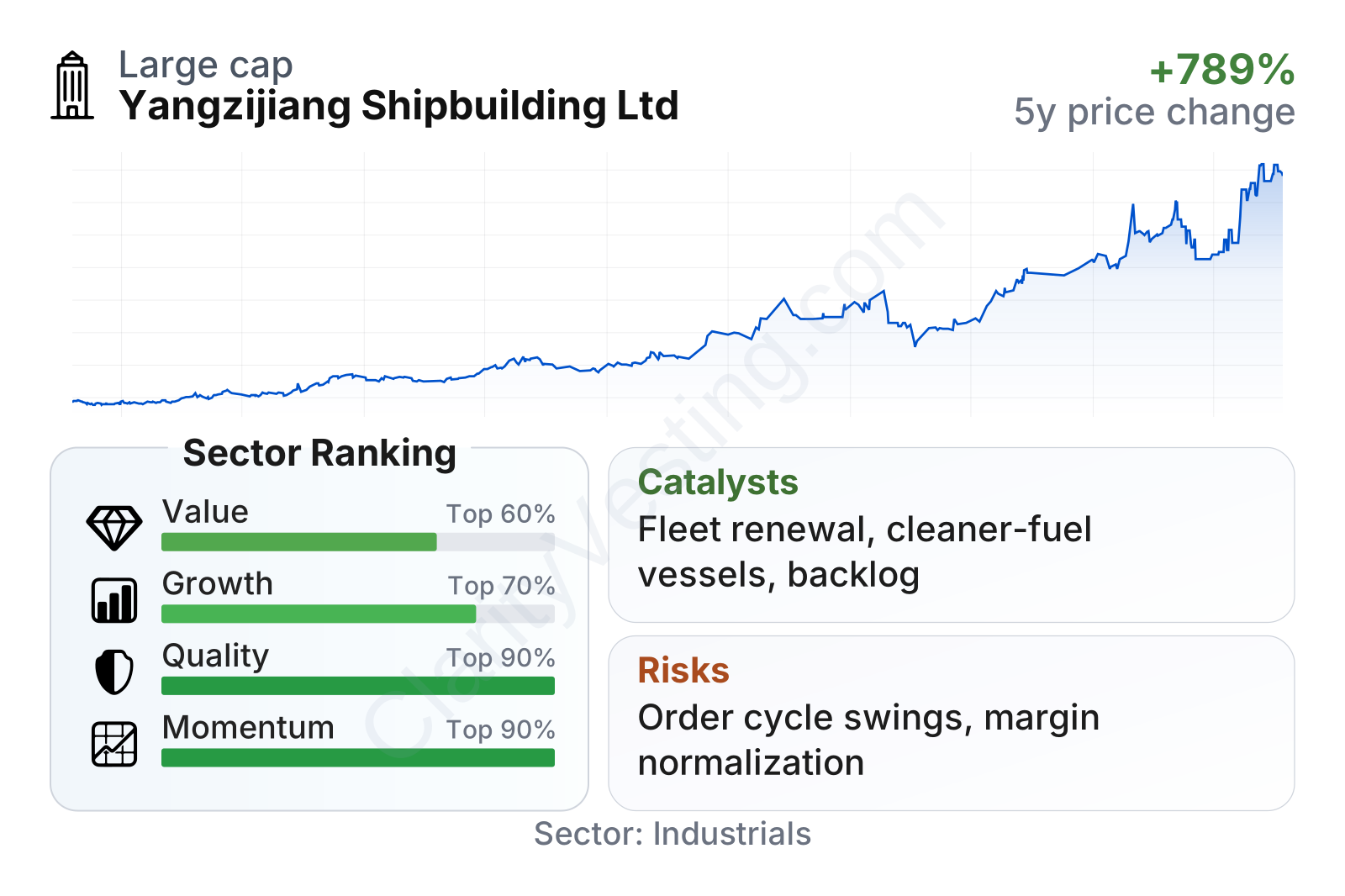
The market profile is unusual in a positive way. The company ranks strongly on quality and momentum versus much of its sector, while valuation measures remain low. Profitability is far above sector norms, leverage is modest, and free cash flow generation is robust. The main weaker spots are longer-term earnings-per-share and free-cash-flow growth consistency, which reflects the cyclical nature of shipbuilding and changes in capital allocation over time.
The share price has climbed sharply since 2021, yet the valuation still looks restrained relative to the broader industrial peer group. That combination only tends to happen when the market is either skeptical about durability or still treating the business as highly cyclical.
Growth
Shipbuilding is a cyclical industry, but several current trends support multi-year demand. Global fleets are aging, environmental rules are tightening, and shipping companies are replacing older vessels with more fuel-efficient designs. Demand is also being supported by the shift toward dual-fuel ships and other vessel types that help operators reduce fuel costs and emissions. That creates room for capable yards to win better-priced orders rather than simply more orders.
Yangzijiang’s strategy fits that backdrop reasonably well. The group has been moving toward higher-value vessels instead of relying only on standard bulk ships. Its orderbook has increasingly included containerships and more technically demanding vessels, which can support margins if execution stays strong. Scale also matters here: a large orderbook gives visibility over several years, helps capacity planning, and can strengthen purchasing power with suppliers.
Recent revenue growth has been well ahead of the sector median, which indicates that Yangzijiang is not just benefiting from a stronger market but also gaining meaningful commercial traction within it. Its five-year revenue-per-share growth also points to real expansion rather than a temporary accounting effect.
Cash generation is another important growth signal. The company is producing a very large amount of free cash flow for its size, which gives it flexibility to expand yard capacity, invest in new programs, pay dividends, or preserve balance-sheet strength during weaker parts of the cycle. In shipbuilding, that financial flexibility matters because orders can be lumpy and working capital needs can swing sharply.
A practical catalyst is the continuing global need for vessel renewal. Environmental compliance, port efficiency, and fuel-transition requirements are pushing shipowners to modernize fleets. If Yangzijiang continues winning orders in cleaner-fuel and more advanced vessel segments, that could extend the current earnings strength beyond a normal short-cycle rebound.
Another favorable point is that global shipyard capacity is not unlimited. Major Asian shipbuilders already have substantial backlogs, and constrained industry capacity can support firmer pricing for newbuilds. In that kind of environment, an efficient yard with established customers can preserve margins better than in past downturns.
Risks
This article is for informational purposes only and does not constitute financial advice. Some content is AI-generated. See Disclaimer


