Stock Analysis · Yamazaki Baking Co Ltd (YMZBY)
Overview
Yamazaki Baking Co. Ltd. is Japan’s largest bakery company and one of the country’s biggest packaged food manufacturers. Its business is centered on everyday staple foods sold through supermarkets, convenience stores, drugstores, and other retail channels. Bread remains the core product, but the company also has meaningful operations in sweet baked goods, processed foods, confectionery, and distribution. Through this mix, Yamazaki is less dependent on a single product than its name may suggest, although baked foods still dominate the business.
The company’s revenue base is mainly domestic and heavily tied to recurring consumer demand. Based on company segment disclosures, the main sources of revenue are approximately:
- Bread: about 35% to 40% of revenue. This includes staple packaged bread products sold under the Yamazaki brand and related bakery lines.
- Sweet buns and Japanese-style / Western-style confectionery: about 30% to 35%. This covers snack cakes, pastries, desserts, and traditional sweet products.
- Processed foods: about 15% to 20%. This generally includes sandwiches, lunch boxes, noodles, and other prepared food items.
- Biscuits, candies, and other food products: about 5% to 10%.
- Distribution, logistics, and other businesses: about 5% to 10%, depending on the year and internal classification.
That mix matters because it shows a company built around high-frequency purchases rather than occasional discretionary spending. It also explains why performance often depends more on pricing, raw material costs, plant efficiency, and shelf space than on sudden changes in consumer taste.
Over the last several years, sales and profit have both moved higher, with revenue rising from roughly $6.6 billion in 2021 to about $8.6 billion in 2025, while net income improved much faster than sales. The business model is not glamorous, but it is deeply rooted in daily consumption and a large-scale manufacturing and delivery network.
The broad picture is improving: revenue has climbed steadily, gross profit has expanded, and operating income has increased faster than sales. That points to better pricing and cost absorption, even though the company still operates with thinner margins than many packaged food peers.
Key Figures
| Metric | Value | Sector ⓘ |
|---|---|---|
| Date | Nov 21, 2026 | |
| Context | ||
| Sector | Consumer Defensive | |
| Industry | Packaged Foods | |
| Market Cap ⓘ | $3.54B | |
| Beta ⓘ | -0.41 | |
Value (Cheapness) | ||
| P/E Ratio ⓘ | 14.43 | 18.64 |
| P/B Ratio ⓘ | N/A | 2.51 |
| FCF Yield ⓘ | 14.87% | 7.02% |
| Dividend Yield ⓘ | 1.67% | 2.67% |
| EBIT / EV ⓘ | 8.64% | 7.77% |
| PEG ⓘ | 2.99 | |
Growth (Business expansion) | ||
| Revenue Growth ⓘ | 5.50% | 3.80% |
| RPS Growth (5Y CAGR) ⓘ | 8.88% | 6.10% |
| EPS Growth (5Y CAGR) ⓘ | 25.29% | -10.36% |
| BVPS Growth (5Y CAGR) ⓘ | 6.48% | 3.04% |
| Margin Growth (5Y Trend) ⓘ | 2.69% | -0.21% |
| FCF Growth (5Y CAGR) ⓘ | 12.51% | 5.25% |
| DPS Growth (5Y CAGR) ⓘ | 20.52% | 5.88% |
Quality (Business durability) | ||
| ROIC (Latest) ⓘ | 8.11% | 11.80% |
| ROA (Latest) ⓘ | 4.70% | 6.20% |
| ROIC (5Y Median) ⓘ | 5.80% | 10.51% |
| ROA (5Y Median) ⓘ | 3.87% | 5.41% |
| Net Debt / EBIT (Latest) ⓘ | -1.14 | 1.88 |
| Net Debt / EBIT (5Y Median) ⓘ | -1.28 | 2.32 |
| Net Debt / EBITDA (Latest) ⓘ | -0.66 | 1.29 |
| Net Debt / Assets ⓘ | -7.96% | 20.02% |
| EBITDA / Interest ⓘ | 63.70 | 9.62 |
| Operating Margin (Latest) ⓘ | 4.70% | 9.06% |
| Operating Margin (5Y Median) ⓘ | 3.96% | 9.57% |
| Debt to Equity (Latest) ⓘ | 19.89% | 67.45% |
| Profit Margin (Latest) ⓘ | 3.18% | 5.43% |
| Free Cash Flow (Latest) ⓘ | $526.96M | |
Momentum (Price trend) | ||
| 3Y Return ⓘ | +24.57% | +17.50% |
| 12M Return (excl. last month) ⓘ | +2.13% | +3.34% |
| 6M Return ⓘ | 0.00% | +2.78% |
| Price vs. 200-Day MA ⓘ | 0.00% | +3.79% |
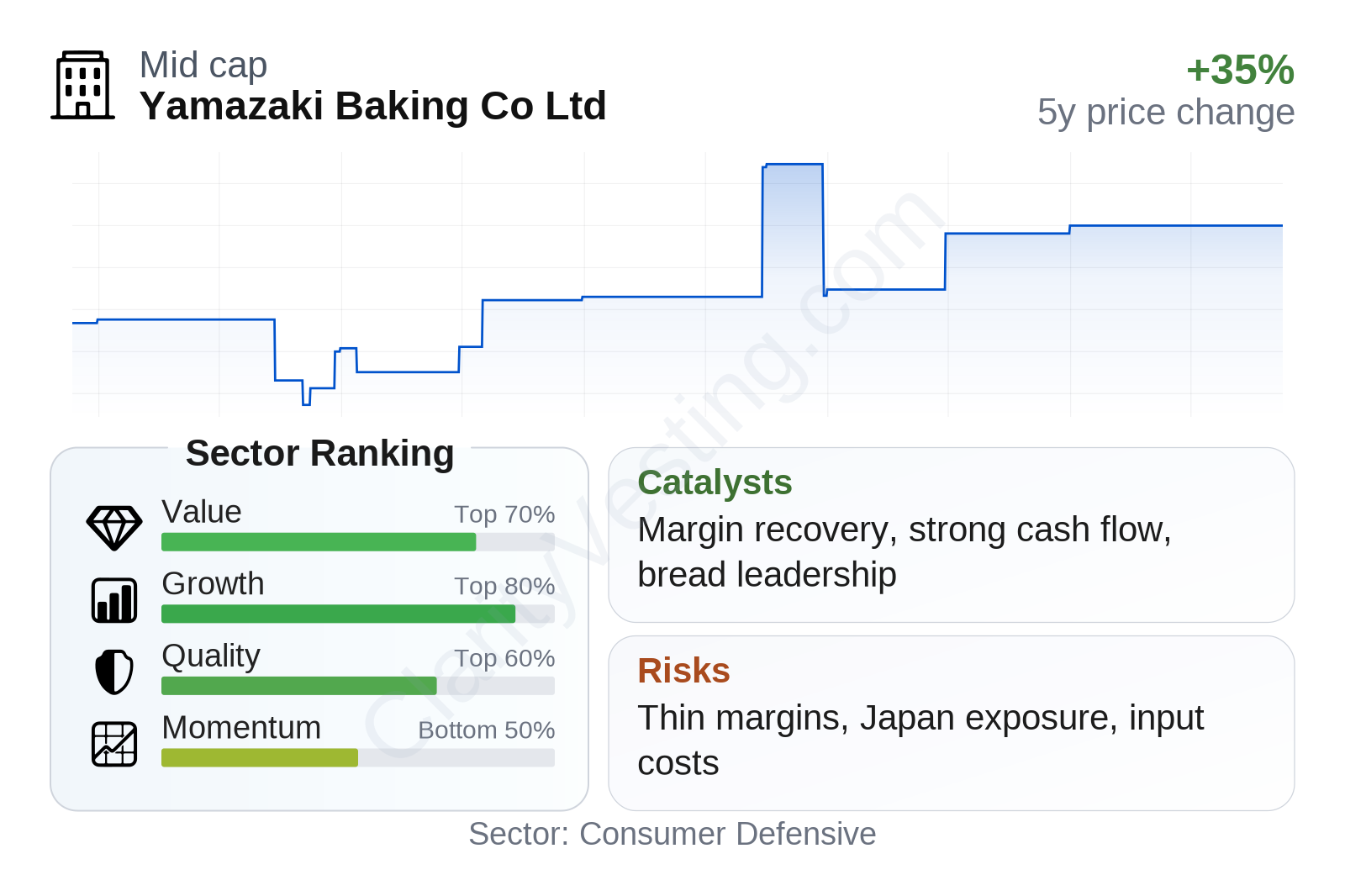
Yamazaki looks like a mid-sized defensive food company with an unusually strong balance-sheet profile. On valuation, its earnings multiple sits below the sector median, while its free-cash-flow yield is clearly stronger than many peers. Growth metrics are one of the brighter areas: revenue growth, free-cash-flow growth, earnings growth, and dividend growth have all outpaced the sector median over the medium term. Quality is more mixed. Debt levels are conservative and interest coverage is very strong, but returns on capital and operating margins remain below the industry’s stronger operators. Market behavior has also been relatively subdued lately, which fits a mature consumer staples business rather than a market favorite.
Growth
Yamazaki operates in a mature sector rather than a fast-expanding one. Packaged foods and bakery products usually grow slowly because demand is tied to population, household spending, and product replacement rather than rapid category creation. That said, mature sectors can still produce solid long-term outcomes when a company has pricing power, efficient manufacturing, and broad distribution. Yamazaki’s recent results suggest that it has been improving on exactly those points.
Recent revenue growth has remained positive in most periods, with annual growth often landing in the mid-single-digit range and occasionally moving higher. For a staple food producer, that is a respectable pace. More importantly, earnings have expanded faster than revenue over five years, which implies that recent growth has not come only from pushing more volume into stores. Margin recovery, product mix, and price adjustments appear to have contributed as well.
Cash generation is another important part of the growth case. Free cash flow is meaningful in absolute terms and has grown at a healthy pace over the last five years. For a food manufacturer, strong cash conversion can support factory upgrades, logistics investments, shareholder distributions, and resilience during periods of raw material volatility. It also reduces dependence on borrowing to fund expansion or operational changes.
The strategy appears sensible for the kind of market Yamazaki serves. In staple foods, future progress usually comes from steady execution: refreshing product lines, optimizing production, adjusting prices when input costs change, and using distribution strength to protect shelf presence. Yamazaki’s scale in Japan gives it room to do this consistently. Its convenience-store and retail relationships are particularly relevant because prepared foods and fresh bakery items benefit from reliable replenishment and dense delivery coverage.
A practical catalyst is the company’s ability to keep lifting profitability from historically low levels. Even modest margin improvement can have an outsized effect on earnings when volumes are large and demand is stable. Another catalyst is the defensive nature of the category itself: bread, snacks, and prepared foods remain recurring purchases even when broader consumer sentiment weakens. If management continues to improve efficiency while maintaining price discipline, growth may remain steadier than the low-growth industry label would suggest.
Risks
This article is for informational purposes only and does not constitute financial advice. Some content is AI-generated. See Disclaimer