Stock Analysis · RLX Technology Inc (RLX)
Overview
RLX Technology Inc is a China-based e-vapor company best known for its RELX branded products. In simple terms, it develops and sells closed-system vaping devices and the refill pods used with them. Its business has historically been centered on the adult smoker market in China, where regulation has reshaped the entire category over the last several years.
The company’s revenue mainly comes from selling e-vapor products through a distribution and retail network. Based on the company’s annual disclosures, the business is overwhelmingly concentrated in one operating category, with limited segment breakdown. The practical revenue mix is therefore best understood as follows:
- E-vapor products in China: approximately 90%+ of revenue. This includes pod-based devices, cartridges, and related products sold under the RELX brand.
- International and other activities: less than 10% of revenue. This can include overseas expansion efforts and smaller ancillary activities, but the company does not present them as a large separate earnings engine.
That concentration matters. RLX is not a diversified consumer products group; it is largely a focused nicotine alternatives business, and its results are tied closely to Chinese demand, regulatory rules, and the company’s ability to maintain distribution in a tightly controlled market.
The broad financial flow also shows a company that went through a sharp contraction after 2021 and then began rebuilding. Revenue and gross profit dropped heavily during the regulatory reset, but operating income and net income remained positive, and sales recovered in 2024 and 2025. Selling expenses remain the largest operating cost after production, which fits a branded consumer product business that relies on retail presence and channel execution.
Key Figures
| Metric | Value | Sector ⓘ |
|---|---|---|
| Date | Nov 24, 2026 | |
| Context | ||
| Sector | Consumer Defensive | |
| Industry | Tobacco | |
| Market Cap ⓘ | $1.89B | |
| Beta ⓘ | 1.11 | |
Value (Cheapness) | ||
| P/E Ratio ⓘ | 14.09 | 18.64 |
| P/B Ratio ⓘ | N/A | 2.51 |
| FCF Yield ⓘ | -0.15% | 6.89% |
| Dividend Yield ⓘ | 6.85% | 2.62% |
| EBIT / EV ⓘ | 15.94% | 7.84% |
| PEG ⓘ | N/A | |
Growth (Business expansion) | ||
| Revenue Growth ⓘ | 15.50% | 3.75% |
| RPS Growth (5Y CAGR) ⓘ | -16.96% | 6.10% |
| EPS Growth (5Y CAGR) ⓘ | 19.68% | -9.28% |
| BVPS Growth (5Y CAGR) ⓘ | 7.29% | 3.01% |
| Margin Growth (5Y Trend) ⓘ | -2.09% | -0.21% |
| FCF Growth (5Y CAGR) ⓘ | -12.23% | 5.40% |
| DPS Growth (5Y CAGR) ⓘ | -24.57% | 5.88% |
Quality (Business durability) | ||
| ROIC (Latest) ⓘ | 5.88% | 11.80% |
| ROA (Latest) ⓘ | 5.22% | 6.20% |
| ROIC (5Y Median) ⓘ | 5.72% | 10.51% |
| ROA (5Y Median) ⓘ | 5.15% | 5.41% |
| Net Debt / EBIT (Latest) ⓘ | -6.12 | 1.86 |
| Net Debt / EBIT (5Y Median) ⓘ | -3.88 | 2.32 |
| Net Debt / EBITDA (Latest) ⓘ | -5.06 | 1.29 |
| Net Debt / Assets ⓘ | -27.52% | 20.02% |
| EBITDA / Interest ⓘ | N/A | 9.62 |
| Operating Margin (Latest) ⓘ | 15.26% | 9.06% |
| Operating Margin (5Y Median) ⓘ | 31.21% | 9.57% |
| Debt to Equity (Latest) ⓘ | 1.78% | 67.45% |
| Profit Margin (Latest) ⓘ | 21.87% | 5.43% |
| Free Cash Flow (Latest) ⓘ | -$2.89M | |
Momentum (Price trend) | ||
| 3Y Return ⓘ | -27.11% | +17.34% |
| 12M Return (excl. last month) ⓘ | -30.85% | +4.43% |
| 6M Return ⓘ | -25.12% | +2.65% |
| Price vs. 200-Day MA ⓘ | -21.18% | +3.67% |
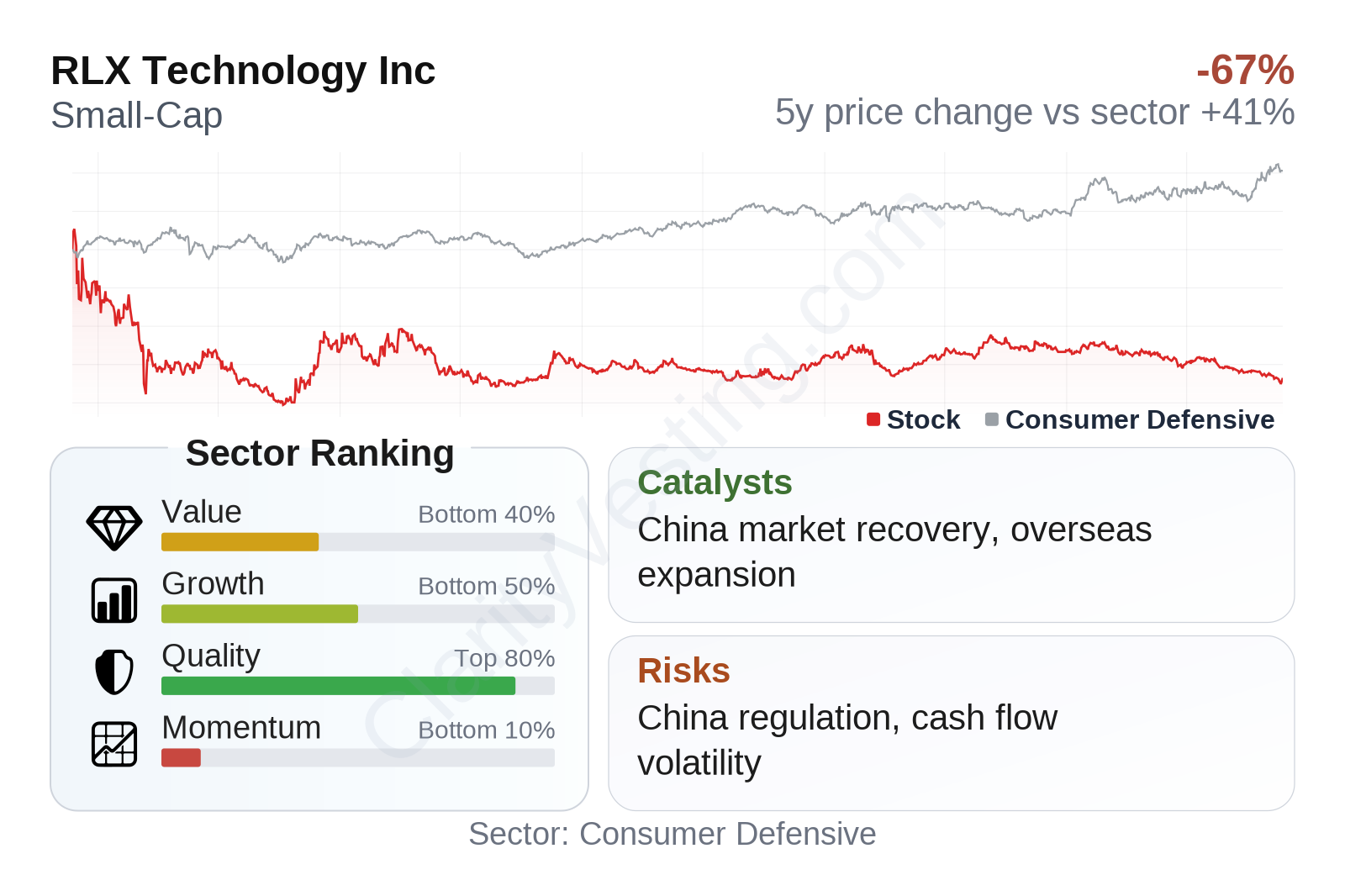
RLX is a small-cap company with a share price history that has been volatile since listing. The stock lost substantial ground from its 2021 peak and has remained weak recently, which explains the very low momentum ranking versus other consumer defensive names.
The table points to a mixed profile. On valuation, the earnings multiple is below the sector median, while EBIT relative to enterprise value looks stronger than average. On quality, the balance sheet stands out: debt is extremely low, net cash is substantial, and margins remain well above the sector median. Growth is less convincing on a multiyear basis because the company is still recovering from a deep regulatory and market reset, even though recent year-over-year revenue growth has been much stronger than the sector median.
One unusual feature is cash generation. Free cash flow has recently weakened enough to turn slightly negative on a trailing basis, even though accounting profitability remains solid. That gap deserves attention because it can affect how durable earnings really are.
Growth
RLX operates in a sector that can still grow over the long term because it sits within the broader shift from traditional cigarettes toward alternative nicotine products. In principle, that is an attractive structural theme. In practice, growth in this industry depends less on pure consumer demand than on regulation, product approvals, and legal distribution channels. For RLX, this means its future is tied not just to brand strength, but also to how China’s regulated e-vapor market develops from here.
The company’s recent trajectory has improved after a severe downturn. Revenue growth turned strongly positive again from late 2023 onward, with several quarters posting very high comparisons as the business recovered from an unusually low base. More recently, the pace has remained positive, though less explosive, which suggests the rebound phase is maturing into a more normal expansion pattern.
That rebound appears consistent with RLX’s strategy. The company has emphasized compliant operations, product development, and channel discipline rather than aggressive expansion at any cost. In a heavily regulated market, that approach makes sense. A company with an established brand, manufacturing know-how, and experience operating under formal licensing rules may be better positioned than smaller or weaker players if the industry consolidates further.
There is also a potential catalyst in overseas expansion, although it is still not large enough to redefine the investment case. If RLX can gradually build business outside mainland China while staying compliant in each market, it could reduce its dependence on one country and one rulebook. Another possible tailwind is continued migration from combustible tobacco to regulated alternatives, provided regulators allow the category to remain commercially viable.
Cash flow, however, is less smooth than the revenue line. Free cash flow improved meaningfully after the earlier slump and reached healthy positive levels, but the latest trailing reading has slipped close to break-even and slightly negative. That does not cancel the recovery, but it shows the business still has moving parts beneath the surface, including working capital swings and the cost of sustaining distribution.
As for recent developments that could matter, the most important ongoing opportunity remains the normalization of China’s legal e-vapor market after the earlier regulatory overhaul. This is not a short burst catalyst; it is more a question of whether RLX can convert compliance and scale into a steadier, more durable recovery over several years.
Risks
This article is for informational purposes only and does not constitute financial advice. Some content is AI-generated. See Disclaimer