Stock Analysis · Frontline Ltd (FRO)
Overview
Frontline Ltd is a shipping company focused on transporting crude oil and refined petroleum products by sea. Its business is straightforward: it owns and operates large tankers, then earns money by chartering those vessels to oil companies, traders, and other cargo customers. Frontline is one of the best-known names in public tanker shipping and has meaningful scale in the global crude tanker market.
The company’s revenue mainly comes from tanker charter income. In practice, that means customers pay Frontline to move cargoes on routes that depend on global oil production, refinery demand, and trade flows. Based on the company’s fleet and disclosures, the business is heavily concentrated in crude tankers, with a smaller contribution from product tankers.
The main revenue sources can be summarized as follows:
- VLCC operations: approximately 45% to 55% of revenue. These very large crude carriers mainly transport long-haul crude oil cargoes between major exporting and importing regions.
- Suezmax operations: approximately 30% to 40% of revenue. These vessels carry crude oil on medium- and long-haul routes and are often used where port or canal constraints make larger ships less practical.
- LR2 / product tanker operations: approximately 10% to 20% of revenue. These ships transport refined products and, in some cases, can also serve parts of the crude and clean-product trades.
For long-term readers, the key point is that Frontline is not a diversified energy company. It is a focused tanker operator whose results are driven mostly by freight rates, fleet utilization, vessel supply, fuel and operating costs, and access to financing. That creates strong upside when tanker markets are tight, but it also means earnings can swing sharply from one cycle to another.
The profit profile has changed dramatically since 2021. Revenue rose strongly through 2022 to 2024, while operating income and net income improved much faster than sales, showing how sensitive tanker shipping can be to stronger day rates. More recently, revenue remained elevated even as earnings moved around with the cycle, which is typical for this industry.
Key Figures
| Metric | Value | Sector ⓘ |
|---|---|---|
| Date | Oct 24, 2026 | |
| Context | ||
| Sector | Energy | |
| Industry | Oil & Gas Midstream | |
| Market Cap ⓘ | $11.20B | |
| Beta ⓘ | 0.18 | |
Value (Cheapness) | ||
| P/E Ratio ⓘ | 7.54 | 15.40 |
| P/B Ratio ⓘ | 3.62 | 1.71 |
| FCF Yield ⓘ | 6.15% | 8.24% |
| Dividend Yield ⓘ | 10.69% | 3.52% |
| EBIT / EV ⓘ | 12.42% | 7.45% |
| PEG ⓘ | 5.58 | |
Growth (Business expansion) | ||
| Revenue Growth ⓘ | 96.50% | 26.85% |
| RPS Growth (5Y CAGR) ⓘ | 23.73% | 6.78% |
| EPS Growth (5Y CAGR) ⓘ | 5.91% | -14.41% |
| BVPS Growth (5Y CAGR) ⓘ | 7.95% | 6.08% |
| Margin Growth (5Y Trend) ⓘ | 24.64% | 0.55% |
| FCF Growth (5Y CAGR) ⓘ | N/A | 2.75% |
| DPS Growth (5Y CAGR) ⓘ | 377.14% | 16.79% |
Quality (Business durability) | ||
| ROIC (Latest) ⓘ | 28.30% | 11.30% |
| ROA (Latest) ⓘ | 25.80% | 6.00% |
| ROIC (5Y Median) ⓘ | 13.34% | 10.35% |
| ROA (5Y Median) ⓘ | 8.19% | 5.46% |
| Net Debt / EBIT (Latest) ⓘ | 1.34 | 1.64 |
| Net Debt / EBIT (5Y Median) ⓘ | 4.14 | 1.82 |
| Net Debt / EBITDA (Latest) ⓘ | 1.12 | 1.08 |
| Net Debt / Assets ⓘ | 36.36% | 17.29% |
| EBITDA / Interest ⓘ | 10.18 | 9.53 |
| Operating Margin (Latest) ⓘ | 58.08% | 16.21% |
| Operating Margin (5Y Median) ⓘ | 39.29% | 20.55% |
| Debt to Equity (Latest) ⓘ | 77.17% | 52.27% |
| Profit Margin (Latest) ⓘ | 54.76% | 8.79% |
| Free Cash Flow (Latest) ⓘ | $688.97M | |
Momentum (Price trend) | ||
| 3Y Return ⓘ | +226.35% | +68.93% |
| 12M Return (excl. last month) ⓘ | +148.68% | +42.90% |
| 6M Return ⓘ | +61.48% | +9.18% |
| Price vs. 200-Day MA ⓘ | +45.49% | +9.87% |
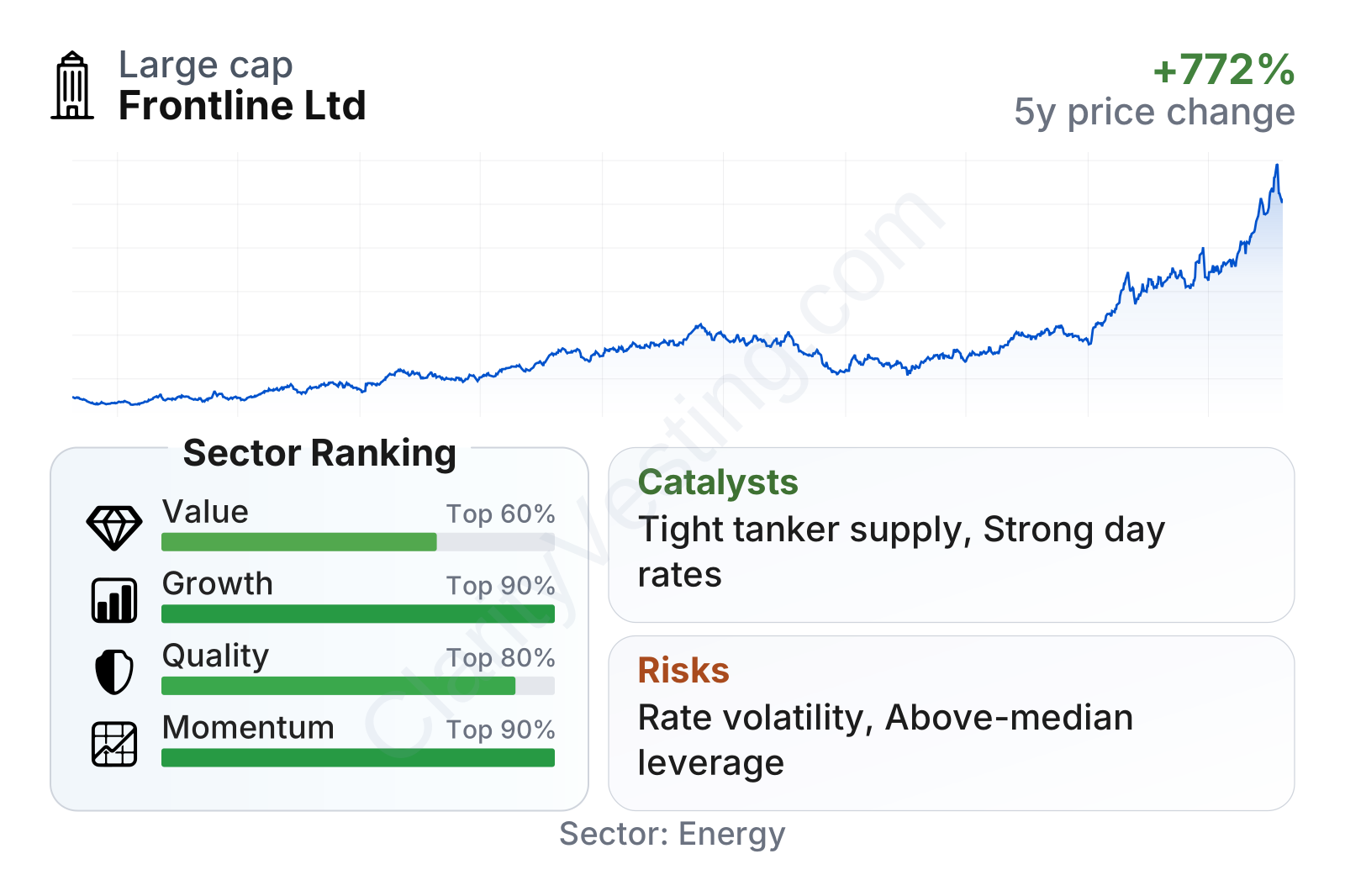
Frontline currently stands out on growth, quality, and recent market performance relative to much of the energy sector. Profitability metrics are especially strong, with margins and returns on capital far above sector medians. Valuation is mixed rather than uniformly cheap: the earnings multiple is low and EBIT relative to enterprise value is strong, but the price-to-book ratio is clearly above the sector norm. The balance sheet is improved versus its own recent history, though leverage still sits above the sector median. The dividend yield is high, but because shipping cash flows are cyclical, that payout level should be viewed as variable rather than fixed.
Growth
Frontline operates in a sector that can grow in periods even without steady underlying volume growth. Tanker shipping is shaped by global oil demand, refinery location changes, sanctions-related rerouting, and “ton-mile” effects, which measure not just how much oil moves, but how far it has to travel. When trade routes lengthen, tanker demand can rise faster than cargo volumes. This has been an important support for the crude tanker market in recent years.
The company’s strategy broadly fits that environment. Frontline has built a large, modern fleet concentrated in the most liquid tanker categories, giving it exposure to the parts of the market where day rates can move quickly. Scale matters here: a bigger fleet improves commercial flexibility, customer reach, and operating efficiency. It also helps the company position vessels across regions as market conditions change.
Revenue growth has been highly volatile, which is normal in shipping, but the recent direction has turned sharply upward again. The latest year-over-year increase is far above the sector median, and the longer five-year revenue-per-share growth record is also well ahead of peers. That does not mean growth will be smooth from here, but it does show Frontline has been participating effectively when market conditions strengthen.
Cash generation has also recovered after a very uneven period. Free cash flow has swung from deeply negative to strongly positive as vessel earnings improved and capital intensity normalized. For a tanker company, that matters because cash flow ultimately supports debt service, dividends, fleet renewal, and resilience during softer markets.
A major catalyst is continued tight vessel supply. New tanker ordering has remained relatively restrained compared with earlier shipping booms, while environmental rules and an aging global fleet can slow effective capacity growth. If oil trade flows stay elongated and fleet supply remains disciplined, charter rates can stay favorable for longer than a typical short spike.
Another meaningful opportunity comes from industry structure. Frontline has been active in fleet and corporate transactions in recent years, and larger operators tend to be better positioned than smaller rivals when customers want reliable counterparties with broad vessel availability. In a fragmented shipping market, that scale can translate into commercial advantage.
Risks
This article is for informational purposes only and does not constitute financial advice. Some content is AI-generated. See Disclaimer


