Stock Analysis · WeRide Inc (WRD)
Overview
WeRide Inc is an autonomous driving company focused on developing and operating driverless mobility and transportation systems. In simple terms, it builds the software, hardware integration, and operating platform needed for vehicles to drive themselves. The company works across several use cases rather than relying on one product only, including robotaxis, robobuses, freight and sanitation vehicles, and autonomous driving solutions for partners.
Its business is still at an early stage, so revenue can shift meaningfully from one year to another depending on project timing, deployments, and partner activity. Based on the company’s public filings, revenue mainly comes from autonomous driving products and services delivered to enterprise and mobility partners, with robotaxi and related autonomous operations becoming a more visible part of the mix as commercialization expands. Precise segment percentages are not consistently disclosed in a way that allows a fully reliable ranking across all current activities, but the broad revenue drivers can be summarized as follows:
- Autonomous driving products and solutions: software, vehicle integration, and system solutions sold or provided to automakers, fleet operators, and commercial partners.
- Autonomous mobility services: robotaxi and robobus operations, including passenger transport services in approved service areas.
- Other commercial deployments: autonomous vehicles for logistics, freight, sanitation, and similar smart transportation use cases.
What stands out most is that WeRide is trying to position itself as a platform company for multiple autonomous vehicle categories, not only a robotaxi operator. That approach can widen its addressable market, but it also makes the business more complex to scale and harder to evaluate than a single-product company.
Over the past few years, revenue has remained relatively modest compared with spending, while operating expenses have been dominated by research and development. In 2025, sales improved sharply versus 2024, suggesting commercialization is moving forward, but losses remained very large because the company continues to invest heavily in technology and deployment.
The financial profile shows a familiar pattern for an autonomous driving developer: revenue is rising from a small base, cost of revenue remains meaningful, and research spending absorbs a very large share of resources. The improvement in 2025 revenue is encouraging, but the business still operates far from break-even.
Key Figures
| Metric | Value | Sector ⓘ |
|---|---|---|
| Date | Nov 21, 2026 | |
| Context | ||
| Sector | Technology | |
| Industry | Software - Application | |
| Market Cap ⓘ | $1.31B | |
| Beta ⓘ | 2.01 | |
Value (Cheapness) | ||
| P/E Ratio ⓘ | N/A | 26.18 |
| FCF Yield ⓘ | -7.10% | 3.74% |
| Dividend Yield ⓘ | N/A | 1.32% |
| EBIT / EV ⓘ | -33.56% | 3.92% |
| PEG ⓘ | N/A | |
Growth (Business expansion) | ||
| Revenue Growth ⓘ | 82.20% | 17.95% |
| RPS Growth (5Y CAGR) ⓘ | 44.26% | 8.44% |
| EPS Growth (5Y CAGR) ⓘ | N/A | -6.06% |
| Margin Growth (5Y Trend) ⓘ | N/A | 0.56% |
| FCF Growth (5Y CAGR) ⓘ | N/A | 9.84% |
| DPS Growth (5Y CAGR) ⓘ | N/A | 7.96% |
Quality (Business durability) | ||
| ROIC (Latest) ⓘ | -28.88% | 10.05% |
| ROIC (5Y Median) ⓘ | N/A | 8.19% |
| Net Debt / EBIT (Latest) ⓘ | N/A | 0.61 |
| Net Debt / EBIT (5Y Median) ⓘ | N/A | 0.48 |
| Net Debt / EBITDA (Latest) ⓘ | N/A | 0.33 |
| Net Debt / Assets ⓘ | -47.18% | 4.20% |
| EBITDA / Interest ⓘ | N/A | 13.53 |
| Operating Margin (Latest) ⓘ | -175.24% | 10.59% |
| Operating Margin (5Y Median) ⓘ | -483.62% | 8.53% |
| Debt to Equity (Latest) ⓘ | 9.63% | 34.34% |
| Profit Margin (Latest) ⓘ | -198.97% | 7.54% |
| Free Cash Flow (Latest) ⓘ | -$92.97M | |
Momentum (Price trend) | ||
| 3Y Return ⓘ | -81.96% | +26.20% |
| 12M Return (excl. last month) ⓘ | -58.06% | +11.65% |
| 6M Return ⓘ | -59.55% | -4.21% |
| Price vs. 200-Day MA ⓘ | -51.94% | -4.34% |
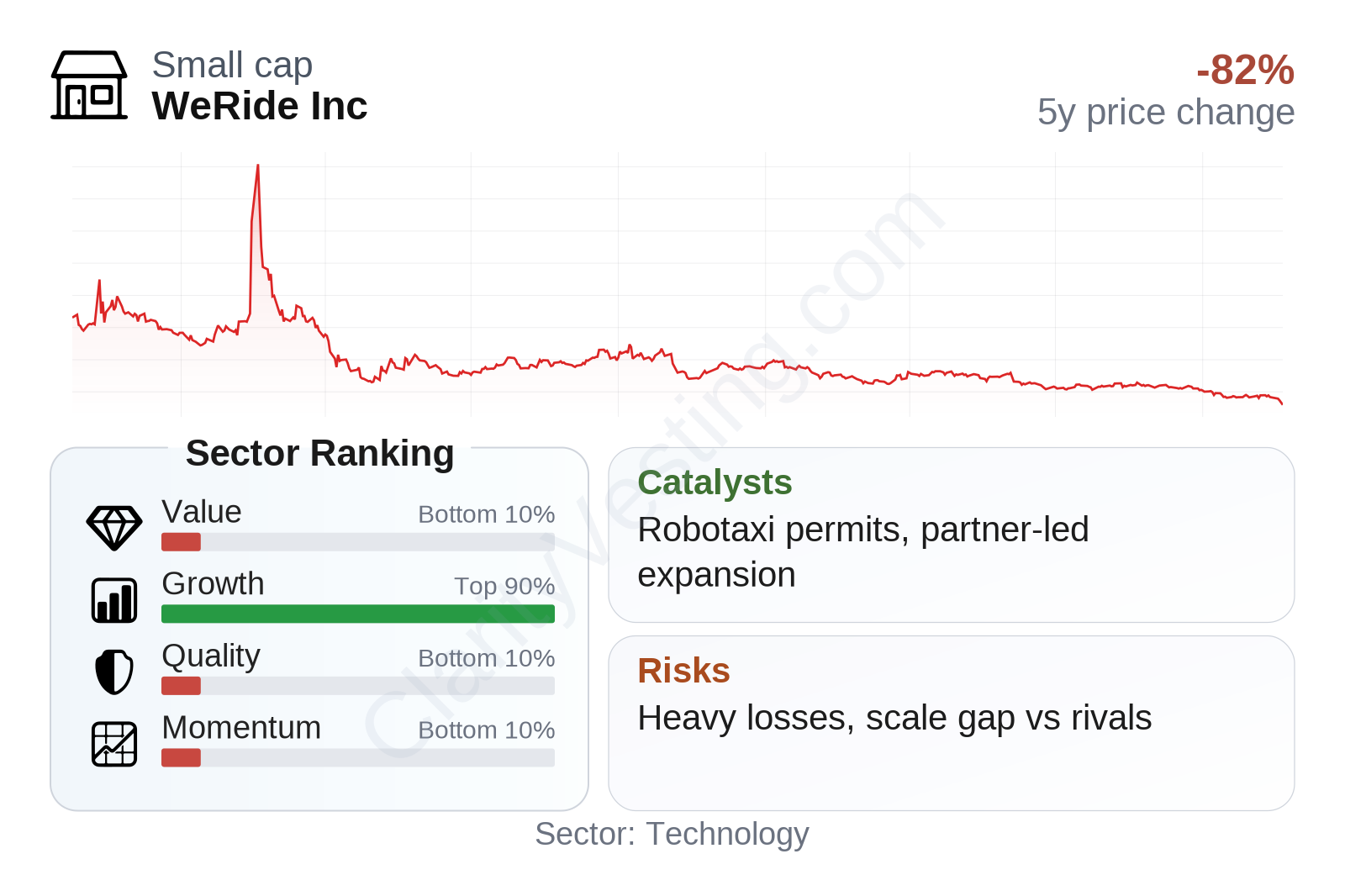
WeRide is a small-cap technology company with unusually high share-price volatility, as reflected by a beta around 2.0. The metrics table points to a business with very strong top-line expansion compared with much of the software sector, but weak profitability, weak cash generation, and weak market momentum. In other words, the company scores well on growth, but poorly on current business quality and traditional valuation measures because earnings and free cash flow are still deeply negative.
The stock’s trading history also shows that public market confidence has been unstable since listing. The share price has fallen sharply from its earlier levels, which often happens when fast-growing but loss-making companies face pressure to prove that commercial progress can eventually turn into durable margins.
Growth
Autonomous driving remains a potentially large long-term market because it touches passenger transport, public transit, logistics, urban services, and automotive software. If the technology continues to improve and regulation gradually opens more operating zones, the addressable market could become very large. That gives WeRide exposure to a sector with real structural growth potential, even if commercialization is still uneven today.
WeRide’s strategy also has a logical industrial angle. Instead of betting only on consumer ride-hailing, it is pursuing several applications where fixed routes, controlled environments, fleet economics, or labor savings may make adoption easier. Robobuses, airport or shuttle services, freight, and sanitation vehicles can in some cases be more practical stepping stones than fully scaled citywide robotaxi networks.
Recent revenue growth has been strong, with year-over-year expansion still far above the sector median even after coming off a very low base. Growth has moderated from an extremely high level at the end of 2025, but the pace remains unusually fast for a listed software-related company. That matters because it suggests WeRide is still converting technical development into commercial activity rather than remaining stuck in a pure research phase.
Another important growth point is international and partnership-led expansion. The company has highlighted collaborations with major automotive and mobility partners, and that model can be powerful in autonomous driving because it reduces the need to build everything alone. Strong partners can help with vehicle platforms, local market access, operations, and regulatory pathways. For a company of WeRide’s size, this is a more realistic route than trying to dominate every layer of the value chain independently.
A meaningful catalyst is the wider industry shift from pilot programs to early commercial deployments in selected cities and use cases. If WeRide continues to secure permits, enlarge operating fleets, and deepen partnerships, revenue could scale faster than in the company’s earlier years. The strongest near-term opportunities appear to be where autonomy can be deployed in repeated, structured environments and where customers care more about service reliability and economics than brand preference.
Risks
This article is for informational purposes only and does not constitute financial advice. Some content is AI-generated. See Disclaimer