Stock Analysis · Yellow Cake plc (YLLXF)
Overview
Yellow Cake plc is a specialized uranium company listed in London and traded in the U.S. over the counter under YLLXF. Its business model is unusually simple: it raises capital, buys physical uranium oxide concentrate from the market and through long-term supply arrangements, and holds that uranium as an investment-like inventory. It is not a miner, does not operate nuclear power plants, and does not process uranium into fuel. Its results are therefore driven mainly by changes in the uranium price and, to a lesser extent, by share issuances, management fees, storage costs, and occasional uranium transactions.
The company was created to give public-market exposure to uranium prices without the operating complexity of running mines. A central part of that model is its long-term agreement with Kazatomprom, the large Kazakh uranium producer, which has historically given Yellow Cake access to meaningful volumes of uranium. The material is stored at licensed facilities in Canada and France.
Yellow Cake’s economic inflows are concentrated in a very small number of sources:
- Changes in the value of held uranium: approximately more than 95% of economic performance over time. This reflects mark-to-market gains or losses as uranium prices rise or fall.
- Net gains or losses on uranium-related transactions: generally a small share of results, depending on whether the company buys, sells, or adjusts holdings during the year.
- Other income: typically minimal, with the business not designed around recurring operating revenue like a traditional industrial company.
Because of this structure, Yellow Cake is better understood as a listed vehicle holding a strategic uranium inventory rather than as a conventional operating business with diversified sales lines. That also means accounting revenue and profit can swing sharply from year to year even when the underlying strategy has not changed much.
The operating picture is consistent with that model: administrative costs are small relative to the value changes in uranium holdings, while reported profit can move from large losses to large gains depending on the uranium price at the reporting date.
Key Figures
| Metric | Value | Sector ⓘ |
|---|---|---|
| Date | Oct 17, 2026 | |
| Context | ||
| Sector | Energy | |
| Industry | Uranium | |
| Market Cap ⓘ | $1.80B | |
| Beta ⓘ | 0.41 | |
Value (Cheapness) | ||
| P/E Ratio ⓘ | 3.93 | 15.44 |
| P/B Ratio ⓘ | 0.84 | 1.73 |
| FCF Yield ⓘ | N/A | 8.20% |
| Dividend Yield ⓘ | N/A | 3.59% |
| EBIT / EV ⓘ | -6.07% | 7.46% |
| PEG ⓘ | N/A | |
Growth (Business expansion) | ||
| Revenue Growth ⓘ | 502.90% | 26.90% |
| RPS Growth (5Y CAGR) ⓘ | N/A | 6.90% |
| EPS Growth (5Y CAGR) ⓘ | N/A | -15.73% |
| BVPS Growth (5Y CAGR) ⓘ | 9.44% | 6.07% |
| Margin Growth (5Y Trend) ⓘ | -111.87% | 0.58% |
| FCF Growth (5Y CAGR) ⓘ | N/A | 1.86% |
| DPS Growth (5Y CAGR) ⓘ | N/A | 16.79% |
Quality (Business durability) | ||
| ROIC (Latest) ⓘ | N/A | 11.40% |
| ROA (Latest) ⓘ | N/A | 6.06% |
| ROIC (5Y Median) ⓘ | N/A | 10.30% |
| ROA (5Y Median) ⓘ | 23.75% | 5.42% |
| Net Debt / EBIT (Latest) ⓘ | N/A | 1.64 |
| Net Debt / EBIT (5Y Median) ⓘ | N/A | 1.83 |
| Net Debt / EBITDA (Latest) ⓘ | N/A | 1.08 |
| Net Debt / Assets ⓘ | N/A | 17.29% |
| EBITDA / Interest ⓘ | N/A | 9.64 |
| Operating Margin (Latest) ⓘ | N/A | 16.27% |
| Operating Margin (5Y Median) ⓘ | 98.35% | 20.39% |
| Debt to Equity (Latest) ⓘ | N/A | 54.76% |
| Profit Margin (Latest) ⓘ | 96.61% | 8.82% |
| Free Cash Flow (Latest) ⓘ | N/A | |
Momentum (Price trend) | ||
| 3Y Return ⓘ | +9.89% | +67.38% |
| 12M Return (excl. last month) ⓘ | +4.88% | +49.19% |
| 6M Return ⓘ | -14.11% | +7.07% |
| Price vs. 200-Day MA ⓘ | -12.19% | +9.56% |
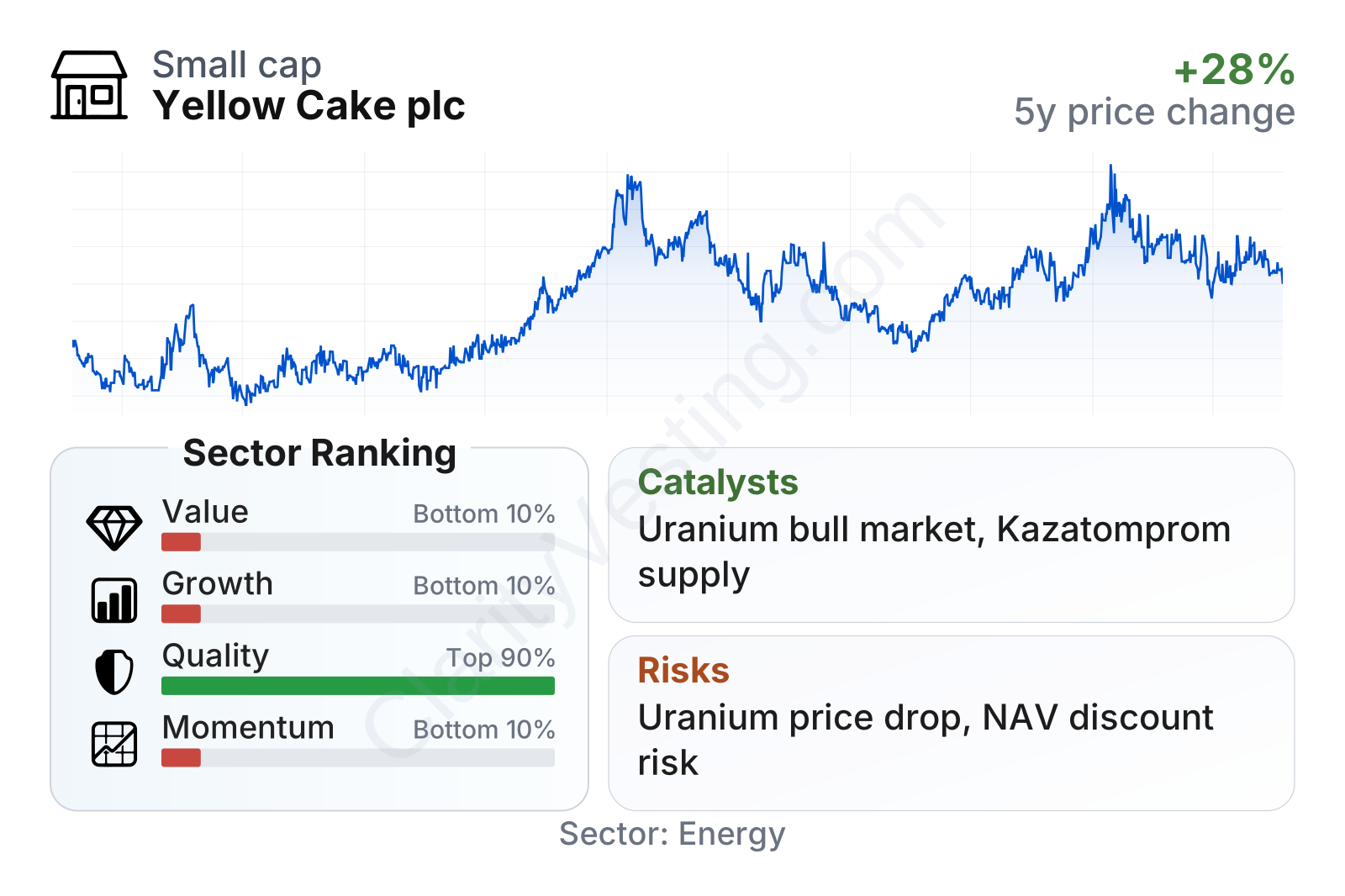
The stock has been volatile over the last several years, with a strong run-up into 2024 followed by a noticeable pullback and then a partial recovery. That pattern fits a company whose value is tied closely to a commodity price rather than to steadily growing operating cash flow.
The metrics table needs to be read with that in mind. On valuation, the shares look inexpensive on simple ratios such as P/E and price-to-book versus the sector median, but those ratios can be distorted by unrealized uranium price movements. On growth, the ranking is weak compared with the broader energy sector because Yellow Cake does not grow like a typical operating company; it grows mostly by adding uranium and benefiting from higher uranium prices. On quality, the balance sheet profile is a real strength: leverage appears low, and profitability can look exceptionally high in years when uranium prices rise sharply. Momentum is weaker, showing that the market has recently been less enthusiastic than for many energy names.
Growth
Yellow Cake operates in a sector that has regained strategic importance. Uranium demand is supported by the global push for reliable low-carbon electricity, life extensions for existing nuclear reactors, new reactor construction in Asia and the Middle East, and rising interest in small modular reactors. Governments in the U.S., Europe, and parts of Asia have also become more focused on fuel security and diversification of nuclear fuel supply chains.
Its strategy makes sense if the long-term uranium market remains tight. Instead of taking mine-development risk, permitting risk, construction risk, and cost-overrun risk, Yellow Cake offers direct exposure to the commodity itself. That is a cleaner structure than many uranium equities, because future performance depends less on whether management can build or restart a mine successfully and more on the direction of uranium prices and access to supply.
A major catalyst is the possibility of a prolonged supply-demand imbalance in uranium. Industry reports from organizations such as the World Nuclear Association have pointed to growing reactor requirements against a supply base that still faces underinvestment, geopolitical frictions, and long lead times for new production. If utilities continue contracting future supply at higher prices, companies holding physical uranium may benefit from a stronger net asset base.
Another meaningful growth lever is Yellow Cake’s relationship with Kazatomprom. Access to additional uranium under long-term arrangements can help the company expand its inventory when financing conditions are favorable. Recent corporate updates have continued to emphasize uranium acquisitions, inventory management, and the company’s role as a physical holder rather than a producer.
Recent industry developments also matter. Nuclear power has been receiving broader policy support as countries try to balance decarbonization, grid stability, and energy security. That does not guarantee higher uranium prices, but it improves the long-term backdrop compared with the period when nuclear demand was widely assumed to be stagnant.
Risks
This article is for informational purposes only and does not constitute financial advice. Some content is AI-generated. See Disclaimer


