Stock Analysis · Yakult Honsha Co Ltd (YKLTY)
Overview
Yakult Honsha is a Japanese consumer health and beverage company best known for its small probiotic dairy drinks sold under the Yakult brand. The business sits at the intersection of everyday beverages, functional foods, and microbiome-related health products. Its core idea is simple: sell products positioned around digestive health and daily wellness, supported by a long-established brand, in-house research, and a distinctive direct-delivery model in several markets.
The company’s revenue is mainly generated by food and beverage products, with pharmaceuticals and other activities representing a much smaller share. Based on recent annual disclosures, the business mix is approximately:
- Food and beverages: about 92% to 94% — mainly Yakult probiotic drinks, dairy beverages, soft drinks, foods, and products sold through retail channels and home delivery.
- Pharmaceuticals: about 5% to 7% — prescription medicines and related healthcare products, mainly in Japan.
- Other activities: about 1% to 2% — smaller businesses such as cosmetics or ancillary operations depending on the reporting year.
Geographically, Japan remains the single most important market, but Yakult also has a meaningful international presence across Asia, Latin America, and selected other regions. That matters because the company is not purely a domestic Japan business: it combines a mature home market with overseas operations where probiotic penetration can still expand.
One notable financial pattern over the last several years is that revenue has continued to rise overall, but the cost base has become heavier. Sales expanded from roughly $2.6 billion in fiscal 2022 to more than $3.2 billion in fiscal 2026, while selling and administrative expenses rose sharply and compressed operating profit in the latest year. In other words, the company still converts a healthy share of sales into net earnings, but recent cost pressure deserves attention.
Key Figures
| Metric | Value | Sector ⓘ |
|---|---|---|
| Date | Nov 21, 2026 | |
| Context | ||
| Sector | Consumer Defensive | |
| Industry | Beverages - Non-Alcoholic | |
| Market Cap ⓘ | $4.96B | |
| Beta ⓘ | 0.05 | |
Value (Cheapness) | ||
| P/E Ratio ⓘ | 18.40 | 18.64 |
| P/B Ratio ⓘ | N/A | 2.51 |
| FCF Yield ⓘ | 6.84% | 7.02% |
| Dividend Yield ⓘ | 1.30% | 2.67% |
| EBIT / EV ⓘ | 6.31% | 7.77% |
| PEG ⓘ | 2.83 | |
Growth (Business expansion) | ||
| Revenue Growth ⓘ | 3.90% | 3.80% |
| RPS Growth (5Y CAGR) ⓘ | 7.92% | 6.10% |
| EPS Growth (5Y CAGR) ⓘ | -34.81% | -10.36% |
| BVPS Growth (5Y CAGR) ⓘ | 8.24% | 3.04% |
| Margin Growth (5Y Trend) ⓘ | -3.58% | -0.21% |
| FCF Growth (5Y CAGR) ⓘ | N/A | 5.25% |
| DPS Growth (5Y CAGR) ⓘ | 22.32% | 5.88% |
Quality (Business durability) | ||
| ROIC (Latest) ⓘ | 4.29% | 11.80% |
| ROA (Latest) ⓘ | 4.90% | 6.20% |
| ROIC (5Y Median) ⓘ | 8.49% | 10.51% |
| ROA (5Y Median) ⓘ | 6.45% | 5.41% |
| Net Debt / EBIT (Latest) ⓘ | -2.09 | 1.88 |
| Net Debt / EBIT (5Y Median) ⓘ | -2.26 | 2.32 |
| Net Debt / EBITDA (Latest) ⓘ | -1.25 | 1.29 |
| Net Debt / Assets ⓘ | -9.91% | 20.02% |
| EBITDA / Interest ⓘ | 38.05 | 9.62 |
| Operating Margin (Latest) ⓘ | 8.76% | 9.06% |
| Operating Margin (5Y Median) ⓘ | 13.68% | 9.57% |
| Debt to Equity (Latest) ⓘ | 18.39% | 67.45% |
| Profit Margin (Latest) ⓘ | 8.83% | 5.43% |
| Free Cash Flow (Latest) ⓘ | $339.60M | |
Momentum (Price trend) | ||
| 3Y Return ⓘ | -12.78% | +17.50% |
| 12M Return (excl. last month) ⓘ | +16.77% | +3.34% |
| 6M Return ⓘ | +4.77% | +2.78% |
| Price vs. 200-Day MA ⓘ | +10.56% | +3.79% |
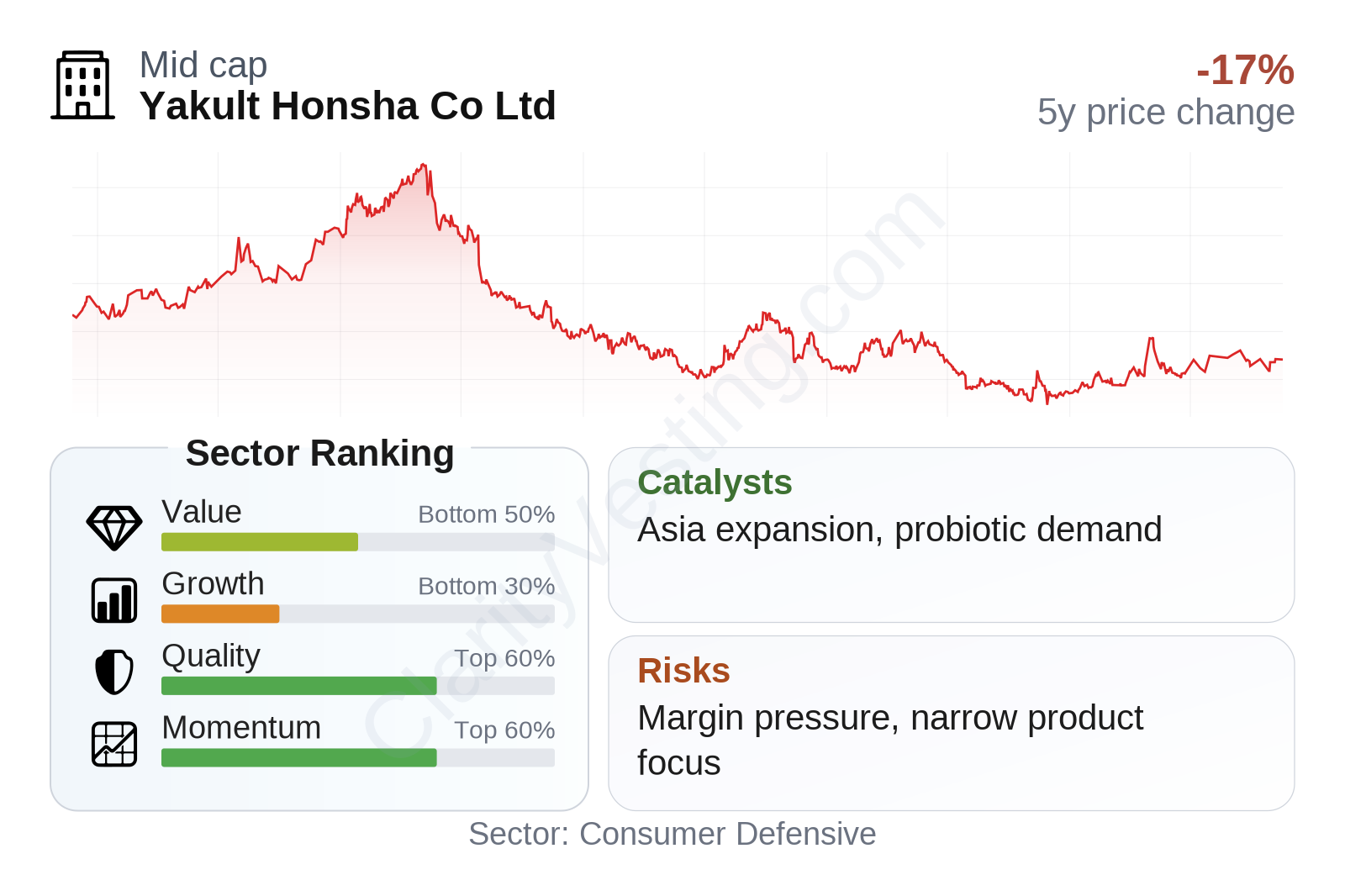
Yakult Honsha is a mid-sized consumer defensive company with unusually low share-price volatility, as shown by its very low beta. On valuation, the stock trades near the sector’s typical earnings multiple rather than at a deep discount. Cash generation is solid, but not clearly superior to peers on a yield basis. The balance sheet is the strongest part of the picture: leverage is low, net cash metrics are favorable, and interest coverage is very comfortable. Growth and profitability, however, look more mixed. Revenue has been steady over time, but earnings growth has been weak on a five-year view, and margins have moved down from earlier highs. Recent share-price momentum has improved from depressed levels, though the longer-term stock performance still trails much of the broader consumer defensive group.
Growth
Yakult operates in a segment that still has long-term room to grow. Consumers globally are spending more attention on digestive health, immunity, functional foods, and daily wellness habits. Probiotic beverages fit neatly into that trend because they are easy to understand and often purchased repeatedly rather than occasionally. This does not make the market limitless, but it does mean Yakult is positioned in a category with better structural support than many standard soft drink lines.
The company’s strategy also has logic for long-term expansion. Yakult’s model combines scientific branding, product consistency, and route-to-market control. In some countries, the company relies not only on supermarkets and convenience stores but also on direct doorstep distribution, which can deepen customer loyalty and help maintain repeat consumption. It also continues to promote the health benefits of its flagship strains and products, which supports pricing power and brand differentiation when consumers are deciding between ordinary dairy drinks and functional beverages.
Recent revenue growth suggests a business that has moved out of a high-growth phase and into a steadier, more moderate rhythm. Growth was very strong in 2022 and early 2023, then faded, briefly turned negative, and has recently returned to low-single-digit expansion. That pattern does not point to a major acceleration yet, but it does indicate stabilization after a softer stretch.
A meaningful catalyst is international expansion, especially in Asian markets where urbanization, rising health awareness, and modern retail penetration can support demand for premium probiotic drinks. Another potential tailwind is product mix: if Yakult can keep shifting demand toward higher-value functional products while preserving brand trust, sales can rise without needing extreme volume growth. The company’s research background also gives it a platform to extend its wellness credentials over time, even if commercialization remains focused on a narrow set of recognizable products.
Recent company disclosures also highlight continued efforts around overseas production, marketing, and distribution capacity. That is important because the clearest long-term opportunity is not reinventing the business, but scaling a proven product system in markets where awareness and household penetration still have room to grow.
Risks
This article is for informational purposes only and does not constitute financial advice. Some content is AI-generated. See Disclaimer