Stock Analysis · Yamato Holdings Co Ltd (YATRY)
Overview
Yamato Holdings is one of Japan’s best-known logistics groups and the parent company behind the Kuroneko Yamato parcel brand. Its core business is collecting, transporting, and delivering parcels and other freight, mainly in Japan. The company also provides contract logistics, supply-chain support, moving-related services, and some international forwarding and cross-border logistics activities. In practice, Yamato is closely tied to day-to-day consumer and business activity: e-commerce parcels, small-business shipping, corporate deliveries, and logistics support for retailers and manufacturers.
The business is still heavily centered on domestic delivery. Based on the company’s recent segment disclosures, revenue is led by the parcel and transport operations, with the rest coming from logistics solutions and smaller adjacent services.
- Retail / parcel delivery and transport: approximately 70% to 80% of revenue. This includes small-parcel delivery for consumers and businesses, TA-Q-BIN services, and related domestic transport operations.
- Corporate logistics and supply-chain solutions: approximately 15% to 25% of revenue. This includes contract logistics, fulfillment, freight handling, warehousing, and business support for enterprise customers.
- Other services: approximately 5% to 10% of revenue. This includes smaller businesses such as moving-related services, financial or administrative support functions, and certain international activities.
That revenue mix matters because it shows Yamato is not a pure high-margin software-like platform. It is a physical network business that depends on route density, labor availability, fuel and transport costs, and pricing discipline. The long-term appeal therefore rests less on rapid disruption and more on whether the company can protect its delivery network, improve productivity, and convert Japan’s steady parcel demand into better profitability.
Over the last several years, revenue has been broadly stable to modestly growing, but the cost structure has become more challenging. Sales rose into fiscal 2026, yet a larger share of revenue has been absorbed by operating costs, leaving much less at the bottom line than a few years ago.
The business model still produces very large revenue for its size, but recent profit conversion has weakened noticeably. That is the central point to keep in mind before looking at growth and valuation.
Key Figures
| Metric | Value | Sector ⓘ |
|---|---|---|
| Date | Nov 21, 2026 | |
| Context | ||
| Sector | Industrials | |
| Industry | Trucking | |
| Market Cap ⓘ | $4.46B | |
| Beta ⓘ | 0.30 | |
Value (Cheapness) | ||
| P/E Ratio ⓘ | 88.00 | 20.77 |
| P/B Ratio ⓘ | N/A | 3.20 |
| FCF Yield ⓘ | 3.01% | 4.98% |
| Dividend Yield ⓘ | 1.03% | 1.88% |
| EBIT / EV ⓘ | 5.44% | 6.24% |
| PEG ⓘ | N/A | |
Growth (Business expansion) | ||
| Revenue Growth ⓘ | -1.30% | 9.60% |
| RPS Growth (5Y CAGR) ⓘ | 6.53% | 7.69% |
| EPS Growth (5Y CAGR) ⓘ | N/A | -5.74% |
| BVPS Growth (5Y CAGR) ⓘ | 2.70% | 6.13% |
| Margin Growth (5Y Trend) ⓘ | -2.79% | 0.72% |
| FCF Growth (5Y CAGR) ⓘ | 34.44% | 11.01% |
| DPS Growth (5Y CAGR) ⓘ | -1.74% | 9.09% |
Quality (Business durability) | ||
| ROIC (Latest) ⓘ | 3.93% | 10.48% |
| ROA (Latest) ⓘ | 0.66% | 5.38% |
| ROIC (5Y Median) ⓘ | 5.86% | 9.45% |
| ROA (5Y Median) ⓘ | 3.35% | 4.91% |
| Net Debt / EBIT (Latest) ⓘ | -0.52 | 2.12 |
| Net Debt / EBIT (5Y Median) ⓘ | -1.77 | 2.28 |
| Net Debt / EBITDA (Latest) ⓘ | -0.19 | 1.42 |
| Net Debt / Assets ⓘ | -1.71% | 19.19% |
| EBITDA / Interest ⓘ | 36.96 | 10.09 |
| Operating Margin (Latest) ⓘ | 2.07% | 10.44% |
| Operating Margin (5Y Median) ⓘ | 3.20% | 10.29% |
| Debt to Equity (Latest) ⓘ | 32.33% | 66.48% |
| Profit Margin (Latest) ⓘ | 0.43% | 6.98% |
| Free Cash Flow (Latest) ⓘ | $134.29M | |
Momentum (Price trend) | ||
| 3Y Return ⓘ | -12.66% | +48.25% |
| 12M Return (excl. last month) ⓘ | -20.02% | +10.31% |
| 6M Return ⓘ | +25.07% | +0.15% |
| Price vs. 200-Day MA ⓘ | +23.36% | 0.00% |
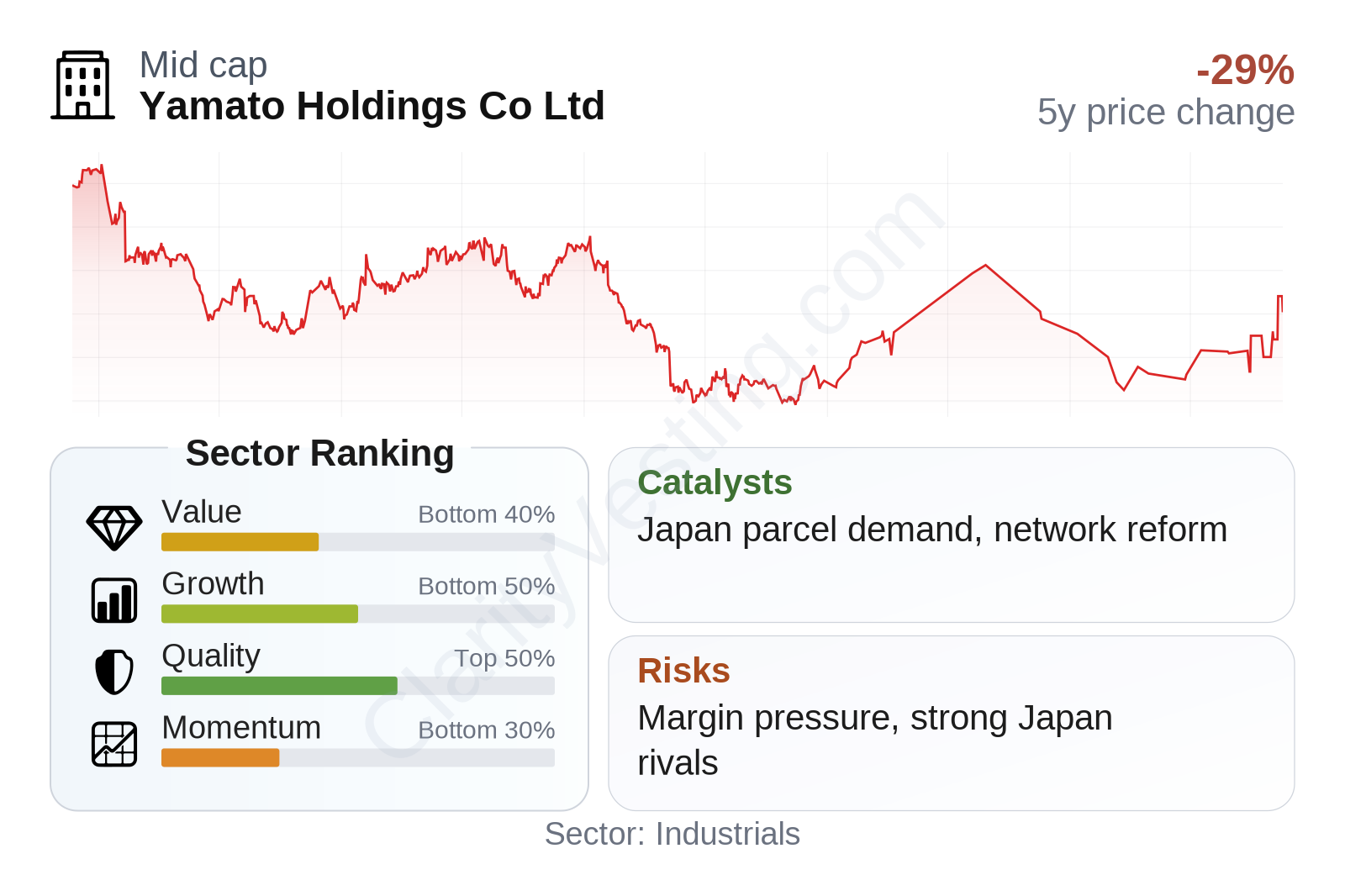
Yamato is a mid-sized logistics company by market value, and its share price behavior has been relatively defensive, with a low beta near 0.3. Even so, that stability has not translated into strong long-term stock performance. The shares remain below levels seen several years ago, although the last six months have shown a meaningful rebound.
The factor picture is mixed. Balance-sheet quality looks solid, helped by low leverage, net cash characteristics, and strong interest coverage. By contrast, value metrics do not look obviously cheap for a company with weak recent earnings, and growth metrics rank in the lower half of the sector. Momentum has improved recently, but the longer three-year record still trails much of the broader industrial universe.
The key takeaway from the current metrics is straightforward: Yamato has financial resilience, but the market is not giving it a low valuation because recent earnings are soft and margins are compressed.
Growth
Yamato operates in a sector with durable long-term demand. Parcel delivery and logistics remain supported by e-commerce, business outsourcing, supply-chain complexity, and the need for reliable last-mile distribution. In Japan specifically, convenience, dense urban populations, and high service expectations support recurring parcel demand. That creates a favorable structural backdrop, even if it does not automatically guarantee profit growth.
The company’s strategy also makes sense in broad terms. Management has been working on network restructuring, better pricing, labor productivity, and expanding logistics services for corporate clients. That is important because mature parcel markets do not usually deliver strong growth from volume alone. The stronger opportunity comes from improving route efficiency, extracting more value from enterprise customers, and using the network for a wider set of services beyond basic home delivery.
Recent revenue trends show a business that went through a period of contraction and then returned to growth. After several quarters of year-over-year declines through 2023 and much of 2024, growth recovered during 2025 and remained positive into early 2026 before softening again. That pattern suggests demand has not disappeared, but it also shows that growth is not yet consistently established.
Cash generation tells a similar story. Free cash flow has been volatile, including a weak phase around fiscal 2025 followed by a recovery. The latest trailing cash flow is positive again, which is encouraging because logistics businesses need regular investment in vehicles, facilities, and systems. Still, the swings imply that Yamato is not currently in a smooth, highly predictable expansion phase.
A practical catalyst for future growth is Japan’s logistics labor challenge. Driver shortages and work-rule changes are forcing shippers to value scale, route optimization, and reliable networks more highly. Large operators such as Yamato can potentially benefit if tighter industry capacity supports better pricing and encourages customers to consolidate volume with established carriers. Another catalyst is deeper penetration into business logistics, where services such as fulfillment and supply-chain support can create stickier client relationships than basic parcel shipping alone.
Recent company updates have also pointed to ongoing operational reform, digitalization, and network optimization. Those initiatives are not instant growth engines, but they are relevant because even modest revenue growth could translate into much stronger earnings if efficiency improves from currently low levels.
Risks
This article is for informational purposes only and does not constitute financial advice. Some content is AI-generated. See Disclaimer