Stock Analysis · Yadea Group Holdings Ltd (YADGF)
Overview
Yadea Group Holdings is a Chinese manufacturer focused on electric two-wheeled vehicles. Its core business is the design, production, and sale of electric scooters, electric bicycles, batteries, chargers, controllers, and related accessories. In simple terms, the company sells low-cost urban transportation powered by electricity, a category that is much more affordable than electric cars and widely used for commuting, delivery work, and short-distance travel.
The business is mainly driven by vehicle sales, while accessories and related parts play a supporting role. Based on the company’s annual reporting structure and business description, revenue is concentrated in a few product lines:
- Electric scooters: the largest source of revenue, typically around 55% to 70% of sales in recent years. This category includes higher-speed electric two-wheelers used for daily commuting.
- Electric bicycles: generally the second-largest source, around 25% to 40% of sales. These products are usually lighter, lower-speed, and aimed at mass-market urban mobility.
- Batteries, chargers, parts, and other accessories: usually a much smaller contribution, often in the low-single-digit to low-teens percentage range depending on the year and reporting scope. This includes replacement components and supporting hardware.
Geographically, Yadea remains heavily tied to China, which is by far the world’s largest market for electric two-wheelers, but it has also been pushing international expansion through Southeast Asia, Latin America, and selected European markets. That matters because the domestic market is already large and competitive, while overseas markets may offer additional room for volume growth and brand building.
Over the last few years, the company has shown that it can scale: revenue rose strongly from 2021 to 2023, dipped in 2024, and then rebounded in 2025. Profitability also recovered after the 2024 slowdown. The broad picture is of a company operating in a large, practical mobility niche rather than a speculative technology theme.
The business mix over time points to a manufacturer with meaningful operating leverage. Revenue and gross profit expanded materially from 2021 through 2023, weakened in 2024, and then improved again in 2025. Research and development spending has also remained substantial, suggesting management is still investing in product upgrades and technology rather than simply defending current volumes.
Key Figures
| Metric | Value | Sector ⓘ |
|---|---|---|
| Date | Oct 24, 2026 | |
| Context | ||
| Sector | Consumer Cyclical | |
| Industry | Auto Manufacturers | |
| Market Cap ⓘ | $3.82B | |
| Beta ⓘ | 0.58 | |
Value (Cheapness) | ||
| P/E Ratio ⓘ | 10.42 | 17.09 |
| P/B Ratio ⓘ | 0.37 | 1.64 |
| FCF Yield ⓘ | 186.68% | 8.68% |
| Dividend Yield ⓘ | 38.08% | 2.70% |
| EBIT / EV ⓘ | N/A | 6.69% |
| PEG ⓘ | N/A | |
Growth (Business expansion) | ||
| Revenue Growth ⓘ | -5.00% | 5.60% |
| RPS Growth (5Y CAGR) ⓘ | 6.33% | 9.01% |
| EPS Growth (5Y CAGR) ⓘ | -9.01% | -17.32% |
| BVPS Growth (5Y CAGR) ⓘ | 22.12% | 5.64% |
| Margin Growth (5Y Trend) ⓘ | 3.73% | -0.17% |
| FCF Growth (5Y CAGR) ⓘ | 23.80% | 5.02% |
| DPS Growth (5Y CAGR) ⓘ | 26.60% | 10.19% |
Quality (Business durability) | ||
| ROIC (Latest) ⓘ | 33.61% | 12.46% |
| ROA (Latest) ⓘ | 15.65% | 5.50% |
| ROIC (5Y Median) ⓘ | 29.21% | 10.68% |
| ROA (5Y Median) ⓘ | 9.74% | 5.44% |
| Net Debt / EBIT (Latest) ⓘ | -0.28 | 2.16 |
| Net Debt / EBIT (5Y Median) ⓘ | -2.23 | 2.29 |
| Net Debt / EBITDA (Latest) ⓘ | -0.23 | 1.48 |
| Net Debt / Assets ⓘ | -4.17% | 21.74% |
| EBITDA / Interest ⓘ | N/A | 9.17 |
| Operating Margin (Latest) ⓘ | 6.63% | 9.08% |
| Operating Margin (5Y Median) ⓘ | 7.87% | 9.56% |
| Debt to Equity (Latest) ⓘ | 75.78% | 75.99% |
| Profit Margin (Latest) ⓘ | 6.83% | 5.30% |
| Free Cash Flow (Latest) ⓘ | $7.13B | |
Momentum (Price trend) | ||
| 3Y Return ⓘ | -23.36% | +19.94% |
| 12M Return (excl. last month) ⓘ | -39.22% | -4.14% |
| 6M Return ⓘ | +7.67% | -3.03% |
| Price vs. 200-Day MA ⓘ | +13.91% | -0.66% |
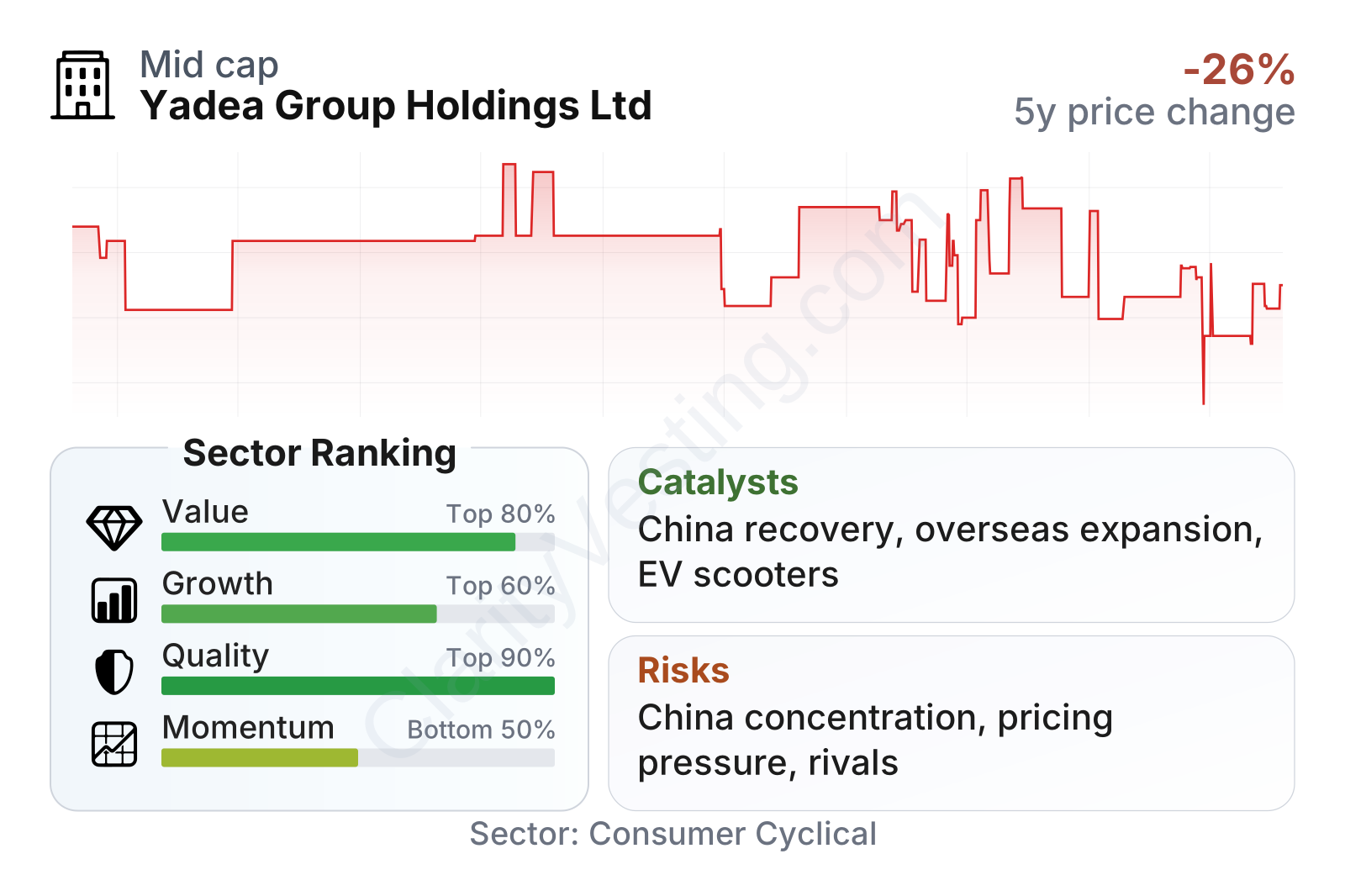
The key metrics paint a mixed but interesting picture. On valuation, Yadea screens cheaper than much of its sector, with a price-to-earnings ratio around 9 and a price-to-book ratio far below the sector median. On quality, the profile is notably strong: returns on capital and assets are well above typical peers, profit margin is solid, and the balance sheet appears conservative with net cash rather than net debt. Growth is more uneven, with recent revenue pressure but stronger multi-year gains in free cash flow, book value, and dividends. The weak area is market performance: the stock has materially lagged the broader sector over one, three, and shorter periods, showing that the market still has doubts despite the company’s profitability and balance-sheet strength.
Growth
Yadea operates in a sector with real long-term demand drivers. Electric two-wheelers are one of the most practical forms of electrified transportation because they are cheaper than cars, easier to recharge, and useful in dense cities where congestion and parking are constant issues. They are also increasingly used in food delivery, courier services, and everyday commuting. That gives the category structural support even when consumer spending weakens for a period.
The company’s strategy broadly makes sense for future growth. Yadea has scale in manufacturing, a wide product lineup, and an established brand in a market where reliability, battery performance, range, and after-sales service matter. It has also invested heavily in research and development, which is important in a category where product differentiation often comes from battery management, durability, design, smart features, and compliance with changing safety standards.
Another growth angle is overseas expansion. China remains the center of the business, but international markets can matter more over time if Yadea succeeds in adapting products to local rules and consumer habits. In many emerging markets, electric two-wheelers can be a low-cost alternative to gasoline motorcycles. In more developed markets, they can benefit from interest in micro-mobility and lower-emission transport.
A further catalyst is regulation. Policies that discourage combustion-powered urban vehicles, support battery swapping or charging ecosystems, or promote cleaner transport can all help demand. Yadea does not need a dramatic technological breakthrough to benefit; it mainly needs continued adoption of electric two-wheelers as a mainstream transport option.
Recent operating trends are encouraging after the 2024 setback. Revenue and earnings recovered in 2025, which suggests the previous decline was not necessarily a permanent break in the business model. If the company can combine domestic recovery with steady international expansion, the current scale could support stronger margin performance over time.
Risks
This article is for informational purposes only and does not constitute financial advice. Some content is AI-generated. See Disclaimer


