Stock Analysis · Xylem Inc (XYL)
Overview
Xylem is a water technology company that sells equipment, software, and services used to move, treat, test, and manage water. Its products are used by cities and utilities, commercial buildings, industrial customers, and residential users. In practical terms, the company helps customers pump water, detect leaks, measure water quality, support wastewater treatment, and modernize water networks with digital tools.
The business became broader after the Evoqua acquisition, which added more exposure to water treatment and service activities. That matters because it made Xylem less dependent on any single product category and increased its presence in recurring aftermarket and service revenue.
Based on recent company reporting, Xylem’s revenue mix is organized mainly through four business segments. Approximate contributions, from largest to smallest, are:
- Water Infrastructure: about 32% to 34% of revenue. This includes transport and treatment solutions for wastewater, pumping systems, and related equipment used mainly by utilities.
- Applied Water: about 28% to 30% of revenue. This segment serves commercial, industrial, and residential markets with pumps, valves, heat exchangers, and pressure boosting systems.
- Measurement & Control Solutions: about 22% to 24% of revenue. This includes smart metering, network software, analytics, and communication technologies used by water utilities.
- Water Solutions & Services: about 14% to 18% of revenue. This area includes outsourced water treatment, dewatering, mobile treatment, and service-heavy offerings, strengthened by Evoqua.
Geographically, Xylem is a global company, with the United States as its largest single market, while Europe and other international regions also represent meaningful shares of sales. Its customer base is relatively diversified, but public-sector water infrastructure remains an important driver.
Xylem’s business profile is appealing for long-term analysis because water infrastructure tends to be essential rather than optional. Municipal systems need maintenance, leakage reduction, quality monitoring, and treatment upgrades regardless of the economic cycle, even if project timing can still move around from year to year.
The business has expanded materially in recent years, with revenue rising from a little above $5 billion in 2021 to just over $9 billion in 2025. Profitability has also improved, suggesting that growth has not come only from volume expansion, but also from a better mix and stronger execution.
Key Figures
| Metric | Value | Sector ⓘ |
|---|---|---|
| Date | Oct 24, 2026 | |
| Context | ||
| Sector | Industrials | |
| Industry | Specialty Industrial Machinery | |
| Market Cap ⓘ | $24.52B | |
| Beta ⓘ | 0.99 | |
Value (Cheapness) | ||
| P/E Ratio ⓘ | 25.00 | 22.29 |
| P/B Ratio ⓘ | 2.47 | 1.98 |
| FCF Yield ⓘ | 3.92% | 6.26% |
| Dividend Yield ⓘ | 1.60% | 1.92% |
| EBIT / EV ⓘ | 4.77% | 4.83% |
| PEG ⓘ | 1.32 | |
Growth (Business expansion) | ||
| Revenue Growth ⓘ | 1.50% | 9.30% |
| RPS Growth (5Y CAGR) ⓘ | 6.65% | 7.76% |
| EPS Growth (5Y CAGR) ⓘ | -2.53% | -13.17% |
| BVPS Growth (5Y CAGR) ⓘ | 26.88% | 6.13% |
| Margin Growth (5Y Trend) ⓘ | 2.09% | 0.74% |
| FCF Growth (5Y CAGR) ⓘ | 28.86% | 10.79% |
| DPS Growth (5Y CAGR) ⓘ | 9.41% | 9.41% |
Quality (Business durability) | ||
| ROIC (Latest) ⓘ | 7.77% | 10.75% |
| ROA (Latest) ⓘ | 5.83% | 5.41% |
| ROIC (5Y Median) ⓘ | 7.38% | 9.37% |
| ROA (5Y Median) ⓘ | 5.06% | 4.95% |
| Net Debt / EBIT (Latest) ⓘ | 1.37 | 2.04 |
| Net Debt / EBIT (5Y Median) ⓘ | 1.86 | 2.27 |
| Net Debt / EBITDA (Latest) ⓘ | 0.96 | 1.39 |
| Net Debt / Assets ⓘ | 10.26% | 19.27% |
| EBITDA / Interest ⓘ | 80.91 | 9.58 |
| Operating Margin (Latest) ⓘ | 14.20% | 10.49% |
| Operating Margin (5Y Median) ⓘ | 11.30% | 10.30% |
| Debt to Equity (Latest) ⓘ | 29.32% | 64.82% |
| Profit Margin (Latest) ⓘ | 11.15% | 6.67% |
| Free Cash Flow (Latest) ⓘ | $960.00M | |
Momentum (Price trend) | ||
| 3Y Return ⓘ | +20.23% | +67.77% |
| 12M Return (excl. last month) ⓘ | -23.89% | +12.05% |
| 6M Return ⓘ | -10.67% | 0.00% |
| Price vs. 200-Day MA ⓘ | -9.92% | +0.67% |
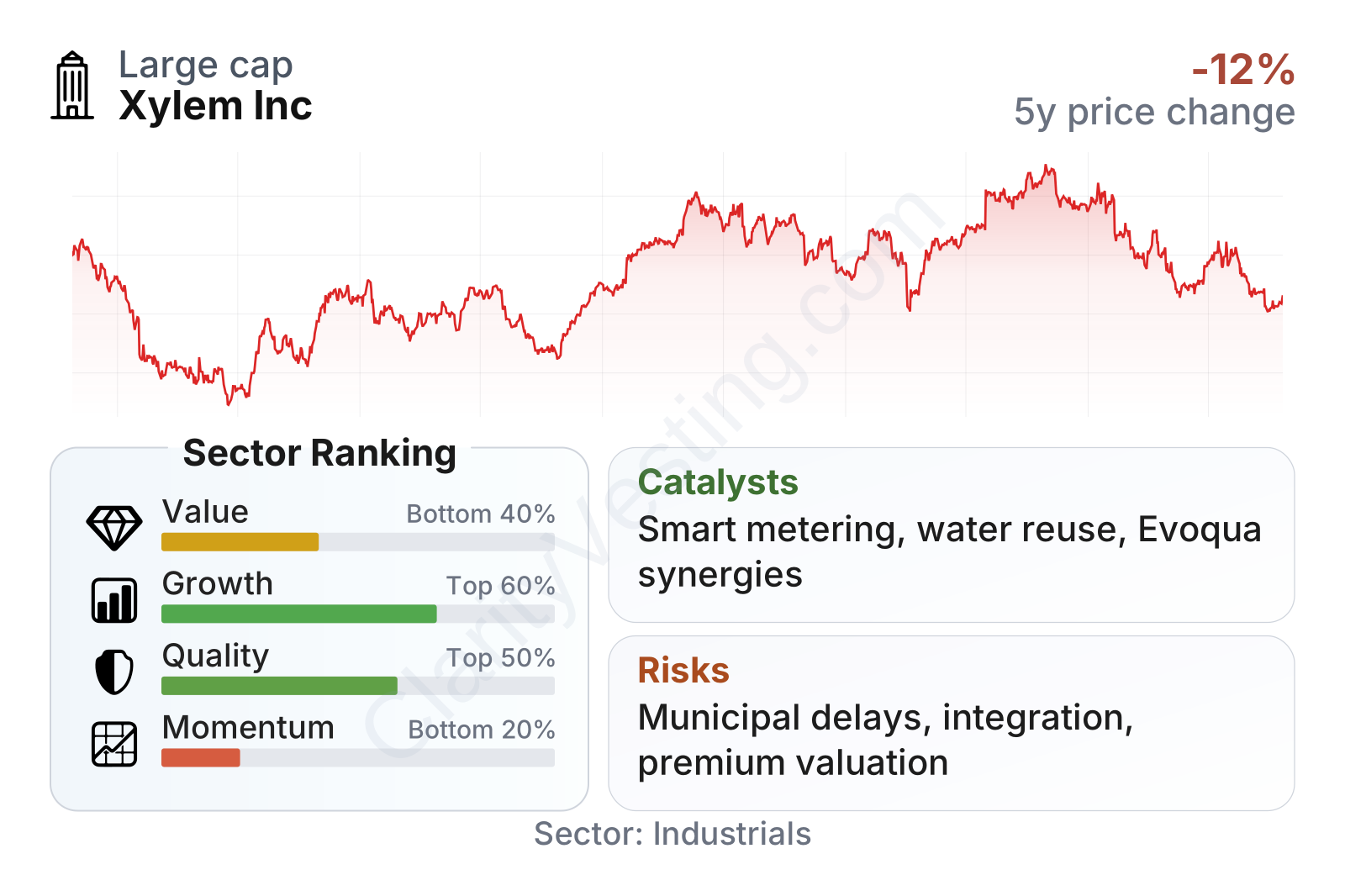
Xylem sits in the upper half of its sector on growth and quality, but not on valuation or recent stock momentum. That combination describes a company with solid operating traits and balance-sheet discipline, yet a market multiple that still assumes a fairly healthy long-term outlook. The current profile also shows a large industrial business with market volatility close to the broader market rather than an unusually defensive trading pattern.
Operationally, the quality profile stands out more than the value profile. Margins are ahead of the sector median, leverage is lower than many peers, and cash generation has improved meaningfully over time. On the other hand, revenue growth has recently cooled versus the sector median, and the stock’s recent performance has lagged much of the industrial universe.
Growth
Xylem operates in a sector with durable long-term demand. Water systems in many regions are old, underfunded, and inefficient. Utilities are under pressure to reduce water loss, improve resilience against floods and droughts, meet tighter regulatory standards, and digitize networks. Those needs create a long runway for investment in monitoring, treatment, pumping, and analytics.
The company’s strategy broadly fits those trends. Xylem is not only selling hardware; it is increasingly combining physical equipment with software, analytics, and services. That is important because digital tools can deepen customer relationships and create recurring revenue opportunities beyond one-time equipment sales. The Evoqua combination also strengthened exposure to treatment and service lines that can be less cyclical than large equipment orders.
Growth has been uneven rather than linear. Revenue accelerated sharply during 2023 and parts of 2024, helped by acquisition effects and solid end-market demand, then slowed to low single-digit year-over-year expansion more recently. That deceleration does not necessarily break the long-term case, but it does show that Xylem is now moving past the easiest post-acquisition comparisons.
Cash generation has been a constructive signal. Trailing free cash flow climbed from roughly $250 million in early 2022 to nearly $1.0 billion more recently. For a long-term business assessment, this matters because rising free cash flow gives the company more flexibility for debt reduction, acquisitions, dividends, share repurchases, and internal investment.
Several catalysts could support future expansion. One is continued replacement of aging water infrastructure in North America and Europe. Another is utility adoption of smart meters, leak detection, and network intelligence tools, where Xylem has an established position. A third is the opportunity to extract cost and cross-selling benefits from the Evoqua integration. Public updates from the company have emphasized productivity actions, digital demand, and a healthy project backdrop in water-related spending, all of which point to a strategy aligned with long-term industry needs.
Risks
This article is for informational purposes only and does not constitute financial advice. Some content is AI-generated. See Disclaimer


