Stock Analysis · Xinyi Glass Holdings Limited (XYIGF)
Overview
Xinyi Glass Holdings Limited is a Hong Kong-listed industrial glass manufacturer with operations spanning float glass, automobile glass, and architectural glass. The company manufactures basic flat glass, processes it into higher-value products, and sells into construction and automotive end markets. Its business is tied to real assets rather than software or consumer brands: buildings need glass for windows, facades, and energy efficiency, while vehicles need windshields, sidelites, and other glazing products.
The group’s revenue mix is generally led by float glass, followed by automobile glass and then architectural glass, based on its recent annual reporting structure. Exact shares can move from year to year with glass prices and construction demand, but the broad breakdown has recently been around:
- Float glass: approximately 55% to 65% of revenue. This is the base flat glass used in construction, furniture, solar-related applications, and further processing.
- Automobile glass: approximately 20% to 30% of revenue. This includes original equipment and aftermarket products such as windshields and other vehicle glazing.
- Architectural glass: approximately 10% to 20% of revenue. This segment includes processed glass products for buildings, such as insulated, tempered, and coated glass.
Xinyi Glass operates a vertically integrated model, which matters in a commodity-leaning industry. By producing raw float glass and then processing part of it into higher-value end products, the company can spread fixed costs, control supply, and preserve margins better than smaller or more specialized peers when market conditions are uneven.
Over the last several years, the business has remained profitable, but earnings have been much more cyclical than revenue alone might suggest. Sales have fallen from the 2021 peak, while profit margins have compressed meaningfully as weaker construction demand and lower glass pricing reduced operating leverage.
The profit structure shows how sensitive the company is to pricing and utilization. Revenue has declined materially from the 2021 high, while operating income and net income fell by even more, a sign that fixed-cost absorption is an important driver. At the same time, interest expense has come down again, which helps cushion weaker operating conditions.
Key Figures
| Metric | Value | Sector ⓘ |
|---|---|---|
| Date | Oct 24, 2026 | |
| Context | ||
| Sector | Basic Materials | |
| Industry | Building Materials | |
| Market Cap ⓘ | $5.53B | |
| Beta ⓘ | 1.22 | |
Value (Cheapness) | ||
| P/E Ratio ⓘ | 13.89 | 16.92 |
| P/B Ratio ⓘ | 0.13 | 1.66 |
| FCF Yield ⓘ | 93.01% | 5.83% |
| Dividend Yield ⓘ | 25.68% | 2.07% |
| EBIT / EV ⓘ | N/A | 6.38% |
| PEG ⓘ | N/A | |
Growth (Business expansion) | ||
| Revenue Growth ⓘ | -3.10% | 11.25% |
| RPS Growth (5Y CAGR) ⓘ | -8.85% | 4.49% |
| EPS Growth (5Y CAGR) ⓘ | -12.86% | -15.24% |
| BVPS Growth (5Y CAGR) ⓘ | 2.45% | 5.49% |
| Margin Growth (5Y Trend) ⓘ | -32.88% | -1.54% |
| FCF Growth (5Y CAGR) ⓘ | -13.84% | 0.37% |
| DPS Growth (5Y CAGR) ⓘ | -47.39% | 5.91% |
Quality (Business durability) | ||
| ROIC (Latest) ⓘ | N/A | 9.59% |
| ROA (Latest) ⓘ | 8.63% | 4.92% |
| ROIC (5Y Median) ⓘ | 12.21% | 7.91% |
| ROA (5Y Median) ⓘ | 9.43% | 3.92% |
| Net Debt / EBIT (Latest) ⓘ | 0.39 | 1.36 |
| Net Debt / EBIT (5Y Median) ⓘ | 0.85 | 1.69 |
| Net Debt / EBITDA (Latest) ⓘ | 0.24 | 0.93 |
| Net Debt / Assets ⓘ | 3.89% | 13.69% |
| EBITDA / Interest ⓘ | 61.75 | 12.38 |
| Operating Margin (Latest) ⓘ | 14.02% | 13.24% |
| Operating Margin (5Y Median) ⓘ | 24.75% | 11.82% |
| Debt to Equity (Latest) ⓘ | 10.46% | 40.30% |
| Profit Margin (Latest) ⓘ | 14.13% | 6.38% |
| Free Cash Flow (Latest) ⓘ | $5.15B | |
Momentum (Price trend) | ||
| 3Y Return ⓘ | +33.80% | +73.47% |
| 12M Return (excl. last month) ⓘ | +18.35% | +27.59% |
| 6M Return ⓘ | -0.14% | -4.02% |
| Price vs. 200-Day MA ⓘ | +22.80% | -0.65% |
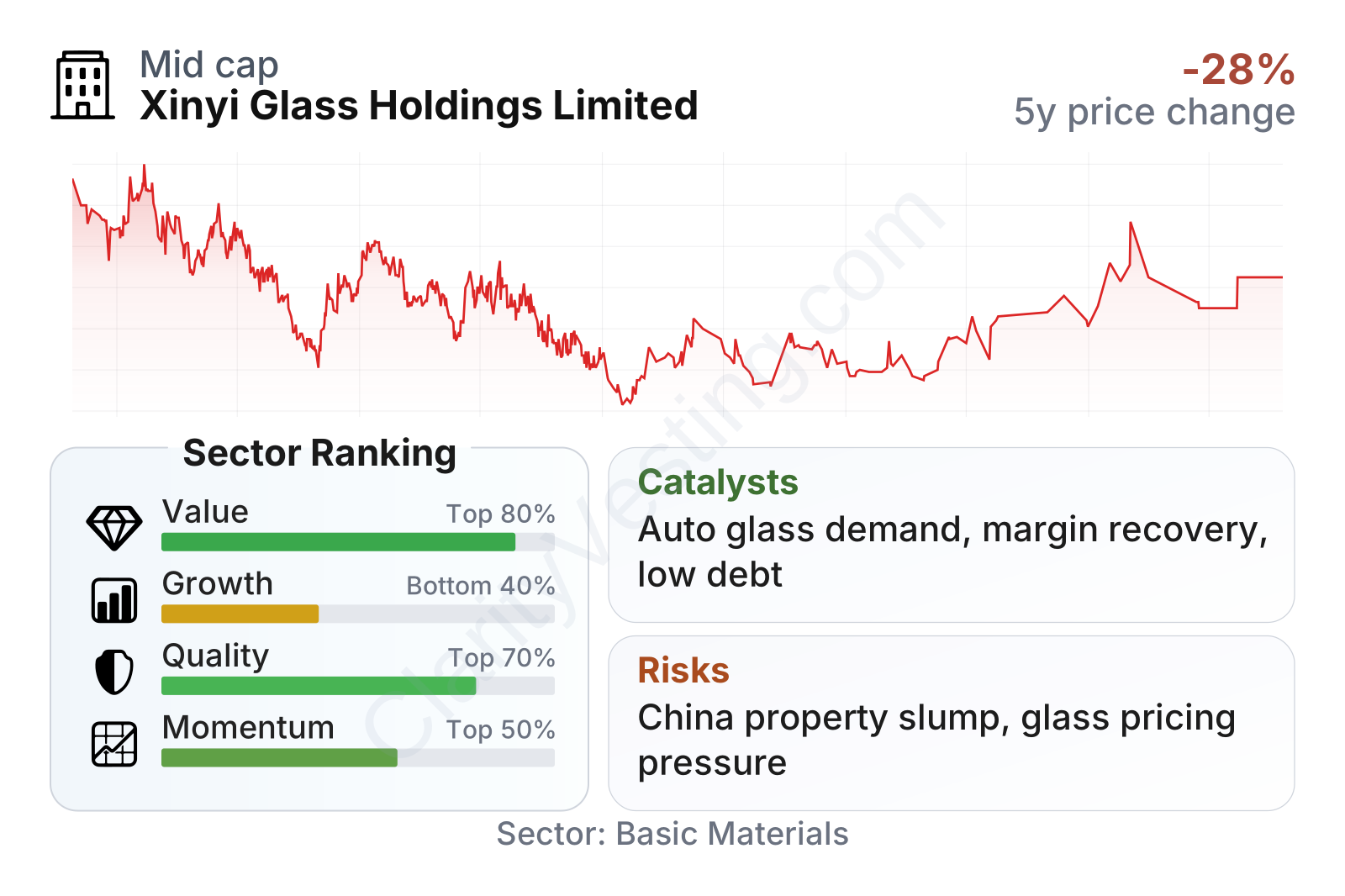
The overall picture is mixed but easy to frame. On valuation measures, Xinyi Glass screens cheaply versus much of the building materials sector, with a lower earnings multiple and an unusually low price-to-book ratio. Income metrics also stand out, with a very high trailing dividend yield and strong free cash flow generation relative to its market value, though readers should remember these can fluctuate sharply in cyclical industries.
Quality is one of the company’s stronger areas. Profit margin, return on assets, balance-sheet leverage, and interest coverage all look healthier than sector medians. Debt appears modest, with debt-to-equity near 10% and net debt very low relative to earnings, giving the company more resilience than heavily leveraged materials producers.
The weak point is growth. Recent revenue has been slightly negative year over year, and the five-year trend in revenue per share, free cash flow, and dividends has been soft. Margins have also come down significantly from their earlier highs. Price performance has been uneven as well: the shares have recovered from their lows, but longer-term returns still trail many peers in the broader materials universe.
Growth
Xinyi Glass operates in sectors with long-term relevance, but not all of its end markets are growing at the same speed. Auto glass has a steadier structural demand base because vehicles continuously need replacement glass and automakers increasingly use higher-specification glazing for safety, insulation, and comfort. Architectural and float glass are more cyclical because they depend more heavily on construction activity, especially in China.
The company’s strategy still makes industrial sense for future growth. Vertical integration, large-scale production, and a broad product range allow it to serve multiple demand channels with the same manufacturing network. That matters in a business where energy cost, plant utilization, and procurement efficiency can make a large difference to profitability.
A meaningful catalyst is the possibility of margin recovery rather than just sales growth. If construction demand stabilizes, glass prices improve, or energy costs remain under control, earnings can recover faster than revenue because the company already has substantial installed capacity. In other words, Xinyi Glass does not need dramatic volume growth to improve results; even a moderate normalization in pricing and utilization could have a visible impact.
Another support factor is financial strength. The company’s low leverage gives it room to continue operating through downturns, maintain production assets, and remain flexible on capital allocation. In cyclical industries, balance-sheet capacity is often part of the growth case because weaker competitors may cut investment or lose ground during softer markets.
Recent company reporting has also pointed to ongoing demand in automotive glass and international markets, even while Chinese property-related demand remains under pressure. That does not remove cyclicality, but it does suggest the business is not dependent on a single product or one narrow customer base.
Risks
This article is for informational purposes only and does not constitute financial advice. Some content is AI-generated. See Disclaimer


