Stock Analysis · XPO Logistics Inc (XPO)
Overview
XPO Logistics Inc is a transportation company focused on moving freight across North America. After several divestitures and separations over the past few years, XPO is now much more concentrated than it used to be. Its core business is less-than-truckload, usually called LTL, a service where multiple customers’ shipments are combined in one truck network. This model is important because it rewards scale, dense terminal networks, and disciplined pricing.
The company mainly serves shippers that need regional, national, and cross-border freight transportation. XPO operates a large network of service centers, tractors, trailers, and technology systems that help route freight, manage capacity, and improve on-time service. In simple terms, it is a logistics infrastructure business that earns money by picking up freight, moving it efficiently through its network, and delivering it with predictable service levels.
Based on recent company reporting, revenue is now overwhelmingly tied to LTL operations, with a very small remainder from other activities. The business mix is therefore much simpler than it was a few years ago.
- Less-than-truckload transportation: approximately 95% to 99% of revenue. This includes linehaul transportation, local pickup and delivery, fuel surcharge revenue, and accessorial services such as special handling.
- Other / corporate and residual activities: approximately 1% to 5% of revenue. This is limited and not a major earnings driver in the current company structure.
One useful pattern in the business economics is that revenue has risen gradually over the last several years while operating income improved more sharply by 2024 and stayed relatively strong afterward. That suggests pricing, network efficiency, and cost control have mattered at least as much as volume growth.
Key Figures
| Metric | Value | Sector ⓘ |
|---|---|---|
| Date | Oct 03, 2026 | |
| Context | ||
| Sector | Industrials | |
| Industry | Trucking | |
| Market Cap ⓘ | $20.77B | |
| Beta ⓘ | 1.70 | |
Value (Cheapness) | ||
| P/E Ratio ⓘ | 52.01 | 22.45 |
| P/B Ratio ⓘ | 10.67 | 1.98 |
| FCF Yield ⓘ | 2.83% | 6.31% |
| Dividend Yield ⓘ | N/A | 1.96% |
| EBIT / EV ⓘ | 3.09% | 4.81% |
| PEG ⓘ | 1.72 | |
Growth (Business expansion) | ||
| Revenue Growth ⓘ | 13.20% | 9.10% |
| RPS Growth (5Y CAGR) ⓘ | 2.06% | 7.75% |
| EPS Growth (5Y CAGR) ⓘ | -17.17% | -13.59% |
| BVPS Growth (5Y CAGR) ⓘ | 11.88% | 6.22% |
| Margin Growth (5Y Trend) ⓘ | 3.63% | 0.72% |
| FCF Growth (5Y CAGR) ⓘ | -7.63% | 10.98% |
| DPS Growth (5Y CAGR) ⓘ | 246.11% | 9.48% |
Quality (Business durability) | ||
| ROIC (Latest) ⓘ | 10.84% | 10.92% |
| ROA (Latest) ⓘ | 4.89% | 5.41% |
| ROIC (5Y Median) ⓘ | 7.70% | 9.21% |
| ROA (5Y Median) ⓘ | 3.97% | 4.94% |
| Net Debt / EBIT (Latest) ⓘ | 4.88 | 2.07 |
| Net Debt / EBIT (5Y Median) ⓘ | 7.09 | 2.28 |
| Net Debt / EBITDA (Latest) ⓘ | 2.86 | 1.43 |
| Net Debt / Assets ⓘ | 44.29% | 19.27% |
| EBITDA / Interest ⓘ | 6.10 | 9.53 |
| Operating Margin (Latest) ⓘ | 8.82% | 10.50% |
| Operating Margin (5Y Median) ⓘ | 5.53% | 10.27% |
| Debt to Equity (Latest) ⓘ | 203.26% | 65.48% |
| Profit Margin (Latest) ⓘ | 4.71% | 6.62% |
| Free Cash Flow (Latest) ⓘ | $588.00M | |
Momentum (Price trend) | ||
| 3Y Return ⓘ | +135.71% | +58.56% |
| 12M Return (excl. last month) ⓘ | +49.57% | +15.63% |
| 6M Return ⓘ | -9.55% | +4.19% |
| Price vs. 200-Day MA ⓘ | -8.47% | +0.93% |
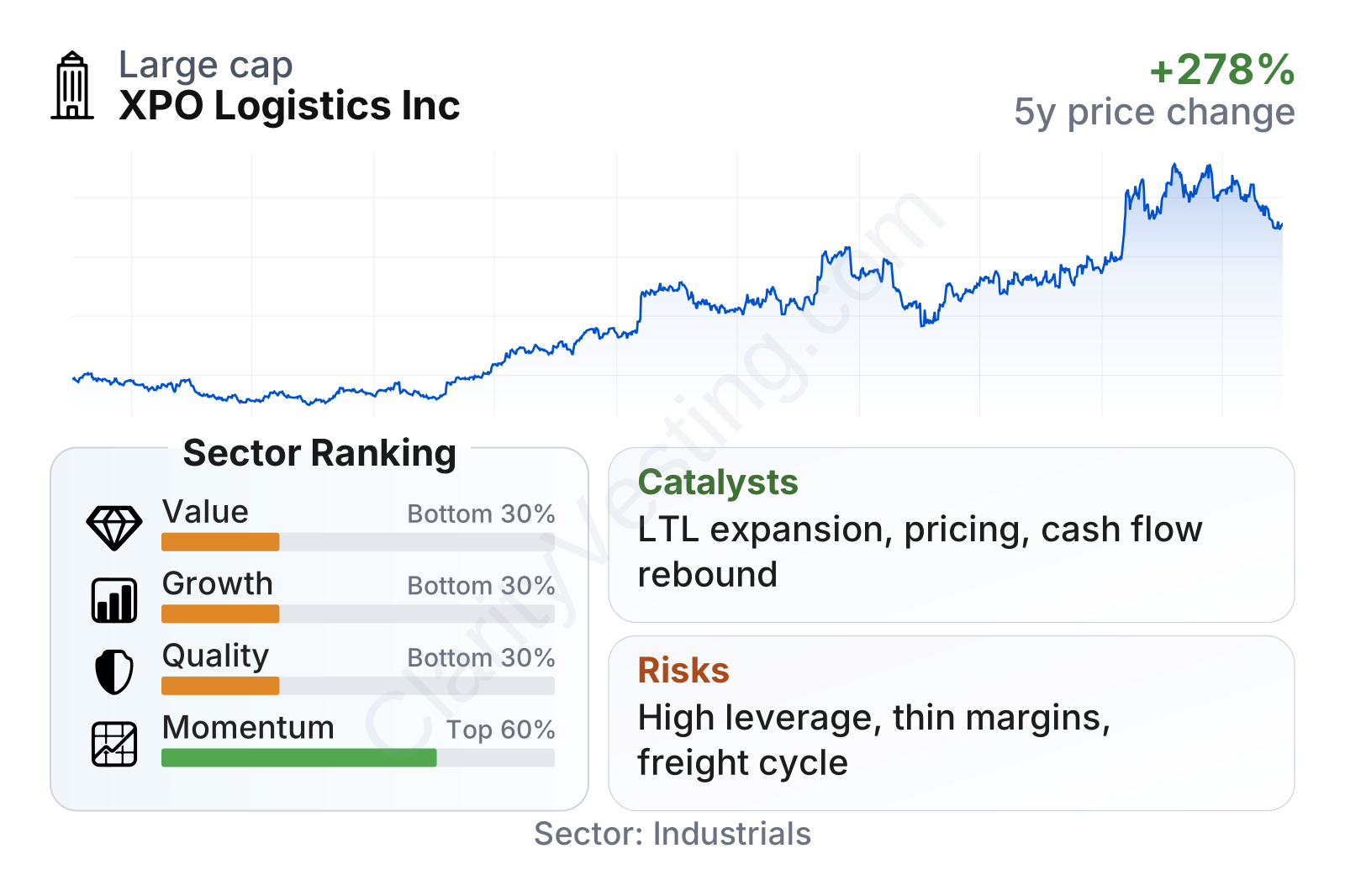
XPO is now a large transportation company with a market value above $20 billion, but the stock still trades with more volatility than the average industrial name, as reflected by its beta above 1.7. The broader profile in the metrics table is mixed. Price momentum has been stronger than much of the sector over multi-year periods, but value, quality, and growth rankings sit in the lower part of the sector. That combination usually means the market is paying up for expected future improvement rather than for already superior balance-sheet strength or profitability.
Growth
XPO operates in a sector that should remain essential over the long run. Freight transportation does not disappear, and LTL in particular benefits from structural demand tied to manufacturing, retail replenishment, e-commerce restocking, and supply-chain diversification. The sector is cyclical, but the long-term need for efficient regional freight networks is durable. Barriers to entry are also meaningful because building a dense LTL network requires terminals, equipment, labor, and customer relationships.
XPO’s strategy is centered on becoming a higher-quality pure-play LTL operator. That focus makes strategic sense because LTL is one of the more attractive areas in trucking: scale can improve route density, pricing discipline can lift margins, and service quality can support customer retention. Management has emphasized network expansion, dock-door additions, yield improvement, and technology-driven productivity. If executed well, these initiatives can produce growth without requiring revenue to rise dramatically every quarter.
Recent revenue growth has turned positive again and appears to be accelerating into 2026, moving above the sector median. That matters because it suggests XPO is not only relying on cost cuts. A stronger top-line trend can indicate better shipment demand, pricing gains, or both. Even so, the longer five-year growth record remains less impressive than the recent rebound, so the current phase still needs to prove it can last through a full freight cycle.
Cash generation also looks better than it did during the weak period. Free cash flow moved from deeply negative territory in 2024 back to clearly positive levels, reaching roughly the mid-hundreds of millions of dollars on a trailing basis. For a capital-intensive transport business, that recovery is a meaningful signal because it gives the company more room to fund terminals, equipment, and debt reduction without depending as heavily on outside financing.
A notable growth catalyst is the ongoing modernization and expansion of XPO’s LTL network. New service centers, additional doors, and technology tools can raise throughput and improve service reliability. Another catalyst is any broader industrial and freight-market recovery in North America, since tighter capacity and firmer demand can support better pricing. Public company updates have also highlighted productivity initiatives and network optimization, which could expand earnings even if industry growth stays moderate rather than spectacular.
Risks
This article is for informational purposes only and does not constitute financial advice. Some content is AI-generated. See Disclaimer


