Stock Analysis · Xinjiang Goldwind Science & Technology Co. Ltd (XNJJY)
Overview
Xinjiang Goldwind Science & Technology Co. Ltd is a Chinese wind power company. It designs and manufactures wind turbines, develops and sells wind farms, and provides wind power services such as operation, maintenance, and asset management. In simple terms, it earns money both from selling the equipment used to produce wind electricity and from participating in the operation of wind power projects.
For long-term readers, the most important point is that Goldwind is tied to the global buildout of renewable energy, especially onshore and offshore wind in China and selected international markets. The business is industrial, capital-intensive, and exposed to project cycles, but it also benefits from long-term demand for low-carbon electricity and grid expansion.
Based on recent annual reporting and company disclosures, its revenue mix is centered on turbine-related activities, with smaller contributions from wind farm development and services. Approximate revenue sources are as follows:
- Wind turbine generators and components: about 70% to 80% of revenue. This includes the sale of wind turbine units, major components, and related equipment.
- Wind power services: about 10% to 20% of revenue. This usually includes operation and maintenance, spare parts, technical services, and digital or asset-management support for wind farms.
- Wind farm development and power project activities: about 10% to 15% of revenue. This area can include project construction, transfer of wind farm stakes, and electricity-related project income, depending on the year.
- Other activities: a small share of revenue, typically linked to ancillary businesses.
The business model matters because turbine manufacturing brings scale, while services can provide steadier recurring income. That combination is usually more attractive than relying only on one-off equipment sales, although manufacturing still dominates the group.
The profit structure shows a business with large production costs and relatively thin margins, which is common in wind equipment. Revenue has expanded over the last several years, and profits recovered in 2025 after a weaker period, but a high share of sales still gets absorbed by manufacturing and project-related expenses. Research and development has also risen, which fits a company competing on turbine technology and larger models.
Key Figures
| Metric | Value | Sector ⓘ |
|---|---|---|
| Date | Nov 21, 2026 | |
| Context | ||
| Sector | Real Estate | |
| Industry | REIT - Residential | |
| Market Cap ⓘ | $5.28B | |
| Beta ⓘ | 0.99 | |
Value (Cheapness) | ||
| P/E Ratio ⓘ | 12.39 | 17.59 |
| P/B Ratio ⓘ | N/A | 1.58 |
| FCF Yield ⓘ | -15.87% | 5.76% |
| Dividend Yield ⓘ | 1.62% | 4.81% |
| EBIT / EV ⓘ | 6.26% | 4.97% |
| PEG ⓘ | N/A | |
Growth (Business expansion) | ||
| Revenue Growth ⓘ | -11.50% | 5.70% |
| RPS Growth (5Y CAGR) ⓘ | 9.44% | 5.96% |
| EPS Growth (5Y CAGR) ⓘ | 22.94% | -3.46% |
| BVPS Growth (5Y CAGR) ⓘ | 1.96% | 0.32% |
| Margin Growth (5Y Trend) ⓘ | -0.65% | -0.65% |
| FCF Growth (5Y CAGR) ⓘ | -8.93% | 5.08% |
| DPS Growth (5Y CAGR) ⓘ | -7.43% | 5.00% |
Quality (Business durability) | ||
| ROIC (Latest) ⓘ | 5.32% | 5.13% |
| ROE (Latest) ⓘ | 7.44% | 7.64% |
| ROA (Latest) ⓘ | 1.80% | 3.05% |
| ROIC (5Y Median) ⓘ | N/A | 4.20% |
| ROE (5Y Median) ⓘ | 6.37% | 6.03% |
| ROA (5Y Median) ⓘ | 1.72% | 2.41% |
| Net Debt / EBIT (Latest) ⓘ | 4.46 | 7.59 |
| Net Debt / EBIT (5Y Median) ⓘ | N/A | 8.34 |
| Net Debt / EBITDA (Latest) ⓘ | 4.46 | 5.43 |
| Net Debt / Assets ⓘ | 13.18% | 38.21% |
| EBITDA / Interest ⓘ | 5.46 | 4.20 |
| Operating Margin (Latest) ⓘ | 6.70% | 34.59% |
| Operating Margin (5Y Median) ⓘ | 7.56% | 37.64% |
| Debt to Equity (Latest) ⓘ | N/A | 90.32% |
| Profit Margin (Latest) ⓘ | 6.84% | 20.10% |
| Free Cash Flow (Latest) ⓘ | -$838.11M | |
Momentum (Price trend) | ||
| 3Y Return ⓘ | +9.92% | +27.88% |
| 12M Return (excl. last month) ⓘ | +6.86% | +1.16% |
| 6M Return ⓘ | +6.86% | -3.06% |
| Price vs. 200-Day MA ⓘ | +4.72% | -0.73% |
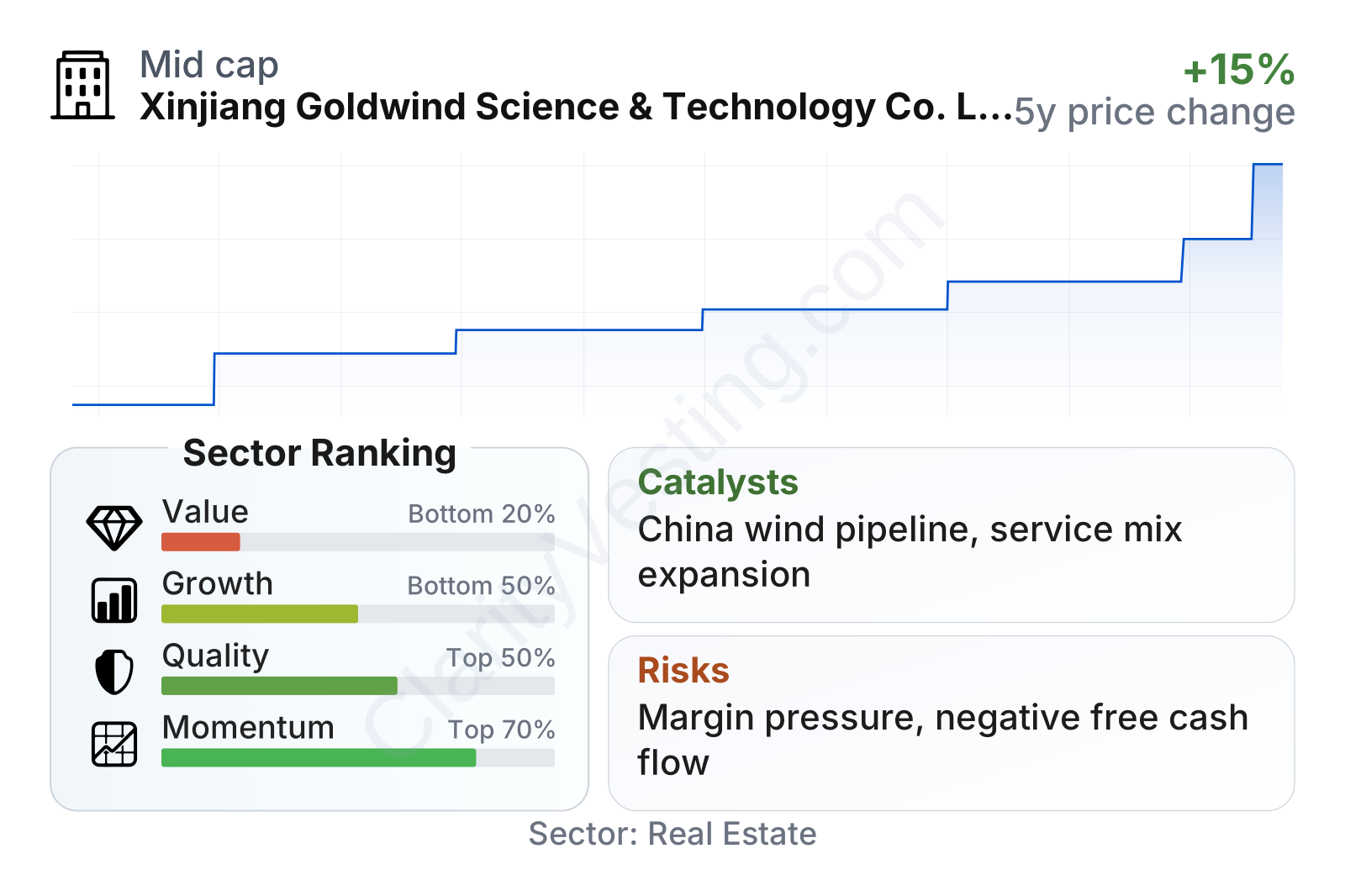
Goldwind appears to be a mid-sized listed company with a stock that has moved more steadily than many cyclical industrial names. Recent market performance has been better than the median in its comparison group over shorter periods, but the longer three-year return has been more modest.
On valuation, the earnings multiple sits below the sector median, which suggests the market is not assigning a premium to the company. That discount likely reflects pressure on cash generation and margins rather than a lack of scale. Profitability is mixed: returns on capital are around the sector median or slightly better, while operating and net margins are clearly lower. Balance-sheet leverage looks more controlled than many peers, with lower net debt relative to earnings and stronger interest coverage. The weak spot is cash flow, with free cash flow remaining negative, which is a meaningful constraint for any capital-intensive manufacturer.
Growth
Goldwind operates in a sector with a strong long-term backdrop. Wind energy remains one of the core technologies in the global energy transition, and China is the world’s largest wind market. Growth drivers include decarbonization policies, rising electricity demand, replacement of older turbines with larger and more efficient models, offshore wind development, and ongoing grid investment. Those trends support long-duration demand even if individual years remain volatile.
The company’s strategy broadly makes sense for future growth. Goldwind combines turbine manufacturing with service capabilities and project development, which gives it several ways to participate in wind deployment. It also continues to invest in research and development, an important point in a market where larger turbines, reliability, and cost per kilowatt-hour can determine competitiveness. If it can keep technology current while expanding service revenue, the business mix could gradually become more resilient.
Revenue per share has trended upward over the last five years despite some year-to-year swings. That is a useful sign because it shows the business has been able to expand its commercial base over time rather than simply relying on financial engineering. The latest year stands out as a stronger step-up, pointing to improved activity after a softer stretch.
The dividend record is less convincing than the revenue trend. Distributions have moved down from earlier levels and only stabilized recently. For a long-term assessment, that suggests management has been preserving financial flexibility rather than signaling a strong income profile. In this case, the dividend looks secondary to operating recovery and cash generation.
A notable catalyst is Goldwind’s exposure to China’s very large domestic wind pipeline, where local scale, manufacturing footprint, and established customer relationships matter. Another catalyst is international expansion, especially in markets looking for lower-cost wind solutions. If turbine deliveries keep rising and higher-value services become a larger share of revenue, earnings quality could improve. Recent company updates have also pointed to continued product development in larger turbine platforms, which is important because customers increasingly focus on efficiency and total project economics, not just headline equipment prices.
Risks
This article is for informational purposes only and does not constitute financial advice. Some content is AI-generated. See Disclaimer


