Stock Analysis · ENN Energy Holdings Limited (XNGSF)
Overview
ENN Energy Holdings Limited is a large Chinese gas utility and clean-energy services company. Its traditional core business is city gas distribution: it buys natural gas from upstream suppliers, transports it through its own networks, and sells it to residential, commercial, and industrial users. Over time, the company has expanded beyond basic gas delivery into integrated energy services, including cooling, heating, steam, and other on-site energy solutions for industrial parks, commercial buildings, and public facilities.
The business is mainly organized around a few recurring revenue streams. Based on the company’s annual reporting in recent years, the mix is broadly as follows:
- Retail gas sales and wholesale-related gas activities: approximately 75% to 85% of revenue. This is the largest source and includes natural gas sold to residential, industrial, and commercial customers connected to ENN’s city gas projects.
- Integrated energy and value-added services: approximately 10% to 20% of revenue. This includes customized energy solutions such as heating, cooling, steam, and energy management services for commercial and industrial users.
- Connection and installation services: approximately 5% to 10% of revenue. This covers fees related to connecting new customers and installing gas infrastructure.
That mix matters because it shows both the strength and the limitation of the company. ENN still depends mostly on gas distribution, a stable but regulated and lower-growth utility activity, while newer energy services are intended to lift growth and deepen customer relationships.
Over the last several years, revenue stayed above roughly RMB 100 billion, but profitability moved around more than revenue. Gross profit remained sizable, yet net income and operating profit have not followed a straight upward line. This suggests ENN’s business is resilient on volume, but margins are influenced by input costs, pricing conditions, and the pace of expansion in newer activities.
The revenue base has remained large and fairly steady, but earnings conversion has been less consistent. Cost of revenue absorbs most sales, which is normal for a gas distributor, and recent years show that even modest pressure on margins can noticeably affect net profit.
Key Figures
| Metric | Value | Sector ⓘ |
|---|---|---|
| Date | Oct 17, 2026 | |
| Context | ||
| Sector | Utilities | |
| Industry | Utilities - Regulated Gas | |
| Market Cap ⓘ | $9.56B | |
| Beta ⓘ | 0.66 | |
Value (Cheapness) | ||
| P/E Ratio ⓘ | 10.89 | 17.28 |
| P/B Ratio ⓘ | 0.14 | 1.51 |
| FCF Yield ⓘ | 78.53% | 0.65% |
| Dividend Yield ⓘ | 32.22% | 3.77% |
| EBIT / EV ⓘ | N/A | 5.01% |
| PEG ⓘ | 3.74 | |
Growth (Business expansion) | ||
| Revenue Growth ⓘ | 2.40% | 6.10% |
| RPS Growth (5Y CAGR) ⓘ | 4.47% | 3.87% |
| EPS Growth (5Y CAGR) ⓘ | -13.05% | -11.30% |
| BVPS Growth (5Y CAGR) ⓘ | 4.29% | 4.23% |
| Margin Growth (5Y Trend) ⓘ | -3.10% | 3.57% |
| FCF Growth (5Y CAGR) ⓘ | -4.80% | -8.84% |
| DPS Growth (5Y CAGR) ⓘ | 2.43% | 4.84% |
Quality (Business durability) | ||
| ROIC (Latest) ⓘ | N/A | 6.53% |
| ROA (Latest) ⓘ | 11.38% | 3.20% |
| ROIC (5Y Median) ⓘ | 12.28% | 5.95% |
| ROA (5Y Median) ⓘ | 5.80% | 2.75% |
| Net Debt / EBIT (Latest) ⓘ | N/A | 7.13 |
| Net Debt / EBIT (5Y Median) ⓘ | 1.36 | 7.23 |
| Net Debt / EBITDA (Latest) ⓘ | 0.51 | 4.31 |
| Net Debt / Assets ⓘ | 10.18% | 38.42% |
| EBITDA / Interest ⓘ | 22.86 | 4.58 |
| Operating Margin (Latest) ⓘ | N/A | 20.83% |
| Operating Margin (5Y Median) ⓘ | 8.70% | 20.08% |
| Debt to Equity (Latest) ⓘ | 40.58% | 137.69% |
| Profit Margin (Latest) ⓘ | 5.42% | 11.37% |
| Free Cash Flow (Latest) ⓘ | $7.51B | |
Momentum (Price trend) | ||
| 3Y Return ⓘ | -12.90% | +52.37% |
| 12M Return (excl. last month) ⓘ | -22.85% | +8.84% |
| 6M Return ⓘ | -26.94% | -3.95% |
| Price vs. 200-Day MA ⓘ | -12.45% | -0.79% |
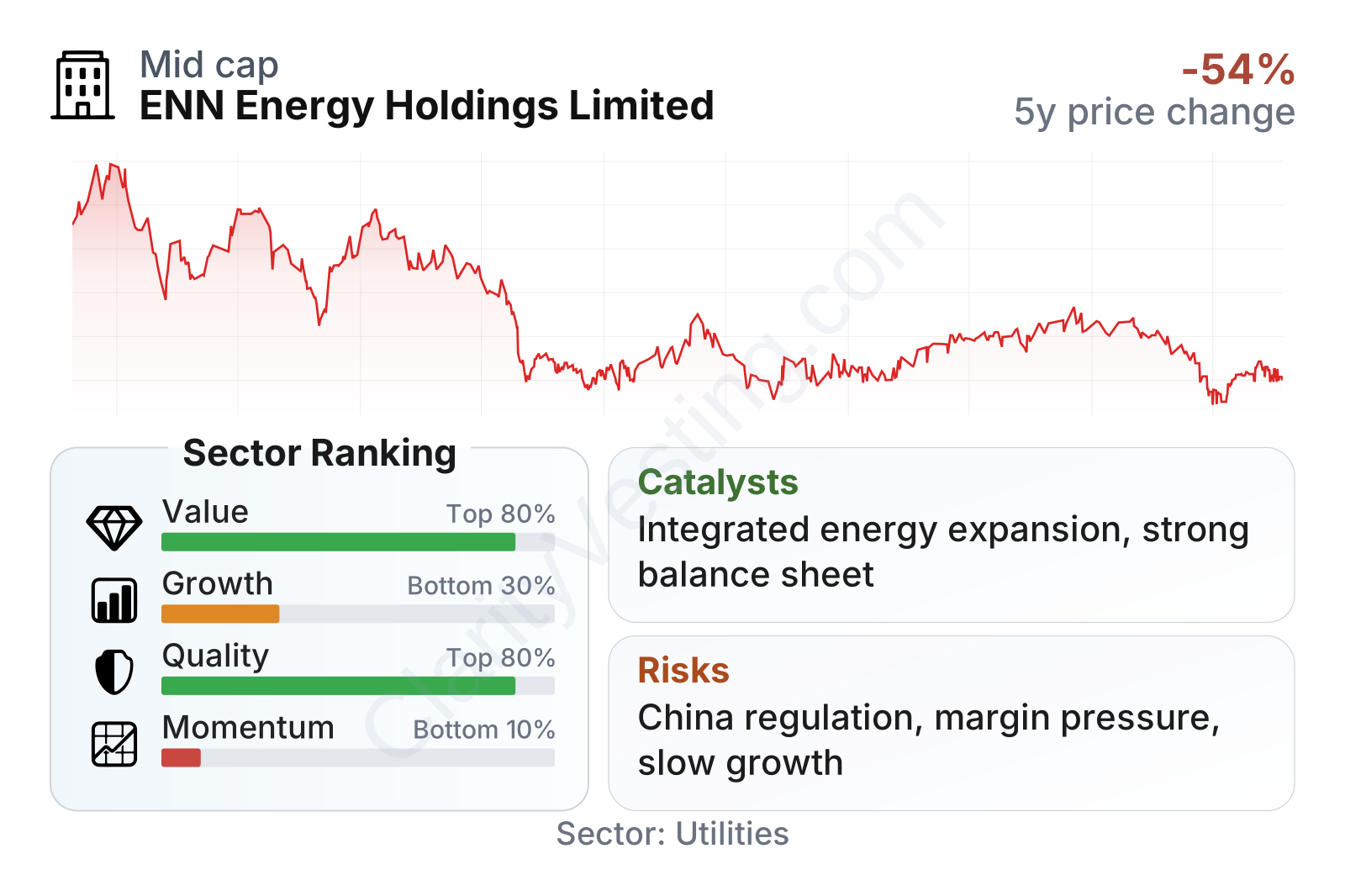
ENN stands out for a combination that is unusual in regulated utilities: low leverage, strong cash generation, and weak recent share-price momentum. The company ranks well on valuation and balance-sheet quality relative to much of the sector, with debt-to-equity around 41% and interest coverage far above many peers. Return on assets is also materially better than the sector median. The weaker side is growth and market performance: revenue growth has been modest, earnings trends have been under pressure over a multiyear period, and the stock has lagged utility peers by a wide margin.
The share price has fallen sharply from 2021 levels and remains far below prior highs. That decline is much steeper than the broader utility median shown in the relative metrics, which indicates that the market has become substantially more cautious about the company’s future growth and China-related exposure.
Growth
ENN operates in a sector that still has long-term relevance, but its growth profile is changing. In China, natural gas has historically benefited from policies favoring cleaner fuels over coal in many urban and industrial applications. That trend has supported city gas demand, network expansion, and fuel switching. However, gas distribution is no longer an early-stage growth market in the way it once was. In mature urban areas, growth depends more on deeper penetration, industrial demand, and value-added services than on simple network buildout.
That is why ENN’s strategy of expanding integrated energy services makes strategic sense. These services can increase revenue per customer, create longer contracts, and make the company less dependent on one single regulated utility activity. If executed well, this also gives ENN a way to participate in the broader energy transition without abandoning its established gas infrastructure base.
Revenue per share increased meaningfully between 2021 and 2023, then flattened. This points to a business that has already achieved scale but is now looking for its next leg of expansion. The flattening does not signal collapse, but it does show that growth has become harder to sustain at the earlier pace.
A relevant catalyst is the continuing buildout of cleaner, more efficient energy systems for industrial parks and commercial customers in China. ENN’s integrated energy offerings are positioned for customers that want lower emissions, better energy efficiency, and bundled solutions rather than just fuel supply. Another potential support is the company’s comparatively strong balance sheet, which leaves room for continued investment, dividends, and selective expansion without the same financing stress seen in more heavily indebted utilities.
Recent company communications and annual reporting have also emphasized operational efficiency, digitalization, and customer-side energy management. These initiatives are not as visible as adding new city-gas concessions, but they may be more important for the next phase of growth because they can improve customer retention and margins across a large installed base.
Risks
This article is for informational purposes only and does not constitute financial advice. Some content is AI-generated. See Disclaimer


