Stock Analysis · Xometry Inc (XMTR)
Overview
Xometry is a digital marketplace for manufacturing. It connects buyers that need custom parts with a network of suppliers that can produce them. In simple terms, a customer uploads a design, receives a quote, places an order, and Xometry helps match that order with a manufacturing partner. The company focuses on on-demand manufacturing rather than owning large factories itself, which gives it an asset-light model built around software, pricing algorithms, supplier management, and customer acquisition.
The platform covers a wide range of production methods, including CNC machining, sheet metal fabrication, injection molding, 3D printing, die casting, and other industrial processes. Xometry also sells tools and services to manufacturers through its Thomas business, which adds a second layer to the model: one side serves buyers of parts, while the other helps suppliers market themselves and operate more efficiently.
Based on recent company reporting, the main revenue sources are broadly organized as follows:
- Marketplace revenue: approximately 80% to 90% of total revenue. This is the core business, where customers order custom-manufactured parts and assemblies through Xometry’s platform.
- Supplier services revenue: approximately 10% to 20% of total revenue. This includes Thomasnet advertising and marketing products, supplier marketing solutions, and financial or operational services offered to manufacturing partners.
- International revenue: still a minority share of total sales, but growing faster than the overall business. This reflects expansion outside the United States rather than a separate reporting line.
The business mix shows a company that is still primarily driven by transaction volume on its marketplace, while supplier-focused services add recurring revenue and can improve the economics of the overall ecosystem. Over the last several years, revenue has expanded strongly, gross profit has also grown, and losses have narrowed meaningfully even though the company remains unprofitable on a net basis.
The long-term pattern is constructive: revenue has risen from a little over $200 million in 2021 to nearly $700 million in 2025, while net losses have become much smaller relative to sales. Gross profit has increased steadily as well, suggesting the platform is scaling, even if operating costs still absorb more than the gross profit generated.
Key Figures
| Metric | Value | Sector ⓘ |
|---|---|---|
| Date | Oct 24, 2026 | |
| Context | ||
| Sector | Industrials | |
| Industry | Industrial Distribution | |
| Market Cap ⓘ | $5.37B | |
| Beta ⓘ | 1.23 | |
Value (Cheapness) | ||
| P/E Ratio ⓘ | N/A | 22.29 |
| P/B Ratio ⓘ | 7.95 | 1.98 |
| FCF Yield ⓘ | -0.26% | 6.26% |
| Dividend Yield ⓘ | N/A | 1.92% |
| EBIT / EV ⓘ | -0.42% | 4.83% |
| PEG ⓘ | N/A | |
Growth (Business expansion) | ||
| Revenue Growth ⓘ | 41.10% | 9.30% |
| RPS Growth (5Y CAGR) ⓘ | 30.37% | 7.76% |
| EPS Growth (5Y CAGR) ⓘ | N/A | -13.17% |
| BVPS Growth (5Y CAGR) ⓘ | -12.16% | 6.13% |
| Margin Growth (5Y Trend) ⓘ | N/A | 0.74% |
| FCF Growth (5Y CAGR) ⓘ | -24.67% | 10.79% |
| DPS Growth (5Y CAGR) ⓘ | N/A | 9.41% |
Quality (Business durability) | ||
| ROIC (Latest) ⓘ | -2.82% | 10.75% |
| ROA (Latest) ⓘ | -3.51% | 5.41% |
| ROIC (5Y Median) ⓘ | -7.78% | 9.37% |
| ROA (5Y Median) ⓘ | -9.36% | 4.95% |
| Net Debt / EBIT (Latest) ⓘ | N/A | 2.04 |
| Net Debt / EBIT (5Y Median) ⓘ | N/A | 2.27 |
| Net Debt / EBITDA (Latest) ⓘ | N/A | 1.39 |
| Net Debt / Assets ⓘ | 30.06% | 19.27% |
| EBITDA / Interest ⓘ | N/A | 9.58 |
| Operating Margin (Latest) ⓘ | -3.06% | 10.49% |
| Operating Margin (5Y Median) ⓘ | -13.60% | 10.30% |
| Debt to Equity (Latest) ⓘ | 57.10% | 64.82% |
| Profit Margin (Latest) ⓘ | -3.82% | 6.67% |
| Free Cash Flow (Latest) ⓘ | -$13.95M | |
Momentum (Price trend) | ||
| 3Y Return ⓘ | +460.43% | +67.77% |
| 12M Return (excl. last month) ⓘ | +84.97% | +12.05% |
| 6M Return ⓘ | +89.56% | 0.00% |
| Price vs. 200-Day MA ⓘ | +18.69% | +0.67% |
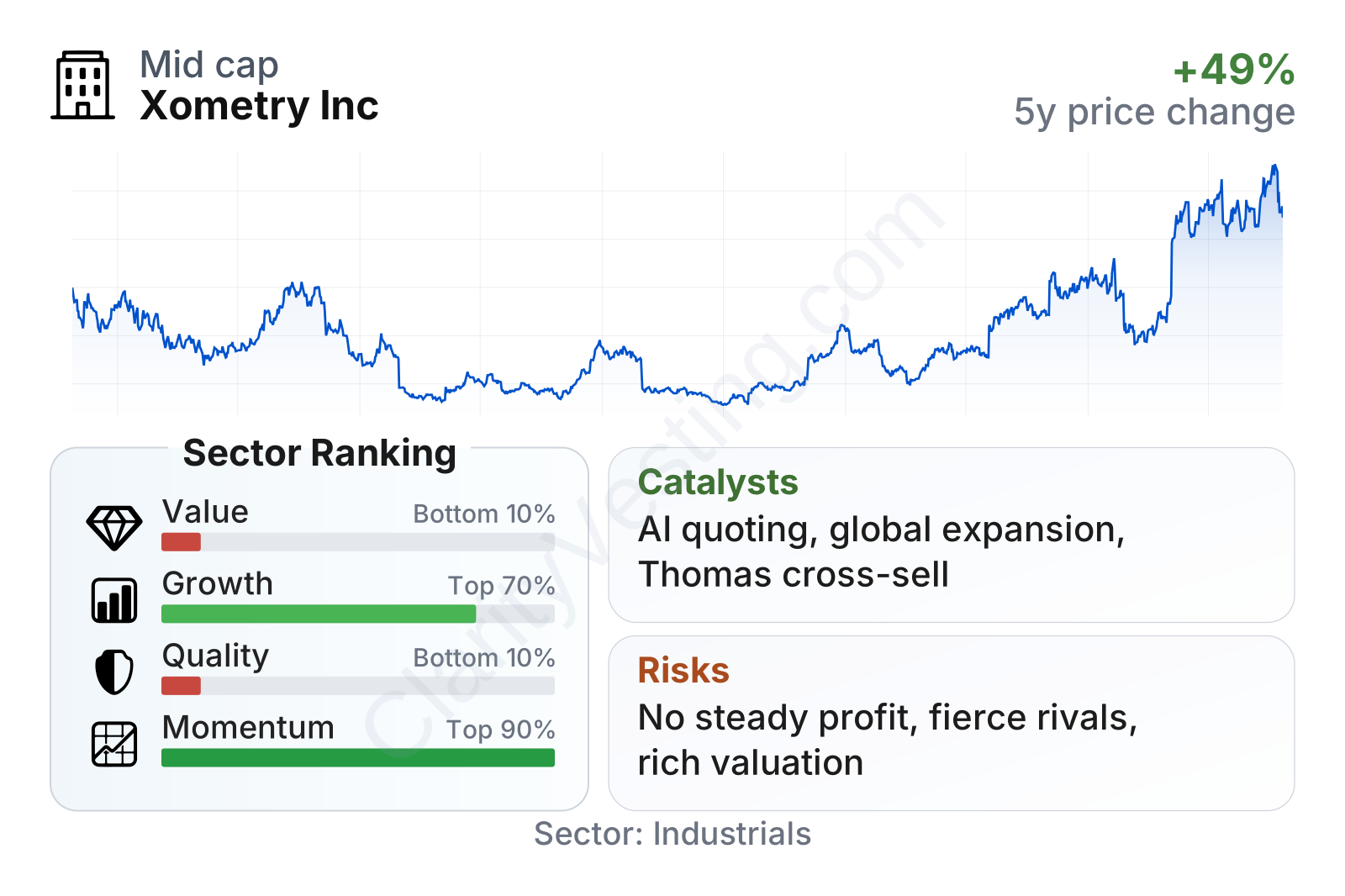
Xometry is now a mid-sized public company by market value, but its financial profile remains uneven. Growth and market momentum stand out positively, while profitability, returns on capital, and traditional valuation measures remain weak. Compared with the broader industrial sector, the company ranks near the bottom on value and quality metrics, but much better on revenue expansion and stock performance. That combination usually signals that the market is pricing in a meaningful improvement in future earnings rather than rewarding current profitability.
Growth
Xometry operates in a part of manufacturing that is benefiting from long-term digitization. Many custom manufacturing workflows are still fragmented, relationship-driven, and manual. A platform that makes sourcing faster, easier, and more transparent addresses a real pain point for both buyers and suppliers. That gives the company exposure to a structural shift rather than only a short-cycle industrial trend.
Its strategy for future growth is coherent. On the demand side, Xometry is trying to attract more enterprise customers and expand wallet share with existing ones. On the supply side, it continues to enlarge and engage its manufacturing network, which can improve pricing, lead times, and fulfillment options. The addition of supplier services through Thomas creates another growth path: once suppliers join the ecosystem, Xometry can monetize them not only through marketplace activity but also through advertising, lead generation, and software-like services.
Recent revenue trends are especially important. Growth slowed after the post-pandemic surge, but it has reaccelerated, with the latest year-over-year pace above 40%, far ahead of the sector median of about 9%. That matters because it suggests demand is not simply stabilizing; it is accelerating again from an already larger revenue base. Over a five-year view, revenue per share growth has also been well above the sector norm.
Cash generation is still not fully in positive territory, but the direction has improved substantially. Trailing free cash flow remains slightly negative, yet losses have narrowed sharply over time. That indicates the business is moving closer to self-funding, which is a major milestone for a platform company that spent years prioritizing scale.
Several catalysts could support continued expansion. International growth remains an obvious one, since Xometry is still much earlier in its penetration outside the U.S. Another is the use of artificial intelligence in quoting, matching, and pricing, where better automation can improve conversion rates and unit economics. The company has also highlighted larger customer relationships and continued cross-selling between the marketplace and Thomas. Those are the kinds of levers that can raise both volume and monetization without requiring the company to build factories.
Recent company updates have also pointed to stronger marketplace activity, expanding buyer engagement, and continued investment in international operations and supplier services. None of this removes execution risk, but it does show that the current growth case is based on several active drivers rather than a single theme.
Risks
This article is for informational purposes only and does not constitute financial advice. Some content is AI-generated. See Disclaimer


