Stock Analysis · Xior Student Housing NV (XIORF)
Overview
Xior Student Housing NV is a European real estate company focused on student accommodation. It owns, develops, and manages purpose-built student housing, mainly in Belgium, the Netherlands, Spain, Portugal, Germany, Denmark, and Sweden. The business model is relatively easy to understand: Xior acquires or develops buildings near universities, rents rooms and studios to students, and aims to keep occupancy high while gradually increasing rental income through portfolio growth, renovation, and new projects.
Its revenue base is concentrated in rental and related property income. Based on the structure described in company reporting, the main sources of revenue are approximately:
- Rental income from student housing: about 85% to 90% — recurring rent from student rooms, studios, and apartments across its portfolio.
- Service charges and property-related recharges: about 5% to 10% — utilities, common area costs, and operating services billed to tenants where applicable.
- Other property income and ancillary activities: about 1% to 5% — items such as short-stay arrangements, commercial space linked to residences, and miscellaneous real estate income.
As a residential REIT focused on students, Xior is less exposed to office demand or discretionary retail spending than many other real estate groups. That specialization matters because student housing tends to be supported by structural demand from university enrollment, urbanization, and limited supply in major education hubs.
Over the last several years, the company has expanded meaningfully, and total revenue has grown from under €100 million in 2021 to above €220 million in 2025. Profitability, however, has been more volatile than revenue because real estate financing costs, valuation movements, and acquisition integration can have a large effect on reported earnings.
The business has clearly become larger over time, with revenue and gross profit moving upward. The more important shift is below the surface: interest expense rose sharply in 2023 and 2024 before easing in 2025, which helps explain why accounting profit has been much less stable than rental income.
Key Figures
| Metric | Value | Sector ⓘ |
|---|---|---|
| Date | Oct 17, 2026 | |
| Context | ||
| Sector | Real Estate | |
| Industry | REIT - Residential | |
| Market Cap ⓘ | $1.27B | |
| Beta ⓘ | 0.69 | |
Value (Cheapness) | ||
| P/E Ratio ⓘ | 13.33 | 17.38 |
| P/B Ratio ⓘ | 0.82 | 0.85 |
| FCF Yield ⓘ | -9.61% | 7.38% |
| Dividend Yield ⓘ | 6.63% | 4.85% |
| EBIT / EV ⓘ | N/A | 3.78% |
| PEG ⓘ | N/A | |
Growth (Business expansion) | ||
| Revenue Growth ⓘ | 1.70% | 5.30% |
| RPS Growth (5Y CAGR) ⓘ | 1.47% | 6.02% |
| EPS Growth (5Y CAGR) ⓘ | -31.23% | -11.37% |
| BVPS Growth (5Y CAGR) ⓘ | -5.45% | 0.45% |
| Margin Growth (5Y Trend) ⓘ | 26.94% | -0.22% |
| FCF Growth (5Y CAGR) ⓘ | 33.69% | 5.40% |
| DPS Growth (5Y CAGR) ⓘ | -4.75% | 5.02% |
Quality (Business durability) | ||
| ROIC (Latest) ⓘ | N/A | 5.69% |
| ROE (Latest) ⓘ | 4.73% | 7.56% |
| ROA (Latest) ⓘ | 2.19% | 2.85% |
| ROIC (5Y Median) ⓘ | 1.53% | 4.22% |
| ROE (5Y Median) ⓘ | 4.20% | 6.03% |
| ROA (5Y Median) ⓘ | 1.91% | 2.44% |
| Net Debt / EBIT (Latest) ⓘ | N/A | 7.59 |
| Net Debt / EBIT (5Y Median) ⓘ | 32.62 | 8.40 |
| Net Debt / EBITDA (Latest) ⓘ | 12.30 | 5.27 |
| Net Debt / Assets ⓘ | 48.58% | 37.76% |
| EBITDA / Interest ⓘ | N/A | 4.10 |
| Operating Margin (Latest) ⓘ | N/A | 35.29% |
| Operating Margin (5Y Median) ⓘ | 30.51% | 37.31% |
| Debt to Equity (Latest) ⓘ | 107.09% | 88.87% |
| Profit Margin (Latest) ⓘ | 36.06% | 19.61% |
| Free Cash Flow (Latest) ⓘ | -$122.02M | |
Momentum (Price trend) | ||
| 3Y Return ⓘ | +23.86% | +30.75% |
| 12M Return (excl. last month) ⓘ | -11.78% | +4.36% |
| 6M Return ⓘ | -15.20% | -2.52% |
| Price vs. 200-Day MA ⓘ | -13.48% | -2.34% |
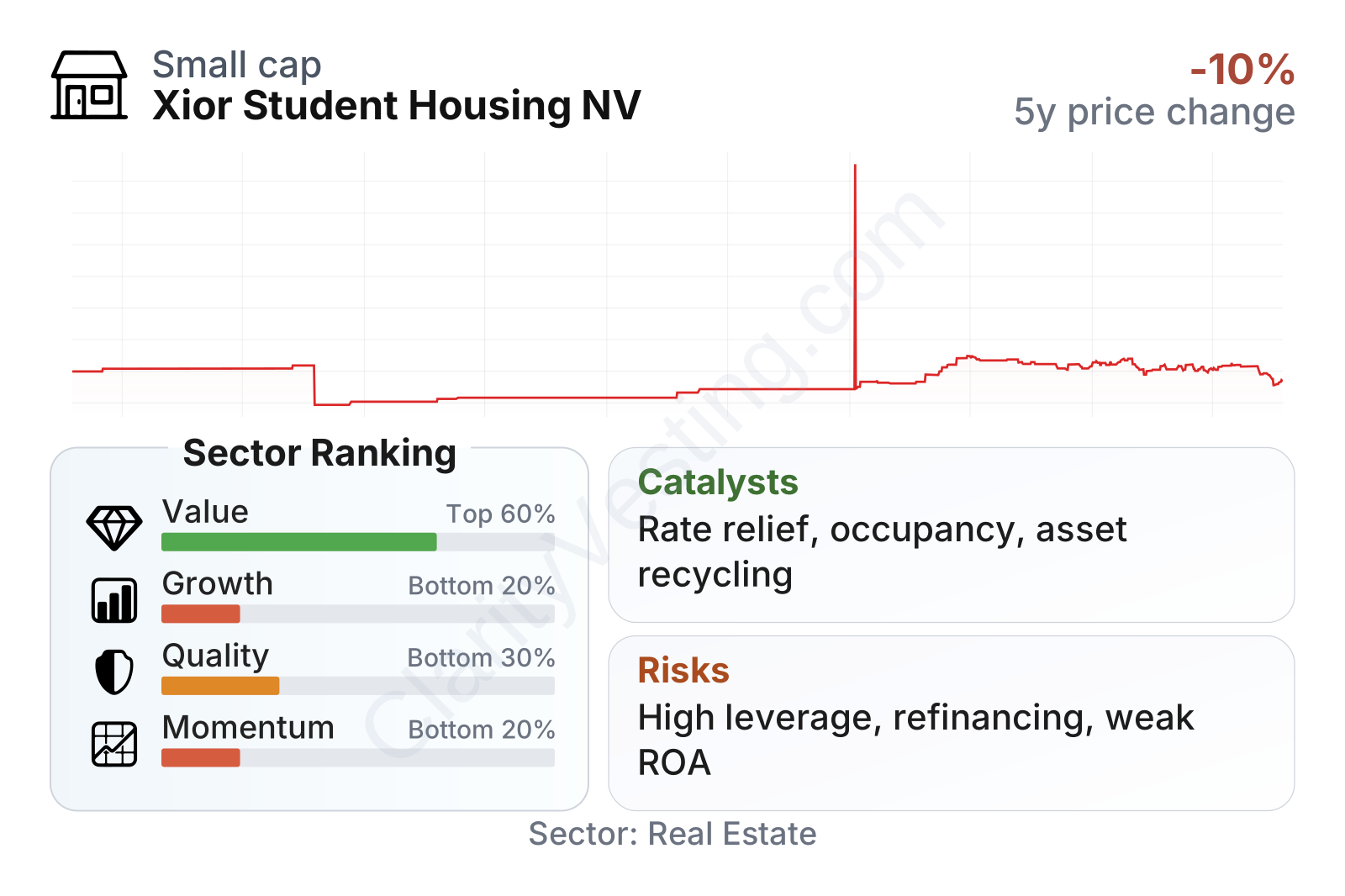
Xior looks like a mid-sized listed residential landlord with a relatively defensive share-price profile, reflected in a beta below 1. On valuation, earnings and book value multiples sit somewhat below sector medians, and the dividend yield is above the sector median. The weaker side is growth and quality: recent revenue growth has been modest, returns on assets and equity are below many peers, leverage is elevated, and free cash flow remains negative. Momentum is also soft, with the stock trailing the broader real estate group over recent periods.
The share-price history also shows how sensitive real estate stocks can be to interest rates. Xior traded much higher in 2022, fell hard in 2023 during the rate shock, recovered strongly into 2025, and then softened again in 2026. That pattern suggests the market is weighing stable property demand against a still-constrained financing backdrop.
Growth
Student housing remains one of the more resilient niches in real estate. In many European university cities, demand is supported by domestic students, international mobility, and an ongoing shortage of modern purpose-built accommodation. That gives operators like Xior a favorable sector backdrop, especially when they focus on cities with strong universities and limited private rental supply.
Xior’s strategy is logical for this segment. Scale matters in student housing because a larger platform can spread operating costs, centralize property management, negotiate financing more effectively, and build relationships with universities and local partners. The company has used acquisitions, developments, and upgrades to expand its portfolio across multiple countries, which reduces reliance on any single city.
That said, growth per share has recently lost momentum. Revenue per share rose steadily through 2023, then moved lower in 2024 and 2025. This is an important distinction for long-term analysis: the company is still growing in absolute size, but not all of that expansion is translating cleanly into stronger results on a per-share basis.
The dividend pattern tells a similar story. Payouts have not followed a smooth upward path, which is less attractive than the steadily rising distributions often associated with mature income-focused property companies. Even so, the current yield remains relatively high, indicating that the market is still assigning value to the underlying rental cash flows.
A meaningful catalyst is the possibility of easing financing pressure if European interest rates stabilize or decline. Real estate businesses with long-duration assets can see sentiment improve quickly when borrowing conditions become more manageable. Another positive factor is occupancy and rental growth in undersupplied student cities, where modern housing can command durable demand. Recent company updates have also emphasized portfolio optimization, development progress, and balance-sheet management, all of which are relevant because future growth now depends not only on expansion, but on growing in a more disciplined way than during the low-rate era.
Risks
This article is for informational purposes only and does not constitute financial advice. Some content is AI-generated. See Disclaimer


