Stock Analysis · Xenia Hotels & Resorts Inc (XHR)
Overview
Xenia Hotels & Resorts Inc. is a lodging real estate investment trust, or REIT. In simple terms, it owns hotels and resorts and earns money from the cash flow those properties generate. The company focuses on higher-end properties in the luxury and upper-upscale segments, largely under well-known brands such as Marriott, Hyatt, Hilton, and Kimpton. Its portfolio is concentrated in U.S. markets with meaningful business travel and leisure demand, including urban hotels, resort destinations, and group-oriented properties.
Because Xenia is a hotel REIT, its revenue is much more tied to daily property performance than that of many other real estate companies. Revenue mainly comes from guests paying for rooms, but hotels also produce income from food and beverage, meeting space, parking, resort fees, and other on-property services. Based on recent annual reporting, the mix is approximately:
- Rooms: about 68% to 72% of total hotel revenue. This is the core business and includes nightly room rates paid by leisure, business, and group travelers.
- Food and beverage: about 20% to 24%. This includes restaurants, bars, banquets, catering, and conference-related dining.
- Other hotel revenue: about 8% to 12%. This usually includes resort fees, parking, retail, spa, golf, and miscellaneous guest services.
Xenia does not mainly operate under its own consumer brand; instead, it owns the real estate while hotel managers and global brand systems help drive occupancy, pricing, and loyalty-program traffic. That gives it access to established reservation networks, but it also means results depend heavily on travel demand and the operating strength of each property.
The business has recovered materially from the pandemic period. Revenue climbed from roughly $616 million in 2021 to just over $1.0 billion in 2024, and it moved higher again in 2025. At the same time, profitability has been uneven, showing how sensitive hotel ownership can be to labor costs, interest expense, and changes in occupancy and room rates.
The long-term picture shows a strong rebound in revenue after 2021, but also a business where a large share of sales is absorbed by hotel operating costs and financing costs. That is normal for the sector, yet it helps explain why revenue growth has not translated into equally smooth bottom-line progress.
Key Figures
| Metric | Value | Sector ⓘ |
|---|---|---|
| Date | Oct 17, 2026 | |
| Context | ||
| Sector | Real Estate | |
| Industry | REIT - Hotel & Motel | |
| Market Cap ⓘ | $1.81B | |
| Beta ⓘ | 1.20 | |
Value (Cheapness) | ||
| P/E Ratio ⓘ | N/A | 17.38 |
| P/B Ratio ⓘ | 1.64 | 0.85 |
| FCF Yield ⓘ | 6.37% | 7.38% |
| Dividend Yield ⓘ | 3.03% | 4.85% |
| EBIT / EV ⓘ | 2.62% | 3.78% |
| PEG ⓘ | N/A | |
Growth (Business expansion) | ||
| Revenue Growth ⓘ | 2.80% | 5.30% |
| RPS Growth (5Y CAGR) ⓘ | 19.66% | 6.02% |
| EPS Growth (5Y CAGR) ⓘ | 13.16% | -11.37% |
| BVPS Growth (5Y CAGR) ⓘ | -2.93% | 0.45% |
| Margin Growth (5Y Trend) ⓘ | 24.79% | -0.22% |
| FCF Growth (5Y CAGR) ⓘ | 78.06% | 5.40% |
| DPS Growth (5Y CAGR) ⓘ | 485.54% | 5.02% |
Quality (Business durability) | ||
| ROIC (Latest) ⓘ | 2.90% | 5.69% |
| ROE (Latest) ⓘ | -0.67% | 7.56% |
| ROA (Latest) ⓘ | -0.25% | 2.85% |
| ROIC (5Y Median) ⓘ | 4.59% | 4.22% |
| ROE (5Y Median) ⓘ | 1.40% | 6.03% |
| ROA (5Y Median) ⓘ | 0.64% | 2.44% |
| Net Debt / EBIT (Latest) ⓘ | 16.54 | 7.59 |
| Net Debt / EBIT (5Y Median) ⓘ | 10.48 | 8.40 |
| Net Debt / EBITDA (Latest) ⓘ | 6.14 | 5.27 |
| Net Debt / Assets ⓘ | 46.14% | 37.76% |
| EBITDA / Interest ⓘ | 2.42 | 4.10 |
| Operating Margin (Latest) ⓘ | 6.94% | 35.29% |
| Operating Margin (5Y Median) ⓘ | 9.52% | 37.31% |
| Debt to Equity (Latest) ⓘ | 123.14% | 88.87% |
| Profit Margin (Latest) ⓘ | -0.66% | 19.61% |
| Free Cash Flow (Latest) ⓘ | $115.51M | |
Momentum (Price trend) | ||
| 3Y Return ⓘ | +76.15% | +30.75% |
| 12M Return (excl. last month) ⓘ | +22.68% | +4.36% |
| 6M Return ⓘ | +18.69% | -2.52% |
| Price vs. 200-Day MA ⓘ | +9.48% | -2.34% |
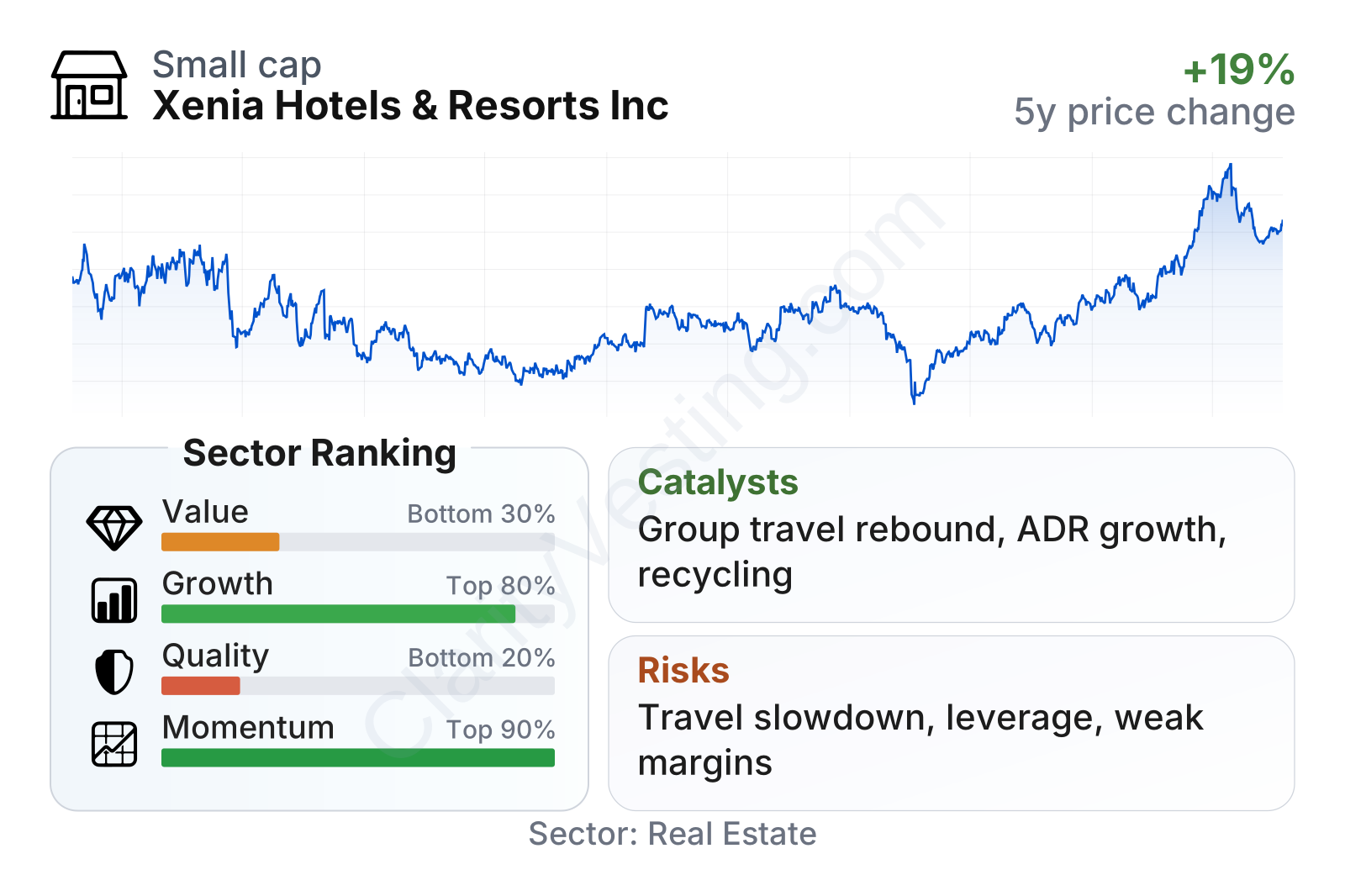
Xenia is a mid-sized public REIT with a market value around the lower end of the listed lodging REIT group, and its share price has been notably volatile, with a beta above 1. The factor view is mixed. Growth and price momentum rank well versus the broader real estate sector, helped by the multi-year recovery in revenue per share, free cash flow, and share performance. By contrast, value and quality rank weaker, reflecting above-median leverage, low current profitability, and valuation measures that no longer look especially cheap relative to peers.
The stock’s recent performance has been strong. Over the last three years, the share price has outpaced the sector median by a wide margin, and the shorter-term trend has also remained favorable. That momentum suggests the market has become more constructive on lodging REITs and on Xenia specifically, but it also means expectations are less depressed than they were in 2023 or early 2025.
Growth
The hotel sector can grow over time, but it is not a smooth compounding industry. Demand depends on consumer travel budgets, corporate travel, conventions, and the health of the broader economy. Within that cyclical backdrop, Xenia’s focus on luxury and upper-upscale hotels gives it exposure to parts of the market that can benefit from higher-income leisure travelers, group events, and premium room pricing. These categories have generally been more resilient than lower-end lodging in periods when travelers remain active but become more selective.
Xenia’s strategy is centered on owning high-quality hotels in markets where replacement costs are high and where branded distribution matters. That approach makes strategic sense for long-term growth because premium properties can often support better pricing power, renovation-driven rate increases, and stronger group business if demand remains healthy. The company has also used asset sales and reinvestment to shape the portfolio rather than simply expand for size alone.
Revenue per share has risen steadily over the past five years, which is an encouraging sign because it suggests growth has not relied only on issuing more shares. This is particularly relevant for REIT analysis: growing revenue on a per-share basis often says more than total revenue alone.
The dividend has also rebuilt meaningfully from the pandemic-disrupted period. That reflects a healthier operating base and improving cash generation, although the current yield still sits below the real estate sector median. In other words, the payout has recovered, but the stock is not being valued primarily as a high-yield name.
A key catalyst is continued normalization in business travel and group bookings. Hotels with meeting space and resort appeal can benefit if companies keep returning to in-person events and conferences. Another potential tailwind is the ability to raise average daily rates at renovated or well-located properties, especially in high-end segments where customers may be less price sensitive. Recent company communications have also emphasized capital recycling and selective investment in the portfolio, which can improve the quality of earnings if management sells lower-upside assets and upgrades the remaining portfolio.
A more recent opportunity comes from the stock market’s changing view of lodging REITs as travel fundamentals have remained firmer than many expected. Xenia’s strong recent price momentum indicates that the market has been rewarding signs of resilient hotel demand, improving property-level performance, and cash flow recovery. If those operating trends continue, there is room for further improvement in earnings quality even without dramatic revenue growth.
Risks
This article is for informational purposes only and does not constitute financial advice. Some content is AI-generated. See Disclaimer


