Stock Analysis · Xeris Pharmaceuticals Inc (XERS)
Overview
Xeris Pharmaceuticals is a specialty pharmaceutical company focused on making injectable and infusion-ready medicines easier to use. Its core business is built around formulation and delivery technology that can turn complex drugs into ready-to-administer liquid products, which can improve convenience for patients, caregivers, and healthcare providers. The company markets products in endocrinology and neurology and also works on partnerships that use its formulation platforms for additional drug candidates.
Revenue is mainly generated from commercial product sales, with a smaller contribution from collaboration, royalty, and other revenue tied to partnered programs and technology-based agreements. Based on recent annual results, the business mix is approximately:
- Product revenue: about 90% to 95% — mainly sales of the company’s marketed medicines, including Gvoke for severe hypoglycemia, Keveyis for primary periodic paralysis, and Recorlev for endogenous Cushing’s syndrome.
- Collaboration, royalty, and other revenue: about 5% to 10% — includes payments connected to partnered development programs, technology access, milestones, and related arrangements.
Within product revenue, the largest current contributors appear to be Recorlev and Gvoke, with Keveyis adding a smaller but still meaningful share. Exact product percentages can shift by quarter as prescription growth, gross-to-net adjustments, and seasonal patterns change.
The broader financial picture has improved materially over the last several years: revenue has expanded rapidly, gross profit has scaled up, and operating losses have narrowed enough for the company to reach roughly break-even operating performance in 2025. That matters because Xeris has moved from being mainly a development-stage business toward becoming a commercial specialty pharma company with a more established revenue base.
The long-term trend is encouraging: revenue rose from roughly $50 million in 2021 to nearly $292 million in 2025, while net losses contracted sharply and operating performance approached profitability. The weak point is that selling, general, and administrative costs remain high, which shows how much commercial execution still matters for the next phase.
Key Figures
| Metric | Value | Sector ⓘ |
|---|---|---|
| Date | Oct 03, 2026 | |
| Context | ||
| Sector | Healthcare | |
| Industry | Drug Manufacturers - Specialty & Generic | |
| Market Cap ⓘ | $1.74B | |
| Beta ⓘ | 0.85 | |
Value (Cheapness) | ||
| P/E Ratio ⓘ | N/A | 24.06 |
| P/B Ratio ⓘ | N/A | 3.08 |
| FCF Yield ⓘ | 3.18% | 3.07% |
| Dividend Yield ⓘ | N/A | 2.05% |
| EBIT / EV ⓘ | 0.23% | 0.63% |
| PEG ⓘ | N/A | |
Growth (Business expansion) | ||
| Revenue Growth ⓘ | 28.70% | 7.50% |
| RPS Growth (5Y CAGR) ⓘ | 28.10% | 8.70% |
| EPS Growth (5Y CAGR) ⓘ | N/A | -18.20% |
| BVPS Growth (5Y CAGR) ⓘ | -49.36% | 3.95% |
| Margin Growth (5Y Trend) ⓘ | N/A | -0.58% |
| FCF Growth (5Y CAGR) ⓘ | N/A | 0.88% |
| DPS Growth (5Y CAGR) ⓘ | -22.44% | 6.80% |
Quality (Business durability) | ||
| ROIC (Latest) ⓘ | 1.32% | 3.29% |
| ROA (Latest) ⓘ | -4.39% | 3.02% |
| ROIC (5Y Median) ⓘ | -13.82% | 4.75% |
| ROA (5Y Median) ⓘ | -18.66% | 1.93% |
| Net Debt / EBIT (Latest) ⓘ | 42.63 | 1.33 |
| Net Debt / EBIT (5Y Median) ⓘ | N/A | 1.83 |
| Net Debt / EBITDA (Latest) ⓘ | 10.22 | 0.99 |
| Net Debt / Assets ⓘ | 40.71% | 5.33% |
| EBITDA / Interest ⓘ | 0.58 | 9.63 |
| Operating Margin (Latest) ⓘ | 1.17% | 9.25% |
| Operating Margin (5Y Median) ⓘ | -22.51% | 7.80% |
| Debt to Equity (Latest) ⓘ | -2973.52% | 28.99% |
| Profit Margin (Latest) ⓘ | -5.12% | 3.60% |
| Free Cash Flow (Latest) ⓘ | $55.38M | |
Momentum (Price trend) | ||
| 3Y Return ⓘ | +428.57% | +37.48% |
| 12M Return (excl. last month) ⓘ | +7.66% | +20.85% |
| 6M Return ⓘ | +53.15% | +9.73% |
| Price vs. 200-Day MA ⓘ | +28.71% | +4.69% |
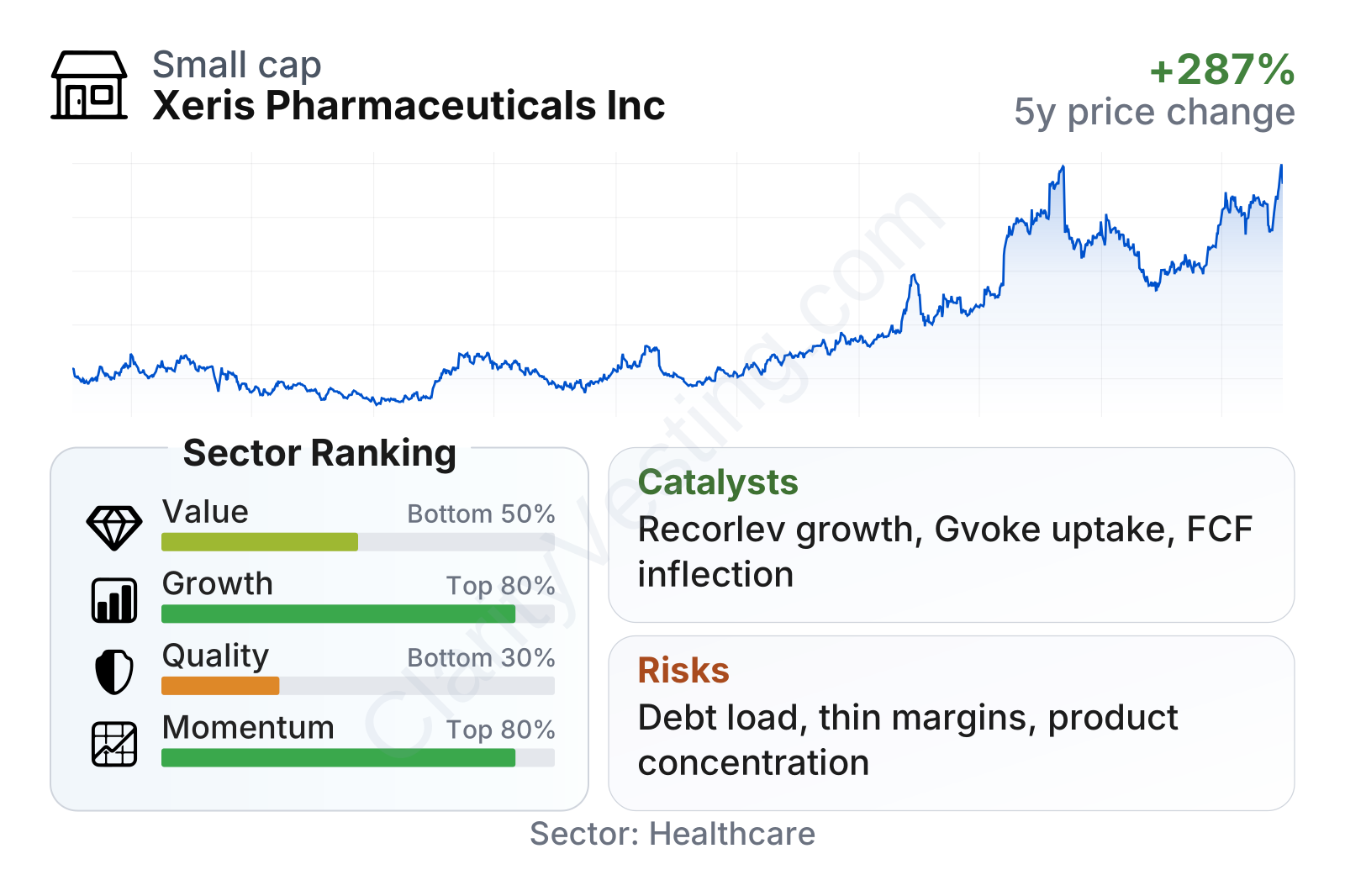
Xeris is a small-cap healthcare company with unusually strong growth and price momentum relative to much of its sector, but weaker balance-sheet and profitability quality measures. The table points to a business in transition: revenue growth is clearly above sector norms, free cash flow has turned positive, and recent share performance has been strong, yet returns on assets and invested capital remain light and leverage metrics are still strained.
The stock chart also reflects that transition. Shares were highly volatile for several years, then rerated upward as revenue growth accelerated and profitability improved. That kind of move often signals that the market is starting to treat the company less like an early commercial biotech and more like an operating business, but volatility remains part of the profile.
Growth
Xeris operates in specialty pharmaceuticals, a segment that can offer durable growth when a company serves rare diseases or clearly defined endocrine and neurological conditions with limited treatment options. The sector itself is attractive because successful products can benefit from targeted prescriber bases, pricing resilience in niche indications, and follow-on opportunities through label expansion or lifecycle management.
Xeris’s strategy is coherent for future growth because it combines three elements that can reinforce each other: expanding existing commercial brands, using its formulation technology to extend internal programs, and adding external partnerships that may create milestone or royalty streams. This is more balanced than relying on only one experimental asset.
Revenue growth has stayed well above the healthcare sector median, even though the pace has naturally slowed from the very high rates seen earlier in the company’s ramp-up. Recent year-over-year growth still sits around the high-20% to high-30% range, which is strong for a company that already has several commercial products on the market.
Another important development is cash generation. Free cash flow moved from deeply negative territory to solidly positive over the trailing twelve months. That shift is significant because it suggests the commercial portfolio is starting to fund more of the business internally rather than relying as heavily on outside capital.
Among the most important catalysts are continued uptake of Recorlev and Gvoke, as these products can still expand through broader physician adoption and improved market access. Keveyis adds support through a rarer-disease niche that can provide recurring demand. In addition, Xeris’s formulation technology remains a strategic asset because it may support new partnered programs or additional internal candidates without requiring the company to build an entirely new scientific foundation each time.
Recent corporate updates have also emphasized ongoing commercial execution and progress toward stronger operating leverage. For a business at this stage, the biggest opportunity is not a single binary event but rather consistent prescription growth, payer coverage progress, and margin improvement across an expanding revenue base.
Risks
This article is for informational purposes only and does not constitute financial advice. Some content is AI-generated. See Disclaimer