Stock Analysis · X-Energy Inc (XE)
Overview
X-Energy Inc operates in advanced nuclear technology. The company is developing small modular nuclear reactors and the specialized fuel designed to run them. In simple terms, it is trying to sell both the “power plant” and the “fuel” for a next-generation nuclear system aimed at electricity producers, large industrial users, and potentially data center and industrial power customers that need steady, carbon-free energy.
Based on the company’s public reporting, the business is still in a development and early commercialization phase rather than a mature, diversified operating model. That means current revenue is relatively small compared with the company’s market value, and revenue can move sharply from year to year depending on milestone payments, engineering work, government-related contracts, and development activity.
The main economic drivers appear to be the following:
- Reactor and engineering services: design work, licensing support, technical services, and program-related milestones tied to the Xe-100 reactor platform.
- Fuel-related activities: development and future commercialization of TRISO-X fuel, including manufacturing capability and related technical work.
- Government and strategic program revenue: support connected to U.S. energy and advanced reactor initiatives, where project timing can materially affect reported sales.
Reliable public breakdown percentages by revenue stream are not yet consistently detailed enough to present a precise ranked split. What is clear is that the company is not yet generating revenue at scale from broad commercial reactor deployment; current sales are still tied mainly to development, services, and program execution before full fleet rollout.
The financial flow over the last several years shows a business that has grown revenue unevenly but has consistently operated at a gross loss, with operating costs rising as commercialization efforts expanded. Selling, general, and administrative expenses have also climbed, which fits a company building infrastructure and partnerships ahead of larger deployment.
The long-term pattern shows an important tension: revenue has moved upward over time from the early base, but costs of delivering that revenue have remained higher than sales, so scale has not yet translated into profitability.
Key Figures
| Metric | Value | Sector ⓘ |
|---|---|---|
| Date | Oct 24, 2026 | |
| Context | ||
| Sector | Industrials | |
| Industry | Specialty Industrial Machinery | |
| Market Cap ⓘ | $4.36B | |
| Beta ⓘ | N/A | |
Value (Cheapness) | ||
| P/E Ratio ⓘ | N/A | 22.29 |
| P/B Ratio ⓘ | 1.99 | 1.98 |
| FCF Yield ⓘ | -9.40% | 6.26% |
| Dividend Yield ⓘ | N/A | 1.92% |
| EBIT / EV ⓘ | -8.99% | 4.83% |
| PEG ⓘ | N/A | |
Growth (Business expansion) | ||
| Revenue Growth ⓘ | 196.20% | 9.30% |
| RPS Growth (5Y CAGR) ⓘ | 25.37% | 7.76% |
| EPS Growth (5Y CAGR) ⓘ | N/A | -13.17% |
| BVPS Growth (5Y CAGR) ⓘ | N/A | 6.13% |
| Margin Growth (5Y Trend) ⓘ | N/A | 0.74% |
| FCF Growth (5Y CAGR) ⓘ | N/A | 10.79% |
| DPS Growth (5Y CAGR) ⓘ | N/A | 9.41% |
Quality (Business durability) | ||
| ROIC (Latest) ⓘ | N/A | 10.75% |
| ROA (Latest) ⓘ | N/A | 5.41% |
| ROIC (5Y Median) ⓘ | N/A | 9.37% |
| ROA (5Y Median) ⓘ | -78.80% | 4.95% |
| Net Debt / EBIT (Latest) ⓘ | N/A | 2.04 |
| Net Debt / EBIT (5Y Median) ⓘ | N/A | 2.27 |
| Net Debt / EBITDA (Latest) ⓘ | N/A | 1.39 |
| Net Debt / Assets ⓘ | -49.60% | 19.27% |
| EBITDA / Interest ⓘ | N/A | 9.58 |
| Operating Margin (Latest) ⓘ | -187.81% | 10.49% |
| Operating Margin (5Y Median) ⓘ | -112.73% | 10.30% |
| Debt to Equity (Latest) ⓘ | 1.48% | 64.82% |
| Profit Margin (Latest) ⓘ | -298.70% | 6.67% |
| Free Cash Flow (Latest) ⓘ | -$410.27M | |
Momentum (Price trend) | ||
| 3Y Return ⓘ | N/A | +67.77% |
| 12M Return (excl. last month) ⓘ | N/A | +12.05% |
| 6M Return ⓘ | N/A | 0.00% |
| Price vs. 200-Day MA ⓘ | N/A | +0.67% |
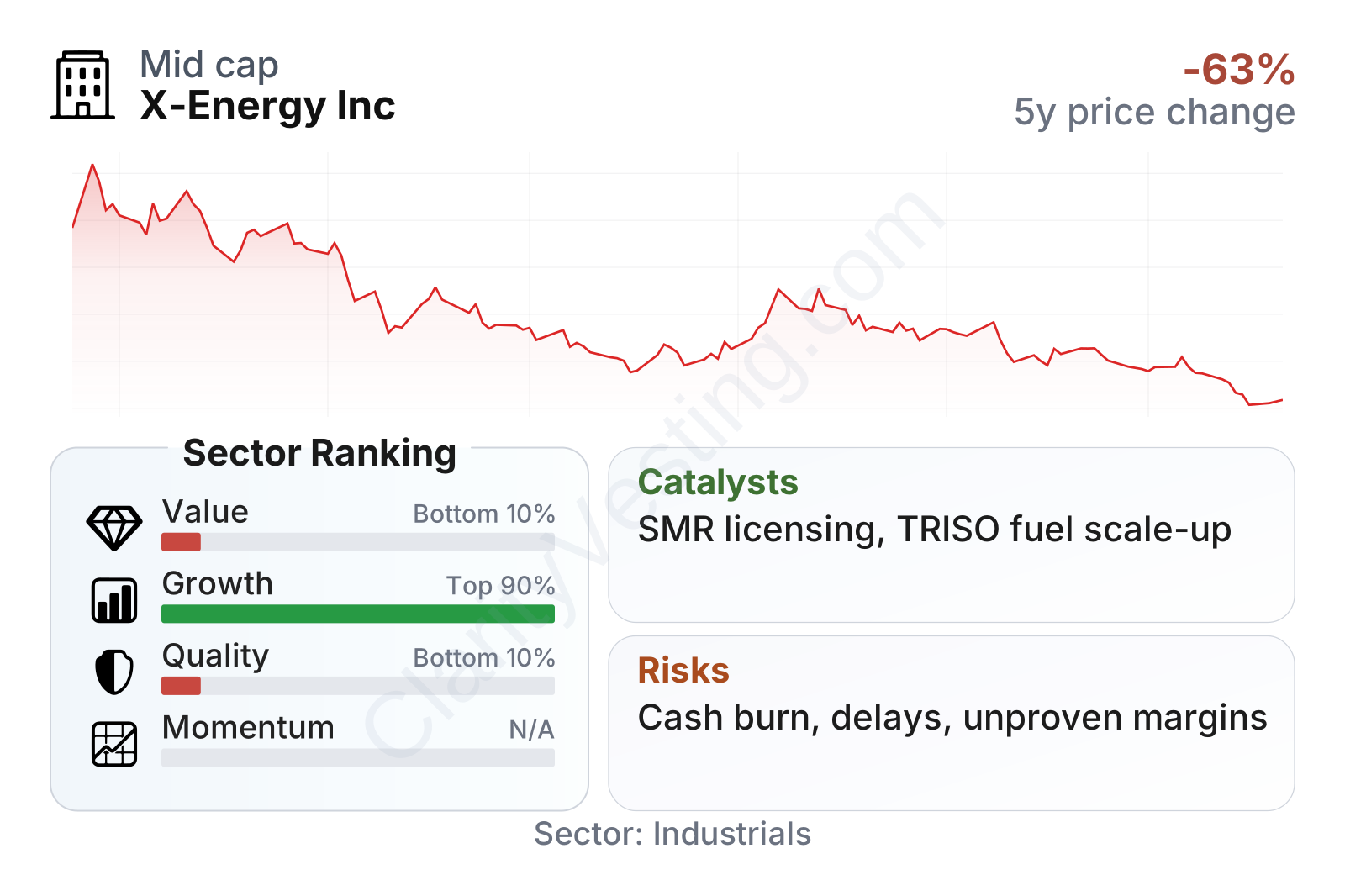
X-Energy is currently a mid-sized listed company by market value, but its operating profile is still highly early-stage. The most striking contrast in the metrics is that growth ranks near the top of the industrial peer group, while value and quality rank near the bottom. Revenue growth has been far above the sector median, yet margins remain deeply negative and free cash flow is substantially below zero. The balance sheet is unusual in a better way: leverage appears very low, with debt-to-equity around 1% to 2% and net cash rather than heavy net debt. That reduces financing pressure in the short run, but it does not offset the fact that the company is still burning cash.
The recent share price decline visible in the chart suggests the market has become more cautious about timing, execution, or valuation. In other words, the market is still assigning meaningful future potential, but it is no longer treating that potential as near-certain.
Growth
X-Energy operates in a sector with real long-term tailwinds. Interest in advanced nuclear has increased because power grids need more firm low-carbon electricity, while electricity demand is rising from electrification, industrial decarbonization, and especially data centers. Small modular reactors are often presented as a possible solution because they aim to be more flexible and easier to deploy than traditional large nuclear plants.
The company’s strategy makes industrial sense if management can execute. X-Energy is not only designing a reactor; it is also building around the fuel supply chain. That matters because advanced nuclear is not just an equipment business. Customers need confidence that fuel, licensing, manufacturing, and project delivery can all come together. A company with a reactor platform plus a dedicated fuel capability can potentially capture more value and reduce one of the sector’s biggest bottlenecks.
A major catalyst is the broader policy and industrial push in the United States for domestic nuclear supply chains. Public support for advanced reactors, interest from large electricity users, and strategic concern about energy security all improve the backdrop. For X-Energy specifically, meaningful catalysts include progress on reactor licensing, additional customer commitments, fuel manufacturing milestones, and movement from engineering-stage awards toward full project deployment.
Another important opportunity is partner validation. In this part of the market, third-party backing from large industrial, utility, or infrastructure players can matter almost as much as current revenue because it helps de-risk future commercialization. If the company continues converting technical development into funded projects, its growth profile could remain much stronger than most industrial peers.
Risks
This article is for informational purposes only and does not constitute financial advice. Some content is AI-generated. See Disclaimer


