Stock Analysis · Worley Limited (WYGPF)
Overview
Worley Limited is an Australia-based engineering, procurement, construction management, and professional services company focused on energy, chemicals, and resources projects. In simple terms, it helps large industrial customers design, build, improve, and operate complex facilities such as oil and gas infrastructure, mining assets, power projects, chemical plants, and lower-carbon energy systems. The company has a global footprint and earns most of its money by supplying technical expertise and project execution services rather than by owning the underlying assets itself.
Its revenue mix is mainly organized by customer end market rather than by a single product line. Based on recent annual reporting, the largest sources of revenue are:
- Energy — approximately 57% of revenue. This includes conventional oil and gas, LNG, refining, pipelines, power, and an increasing amount of work tied to energy transition projects.
- Chemicals — approximately 16% of revenue. This covers petrochemicals, specialty chemicals, fertilizers, and related processing facilities.
- Resources — approximately 27% of revenue. This includes mining, minerals processing, and metals-related infrastructure.
Another useful way to understand Worley is by service type. A large share of activity comes from reimbursable professional services, project delivery, and maintenance-related support, which usually makes revenue broad-based across many contracts rather than dependent on a single mega-project. The business model is asset-light compared with producers and operators, but it is still exposed to customer spending cycles in energy and mining.
Over the last several years, revenue expanded strongly through 2024 before easing in 2025 and 2026, while profitability remained positive. That pattern suggests a business with meaningful scale and recurring client demand, but one that is still sensitive to project timing, customer capital budgets, and contract mix.
The revenue bridge also shows an important feature of Worley’s model: its cost of revenue absorbs most sales, leaving relatively thin margins. Even so, operating income improved materially from 2022 to 2025 before softening in 2026, which indicates that execution and contract quality matter at least as much as top-line growth.
Key Figures
| Metric | Value | Sector ⓘ |
|---|---|---|
| Date | Oct 17, 2026 | |
| Context | ||
| Sector | Energy | |
| Industry | Oil & Gas Equipment & Services | |
| Market Cap ⓘ | $3.22B | |
| Beta ⓘ | 0.40 | |
Value (Cheapness) | ||
| P/E Ratio ⓘ | 20.62 | 15.44 |
| P/B Ratio ⓘ | 0.68 | 1.73 |
| FCF Yield ⓘ | 31.15% | 8.20% |
| Dividend Yield ⓘ | 7.58% | 3.59% |
| EBIT / EV ⓘ | N/A | 7.46% |
| PEG ⓘ | 1.05 | |
Growth (Business expansion) | ||
| Revenue Growth ⓘ | -7.90% | 26.90% |
| RPS Growth (5Y CAGR) ⓘ | 3.34% | 6.90% |
| EPS Growth (5Y CAGR) ⓘ | -0.07% | -15.73% |
| BVPS Growth (5Y CAGR) ⓘ | -2.81% | 6.07% |
| Margin Growth (5Y Trend) ⓘ | 3.41% | 0.58% |
| FCF Growth (5Y CAGR) ⓘ | 6.44% | 1.86% |
| DPS Growth (5Y CAGR) ⓘ | -0.09% | 16.79% |
Quality (Business durability) | ||
| ROIC (Latest) ⓘ | N/A | 11.40% |
| ROA (Latest) ⓘ | 6.01% | 6.06% |
| ROIC (5Y Median) ⓘ | 3.30% | 10.30% |
| ROA (5Y Median) ⓘ | 2.19% | 5.42% |
| Net Debt / EBIT (Latest) ⓘ | N/A | 1.64 |
| Net Debt / EBIT (5Y Median) ⓘ | 3.25 | 1.83 |
| Net Debt / EBITDA (Latest) ⓘ | 1.17 | 1.08 |
| Net Debt / Assets ⓘ | 16.31% | 17.29% |
| EBITDA / Interest ⓘ | 6.72 | 9.64 |
| Operating Margin (Latest) ⓘ | N/A | 16.27% |
| Operating Margin (5Y Median) ⓘ | 5.07% | 20.39% |
| Debt to Equity (Latest) ⓘ | 58.33% | 54.76% |
| Profit Margin (Latest) ⓘ | 2.22% | 8.82% |
| Free Cash Flow (Latest) ⓘ | $1.00B | |
Momentum (Price trend) | ||
| 3Y Return ⓘ | -31.75% | +67.38% |
| 12M Return (excl. last month) ⓘ | -9.15% | +49.19% |
| 6M Return ⓘ | -14.34% | +7.07% |
| Price vs. 200-Day MA ⓘ | -18.19% | +9.56% |
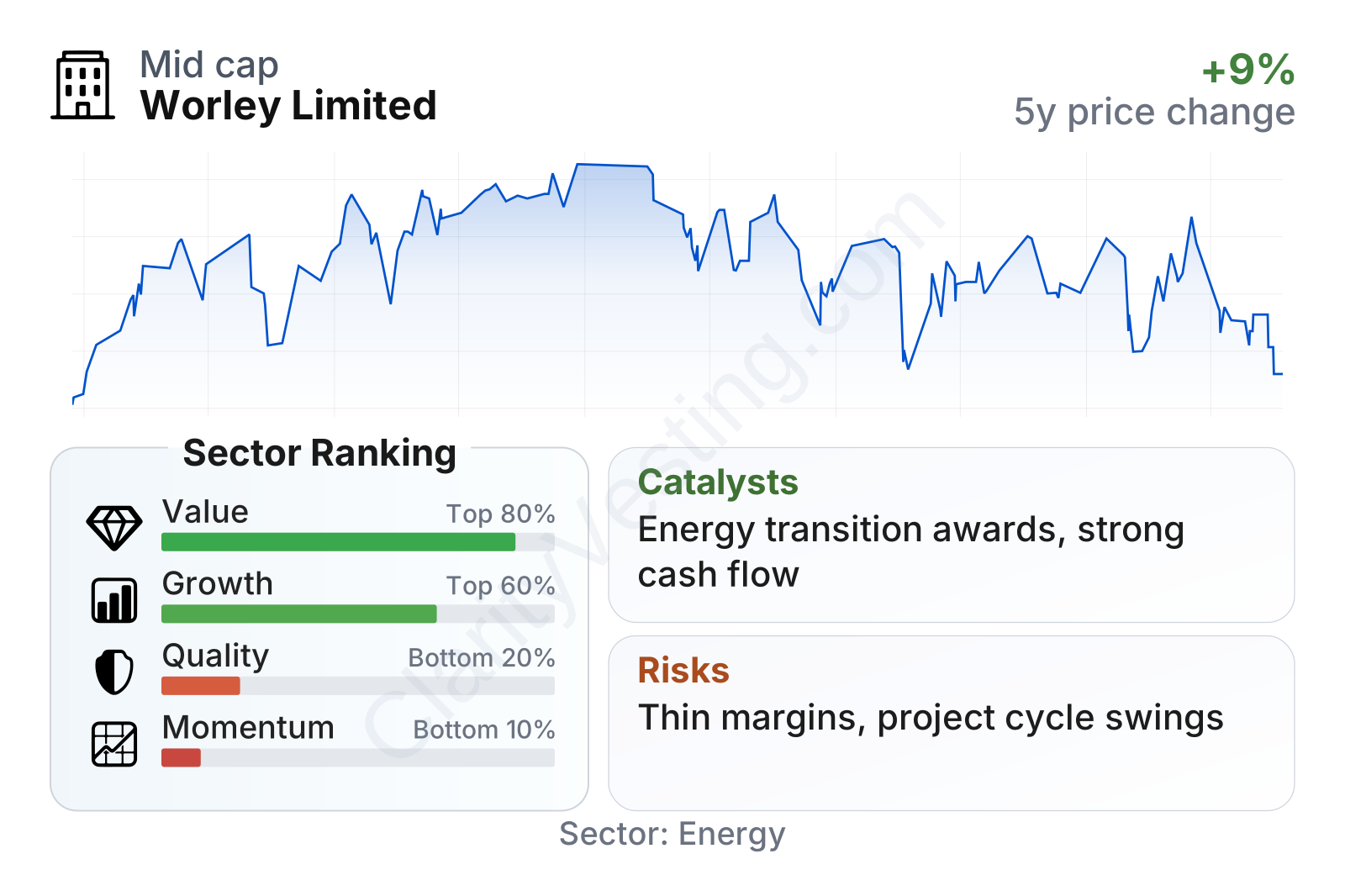
Worley stands out on cash generation and income distribution more than on headline growth or profitability. Its free cash flow yield is far above the sector median, and the dividend yield is also notably higher. At the same time, the earnings multiple is above the sector median, which means the market is not treating it as a distressed business despite weak recent share momentum.
The quality profile is less convincing. Profit margin is well below the sector median, leverage is manageable but not especially conservative, and interest coverage is decent rather than strong. On growth, the long-term picture is mixed: free cash flow and margin trend have improved over five years, but recent revenue growth has lagged the broader sector. Price performance has also trailed peers over one year and three years, showing that sentiment remains cautious.
As a result, the market currently appears to be recognizing Worley’s cash conversion and dividend capacity, while still discounting the business for low margins, uneven revenue progression, and softer market confidence.
Growth
Worley operates in markets that should remain relevant for many years. Global investment in energy supply, grid infrastructure, mining, chemicals, and decarbonization-related facilities continues to require engineering and project delivery expertise. That does not mean growth is linear, but it does support a durable demand backdrop. Even when commodity prices fluctuate, customers still need maintenance, plant upgrades, emissions reduction work, efficiency improvements, and selective capacity additions.
The company’s strategy also makes industrial sense. Worley has been positioning itself as a partner not only for traditional hydrocarbons and mining, but also for lower-carbon projects such as carbon capture, hydrogen, sustainable fuels, electrification, and more efficient processing systems. This matters because many customers are not abandoning legacy assets; instead, they are extending, upgrading, and decarbonizing them. That plays directly into Worley’s capabilities.
One of the more important catalysts is its exposure to the energy transition without being limited to a single niche theme. If spending on carbon capture, sustainable fuels, power system upgrades, and industrial decarbonization continues to rise, Worley can participate through engineering and advisory work. At the same time, continued investment in LNG, conventional energy infrastructure, and mining gives it multiple demand engines.
Another favorable point is contract diversity. A broad customer base and global delivery network can help smooth individual project volatility. Worley has also emphasized higher-value professional services and disciplined project selection, which is important in a business where poor contract terms can quickly damage margins.
Recent company updates have continued to highlight award activity across conventional energy, chemicals, mining, and transition-related projects. That does not guarantee a step-change in earnings, but it supports the idea that end-market demand remains active across several verticals rather than being dependent on one narrow cycle.
Risks
This article is for informational purposes only and does not constitute financial advice. Some content is AI-generated. See Disclaimer


