Stock Analysis · Weyerhaeuser Company (WY)
Overview
Weyerhaeuser Company is one of the largest private owners of timberlands in the United States. It grows and harvests trees, manages forestlands, and turns logs into wood products used in residential construction, repair and remodeling, and light commercial building. Although it is organized as a real estate investment trust, its business is much more tied to forests, lumber, oriented strand board, and land management than to office or apartment real estate.
The company’s revenue comes from three main operating areas. Based on its latest annual reporting structure, the mix is approximately as follows:
- Wood Products: about 70% to 75% — This is the largest business. It includes lumber, oriented strand board, engineered wood products, and distribution activities. Results here are heavily influenced by housing demand, renovation spending, and commodity wood prices.
- Timberlands: about 20% to 25% — This segment earns money by selling harvested logs, as well as through forest management and related activities. Pricing depends on log demand from sawmills, export markets, and regional supply conditions.
- Real Estate, Energy & Natural Resources: about 5% to 10% — This smaller but strategically important business includes land sales, easements, mineral and natural resource rights, and renewable-energy-related opportunities such as solar, wind, and carbon-related projects.
Weyerhaeuser’s structure gives it two layers of value. First, it has a large base of hard assets in the form of timberland. Second, it has operating exposure to wood products, which can produce strong earnings when lumber and panel prices are favorable. That combination makes the business different from most REITs and also more cyclical than many income-oriented real estate companies.
The broad financial flow over recent years shows a clear pattern: revenue stayed high in 2021 and 2022, then declined in 2023 through 2025 as wood-product pricing and profitability normalized. Costs remained substantial, so earnings fell faster than sales. That helps explain why recent returns on the business look much weaker than they did at the peak of the cycle.
Key Figures
| Metric | Value | Sector ⓘ |
|---|---|---|
| Date | Oct 17, 2026 | |
| Context | ||
| Sector | Real Estate | |
| Industry | REIT - Specialty | |
| Market Cap ⓘ | $13.62B | |
| Beta ⓘ | 0.93 | |
Value (Cheapness) | ||
| P/E Ratio ⓘ | 29.08 | 17.38 |
| P/B Ratio ⓘ | 1.48 | 0.85 |
| FCF Yield ⓘ | -3.24% | 7.38% |
| Dividend Yield ⓘ | 4.43% | 4.85% |
| EBIT / EV ⓘ | 3.17% | 3.78% |
| PEG ⓘ | 1.35 | |
Growth (Business expansion) | ||
| Revenue Growth ⓘ | -0.90% | 5.30% |
| RPS Growth (5Y CAGR) ⓘ | -8.39% | 6.02% |
| EPS Growth (5Y CAGR) ⓘ | -49.16% | -11.37% |
| BVPS Growth (5Y CAGR) ⓘ | -2.31% | 0.45% |
| Margin Growth (5Y Trend) ⓘ | -27.86% | -0.22% |
| FCF Growth (5Y CAGR) ⓘ | -56.98% | 5.40% |
| DPS Growth (5Y CAGR) ⓘ | -8.10% | 5.02% |
Quality (Business durability) | ||
| ROIC (Latest) ⓘ | 6.51% | 5.69% |
| ROE (Latest) ⓘ | 5.00% | 7.56% |
| ROA (Latest) ⓘ | 2.85% | 2.85% |
| ROIC (5Y Median) ⓘ | 10.71% | 4.22% |
| ROE (5Y Median) ⓘ | 8.00% | 6.03% |
| ROA (5Y Median) ⓘ | 4.89% | 2.44% |
| Net Debt / EBIT (Latest) ⓘ | 7.55 | 7.59 |
| Net Debt / EBIT (5Y Median) ⓘ | 3.22 | 8.40 |
| Net Debt / EBITDA (Latest) ⓘ | 4.23 | 5.27 |
| Net Debt / Assets ⓘ | 29.66% | 37.76% |
| EBITDA / Interest ⓘ | 4.25 | 4.10 |
| Operating Margin (Latest) ⓘ | 9.40% | 35.29% |
| Operating Margin (5Y Median) ⓘ | 15.86% | 37.31% |
| Debt to Equity (Latest) ⓘ | 57.37% | 88.87% |
| Profit Margin (Latest) ⓘ | 6.89% | 19.61% |
| Free Cash Flow (Latest) ⓘ | -$442.00M | |
Momentum (Price trend) | ||
| 3Y Return ⓘ | -29.18% | +30.75% |
| 12M Return (excl. last month) ⓘ | -6.92% | +4.36% |
| 6M Return ⓘ | -18.52% | -2.52% |
| Price vs. 200-Day MA ⓘ | -17.84% | -2.34% |
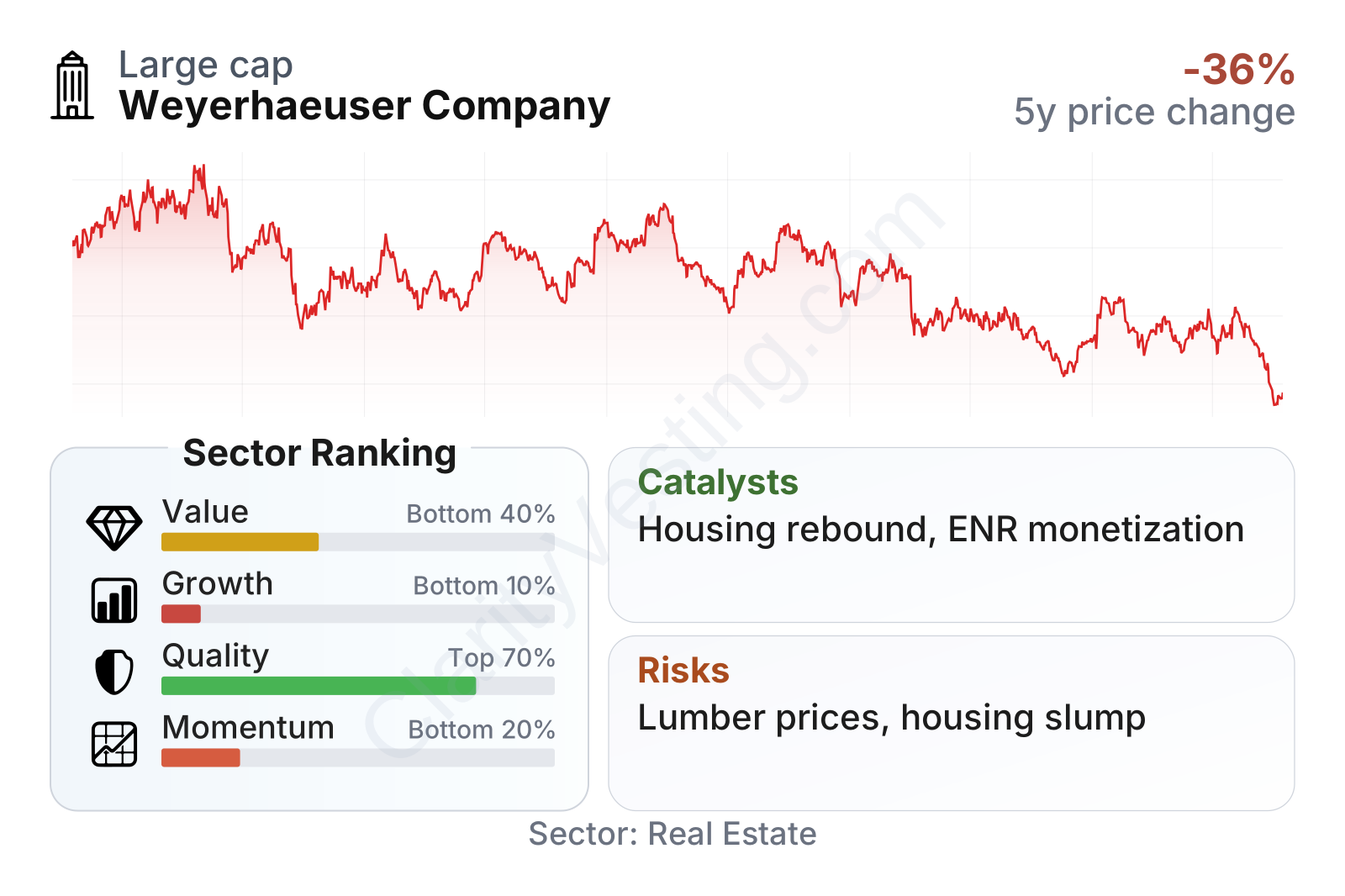
Weyerhaeuser is a large-cap company with a below-market beta of about 0.9, so its share price has historically been somewhat less volatile than the overall market. Even so, the stock has trended down over the last several years, reflecting weaker lumber markets and softer operating results rather than unusually high market risk.
The metric profile is mixed. On quality, the company sits around the upper-middle part of its sector, supported by a stronger long-term return record than many peers and balance-sheet leverage that remains below the sector median. But growth and momentum are notably weak. Revenue, earnings, free cash flow, and dividends have all moved lower over the last five years, and the stock’s recent price performance ranks near the bottom of the sector.
Valuation measures also look demanding compared with the broader real estate group. The earnings multiple and price-to-book ratio both sit above sector medians, while free cash flow is currently negative. In other words, the market is still assigning meaningful value to the company’s land base and normalized earnings potential even though current operating conditions remain subdued.
Growth
Weyerhaeuser operates in sectors that should remain structurally relevant for decades. Wood is a core building material, U.S. housing supply remains tight over the long run, and repair and remodeling activity creates recurring demand even when new-home construction slows. Timberland also has strategic value because it is difficult to replicate at scale, and forests can support more than just log production over time.
The challenge is that this is not a smooth growth business. Near-term performance depends heavily on lumber prices, panel prices, mill utilization, mortgage rates, and housing affordability. That means long-term demand can be favorable while short-term earnings still fluctuate sharply.
Weyerhaeuser’s strategy for future growth is sensible in that context. Management has continued to focus on high-quality timberlands, disciplined capital allocation, mill efficiency, and extracting more value from land through non-timber uses. The most interesting longer-term opportunity is the Real Estate, Energy & Natural Resources segment. Carbon credits, solar and wind land leases, and mineral-related income are still relatively small today, but they can generate higher-value revenue from land that the company already owns.
Revenue per share has moved lower since the 2021–2022 peak, which shows how cyclical the core business is. That decline does not necessarily mean the asset base is deteriorating, but it does show that recent years have been a downcycle rather than a period of sustained operating expansion.
The dividend pattern tells a similar story. Weyerhaeuser uses a base-plus-variable approach, so shareholder distributions can rise sharply in strong years and fall when cash generation weakens. That makes the payout more flexible than a rigid fixed dividend, but it also means income has been less predictable than at many traditional REITs.
A meaningful catalyst would be a recovery in U.S. housing activity, especially if lower interest rates improve affordability and lift single-family construction. A stronger lumber and oriented strand board pricing environment would likely have an outsized effect on earnings because Wood Products is the largest segment. In addition, continued expansion of natural-resource monetization could gradually make the business less dependent on pure lumber cycles.
Recent company communications have continued to emphasize operational improvements, portfolio management, and growth in higher-value land uses. None of these changes transforms the business overnight, but together they support a clearer path to better returns if the construction cycle becomes more favorable.
Risks
This article is for informational purposes only and does not constitute financial advice. Some content is AI-generated. See Disclaimer


