Stock Analysis · Want Want China Holdings Ltd (WWNTY)
Overview
Want Want China Holdings Ltd is a packaged food and beverages company best known for everyday consumer products sold across mainland China, with roots in rice crackers and a broad portfolio that now includes dairy drinks, snack foods, and other convenience items. The business targets mass-market consumption rather than premium niche categories, which makes it closely tied to household spending, retail traffic, and distribution strength.
The company’s revenue is mainly generated from branded food and beverage sales. Based on the latest annual reporting structure, the business is usually divided into three main product groups:
- Dairy products and beverages: approximately 50% to 55% of revenue. This category includes ready-to-drink milk beverages and related drinks, and it is typically the largest contributor.
- Rice crackers: approximately 20% to 25% of revenue. This is the legacy category that built the brand and still contributes a meaningful share of sales and brand recognition.
- Snack foods and other products: approximately 20% to 30% of revenue. This includes a broader mix of snack items and smaller product lines that help diversify the portfolio.
Geographically, the company is overwhelmingly exposed to China, which means its results depend heavily on domestic consumption trends, channel execution, and competition in the Chinese packaged food market.
The business model is straightforward: develop recognizable brands, manufacture at scale, distribute widely, and rely on repeat purchases. That model can be attractive for long-term analysis when paired with strong margins and disciplined balance sheet management, both of which have been visible in recent years.
The operating picture has been fairly stable over the last several years: revenue has hovered around a similar level, gross profit has remained solid, and net income recovered after a weaker period. The more notable recent change is that operating income fell in the latest fiscal year even though revenue stayed roughly flat, suggesting that selling and administrative expenses rose faster than sales.
Key Figures
| Metric | Value | Sector ⓘ |
|---|---|---|
| Date | Oct 10, 2026 | |
| Context | ||
| Sector | Consumer Defensive | |
| Industry | Packaged Foods | |
| Market Cap ⓘ | $4.59B | |
| Beta ⓘ | 0.34 | |
Value (Cheapness) | ||
| P/E Ratio ⓘ | 8.59 | 17.64 |
| P/B Ratio ⓘ | 0.23 | 1.27 |
| FCF Yield ⓘ | 125.56% | 12.68% |
| Dividend Yield ⓘ | 3.50% | 2.85% |
| EBIT / EV ⓘ | N/A | 6.32% |
| PEG ⓘ | 1.80 | |
Growth (Business expansion) | ||
| Revenue Growth ⓘ | 5.20% | 3.85% |
| RPS Growth (5Y CAGR) ⓘ | -0.04% | 6.20% |
| EPS Growth (5Y CAGR) ⓘ | 38.95% | -14.31% |
| BVPS Growth (5Y CAGR) ⓘ | 4.81% | 3.33% |
| Margin Growth (5Y Trend) ⓘ | -4.12% | -0.17% |
| FCF Growth (5Y CAGR) ⓘ | -0.58% | 4.37% |
| DPS Growth (5Y CAGR) ⓘ | -1.18% | 6.68% |
Quality (Business durability) | ||
| ROIC (Latest) ⓘ | N/A | 12.58% |
| ROA (Latest) ⓘ | 21.82% | 6.32% |
| ROIC (5Y Median) ⓘ | 16.11% | 10.38% |
| ROA (5Y Median) ⓘ | 13.76% | 5.44% |
| Net Debt / EBIT (Latest) ⓘ | -1.13 | 1.92 |
| Net Debt / EBIT (5Y Median) ⓘ | -0.67 | 2.32 |
| Net Debt / EBITDA (Latest) ⓘ | -0.98 | 1.36 |
| Net Debt / Assets ⓘ | -29.97% | 21.29% |
| EBITDA / Interest ⓘ | N/A | 9.52 |
| Operating Margin (Latest) ⓘ | 20.38% | 8.88% |
| Operating Margin (5Y Median) ⓘ | 22.18% | 9.53% |
| Debt to Equity (Latest) ⓘ | 14.13% | 71.95% |
| Profit Margin (Latest) ⓘ | 15.73% | 5.37% |
| Free Cash Flow (Latest) ⓘ | $5.76B | |
Momentum (Price trend) | ||
| 3Y Return ⓘ | -34.15% | +18.12% |
| 12M Return (excl. last month) ⓘ | -39.31% | +2.64% |
| 6M Return ⓘ | -31.65% | +1.32% |
| Price vs. 200-Day MA ⓘ | -25.03% | +0.17% |
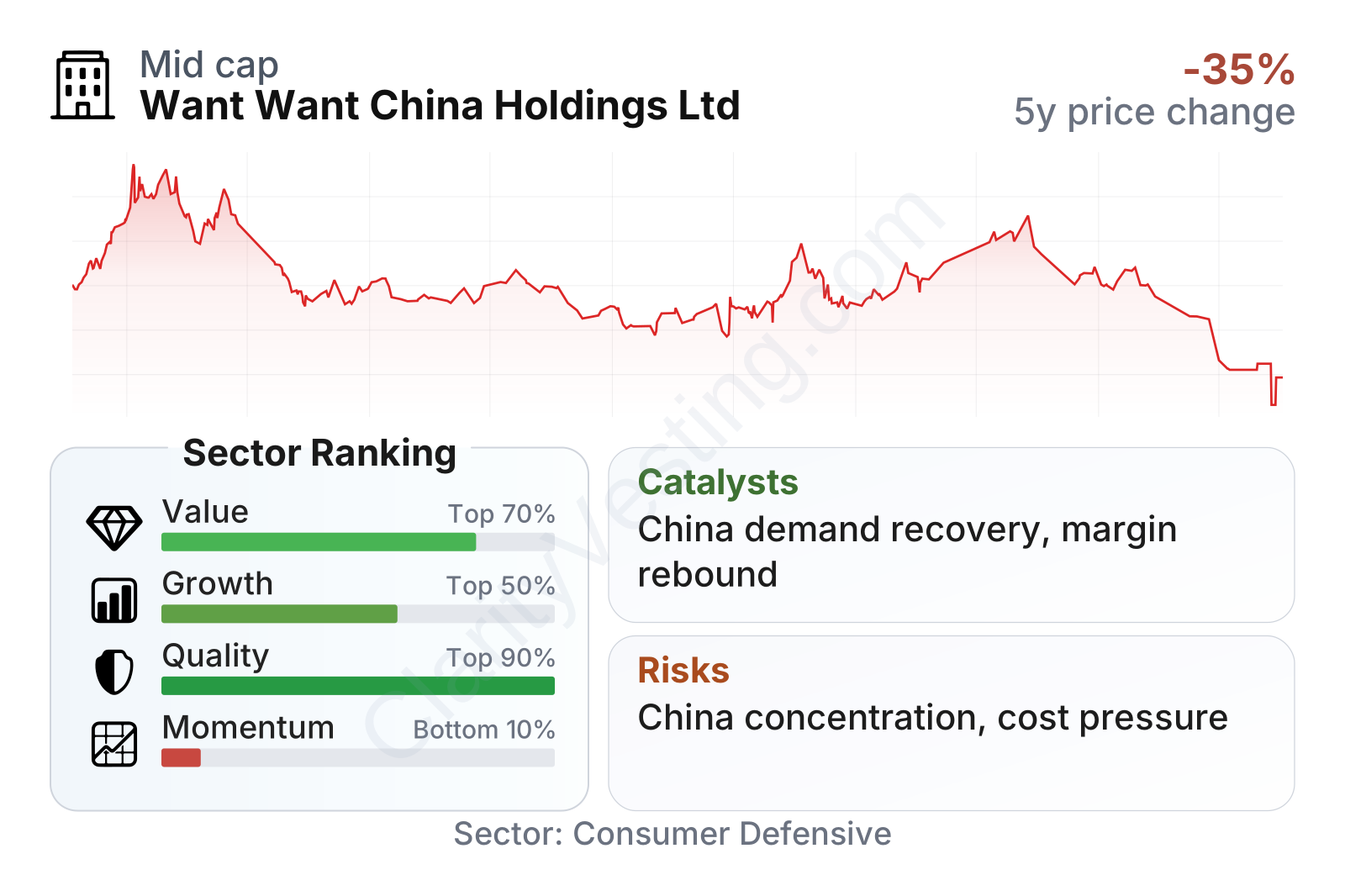
Want Want stands out on quality. Profitability is clearly ahead of the sector median, with operating margin around 20% and profit margin near 16%, both well above typical packaged food peers. Asset returns are also unusually strong. The balance sheet is another important strength: debt is modest, and net debt metrics indicate the company is in a net cash position rather than being heavily leveraged.
On growth, the picture is mixed. Recent year-over-year revenue growth is positive and slightly ahead of the sector median, but longer-term revenue per share and free cash flow growth have been mostly flat. Earnings growth over five years looks much better than the sector, though part of that reflects recovery from earlier softness rather than uninterrupted expansion.
On valuation, the stock screens as inexpensive versus the sector on earnings and book value multiples, while free cash flow yield appears exceptionally high. On momentum, however, the stock has been weak over the last 6 months, 12 months, and 3 years, showing that the market has not rewarded those fundamentals recently.
Growth
Want Want operates in the consumer staples sector, which is generally a mature market rather than a high-growth one. That matters because the long-term case depends less on rapid expansion and more on brand durability, efficient manufacturing, product refreshes, and the ability to defend shelf space in a highly competitive retail environment.
Within China, packaged foods and ready-to-drink beverages remain large and resilient categories because they are tied to habitual purchases. Even when the economy is uneven, staple snacks and drinks often hold up better than discretionary categories. For Want Want, that creates a base of recurring demand, especially if its brands remain familiar and affordable.
The company’s strategy for future growth appears sensible in a conservative way. It already has national brand recognition, broad distribution, and manufacturing scale. In that context, realistic growth drivers are likely to come from better product mix, channel execution, penetration into lower-tier cities, and steady expansion of higher-margin categories rather than transformational leaps.
Recent revenue growth has turned positive, which is a useful sign after several years of largely stable sales. The pace is not dramatic, but it does suggest the business is still capable of moving forward in a mature category.
Cash generation remains one of the company’s most important strengths. Free cash flow has stayed substantial, even if the multi-year trend has not shown strong expansion. That gives the group flexibility to support dividends, maintain production capacity, and absorb periods of weaker demand without relying on heavy borrowing.
One meaningful catalyst is the combination of a strong balance sheet and high profitability in a sector where many companies face margin pressure. If management can stabilize operating expenses and improve sales mix, even modest revenue growth could translate into solid earnings conversion. Another possible catalyst is any broader recovery in Chinese consumer sentiment, since the company is closely linked to mass-market domestic spending.
Recent annual results also indicate that revenue remained steady despite pressure on operating income. That combination can matter for future periods: if costs normalize or selling expenses become more efficient, margin recovery could become a significant earnings lever without requiring major top-line acceleration.
Risks
This article is for informational purposes only and does not constitute financial advice. Some content is AI-generated. See Disclaimer


