Stock Analysis · Want Want China Holdings Limited (WWNTF)
Overview
Want Want China Holdings Limited is a packaged food and beverage company best known for rice crackers, flavored milk, snack foods, and ready-to-drink products sold mainly in Greater China. The group traces its roots to Taiwan and built its scale in mainland China through a broad distribution network, strong brand recognition, and a product lineup aimed at mass-market daily consumption. Its business sits in the consumer staples category, which usually means demand is steadier than in more cyclical industries because consumers keep buying affordable food and drinks even during weaker economic periods.
The company’s revenue is mainly generated from three operating segments disclosed in its annual reporting. Based on the latest annual report for the fiscal year ended March 31, 2026, the mix is approximately:
- Rice crackers: about 24% — the company’s traditional core category, including its well-known rice snack products.
- Dairy products and beverages: about 53% — the largest source of sales, mainly flavored milk drinks, yogurt-style beverages, and other packaged drinks.
- Snack foods and other products: about 23% — a wider range including confectionery, savory snacks, and related packaged food items.
This mix matters because it shows Want Want is no longer just a rice cracker company. Beverages are now the main economic engine, while snacks add diversification across price points and consumption occasions.
Over the last several years, the business has generally kept revenue around the same broad range, but profitability has been more volatile. Gross profit remained resilient through fiscal 2025, then operating income fell more sharply in fiscal 2026 as selling and administrative expenses rose materially. That points to a business with strong product economics, but one that still needs tighter cost discipline to fully convert sales into earnings.
The operating structure shows a consumer business with healthy gross margins and historically solid earnings conversion, but the latest year also highlights how a spike in overhead and selling costs can pressure profits even when revenue stays broadly flat.
Key Figures
| Metric | Value | Sector ⓘ |
|---|---|---|
| Date | Oct 17, 2026 | |
| Context | ||
| Sector | Consumer Defensive | |
| Industry | Packaged Foods | |
| Market Cap ⓘ | $4.31B | |
| Beta ⓘ | 0.34 | |
Value (Cheapness) | ||
| P/E Ratio ⓘ | 7.40 | 17.88 |
| P/B Ratio ⓘ | 0.22 | 1.29 |
| FCF Yield ⓘ | 133.33% | 12.39% |
| Dividend Yield ⓘ | 25.68% | 2.85% |
| EBIT / EV ⓘ | N/A | 6.43% |
| PEG ⓘ | 3.85 | |
Growth (Business expansion) | ||
| Revenue Growth ⓘ | 5.20% | 4.10% |
| RPS Growth (5Y CAGR) ⓘ | -0.16% | 6.18% |
| EPS Growth (5Y CAGR) ⓘ | -0.92% | -13.59% |
| BVPS Growth (5Y CAGR) ⓘ | 4.81% | 3.20% |
| Margin Growth (5Y Trend) ⓘ | -4.12% | -0.15% |
| FCF Growth (5Y CAGR) ⓘ | -0.70% | 4.10% |
| DPS Growth (5Y CAGR) ⓘ | -1.30% | 6.79% |
Quality (Business durability) | ||
| ROIC (Latest) ⓘ | N/A | 12.34% |
| ROA (Latest) ⓘ | 21.80% | 6.30% |
| ROIC (5Y Median) ⓘ | 16.11% | 10.49% |
| ROA (5Y Median) ⓘ | 13.76% | 5.44% |
| Net Debt / EBIT (Latest) ⓘ | -1.13 | 1.96 |
| Net Debt / EBIT (5Y Median) ⓘ | -0.67 | 2.35 |
| Net Debt / EBITDA (Latest) ⓘ | -0.95 | 1.38 |
| Net Debt / Assets ⓘ | -29.97% | 21.51% |
| EBITDA / Interest ⓘ | N/A | 9.46 |
| Operating Margin (Latest) ⓘ | 20.39% | 8.87% |
| Operating Margin (5Y Median) ⓘ | 22.18% | 9.53% |
| Debt to Equity (Latest) ⓘ | 14.13% | 72.35% |
| Profit Margin (Latest) ⓘ | 15.73% | 5.40% |
| Free Cash Flow (Latest) ⓘ | $5.75B | |
Momentum (Price trend) | ||
| 3Y Return ⓘ | -34.29% | +20.92% |
| 12M Return (excl. last month) ⓘ | -21.09% | +2.13% |
| 6M Return ⓘ | -29.66% | +1.26% |
| Price vs. 200-Day MA ⓘ | -29.16% | +1.39% |
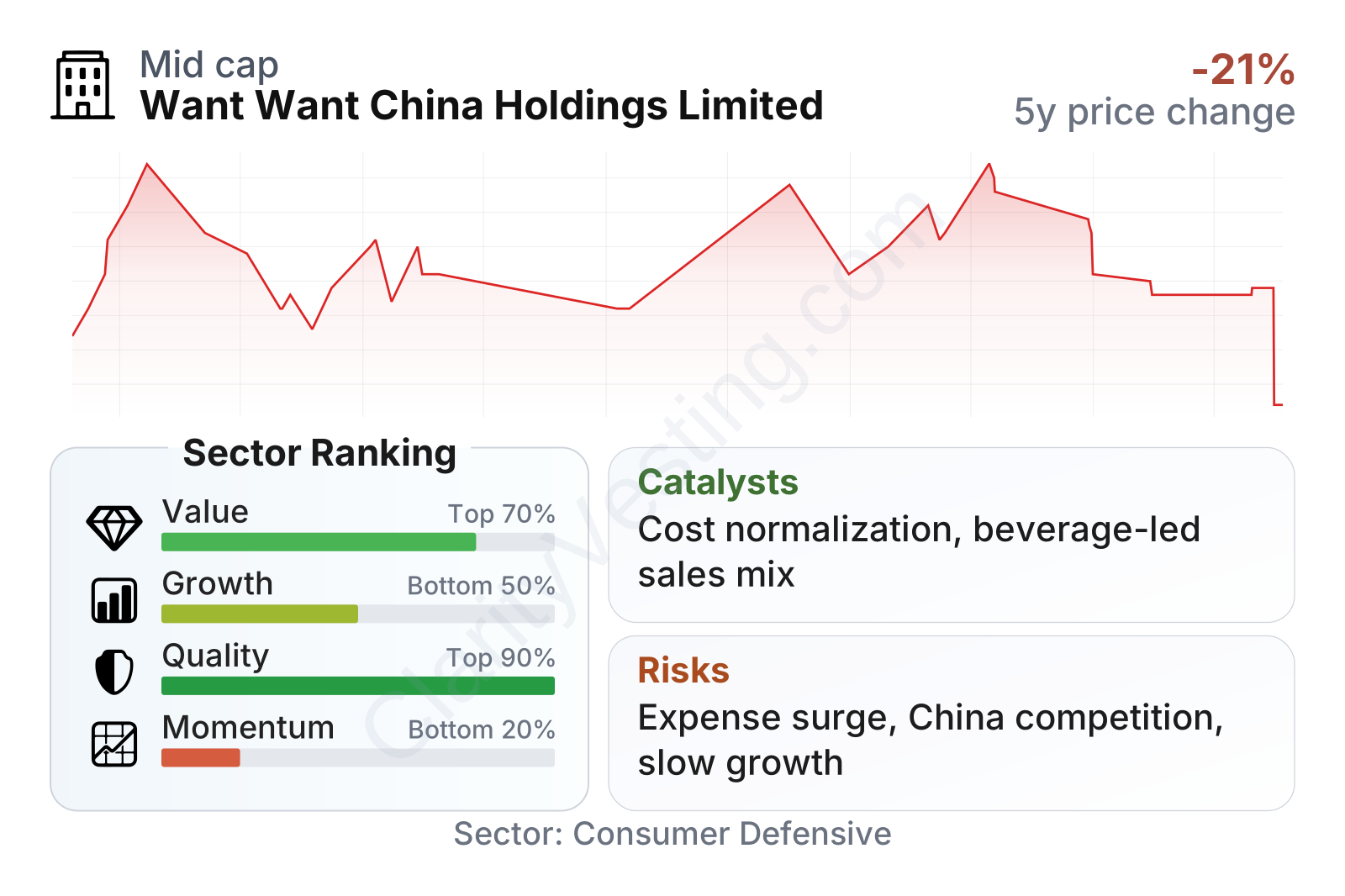
Want Want stands out more for quality and balance-sheet strength than for fast expansion. Profitability metrics are well above the sector median, leverage is very low, and the company holds a net cash position rather than relying heavily on debt. The stock’s volatility is also low, which fits the profile of a mature consumer staples business. On the other hand, growth metrics are mixed, with recent revenue improvement but a softer multiyear trend in sales per share, free cash flow growth, and margin progression. Market performance has also lagged much of the sector over the last year and over a three-year view.
Growth
Want Want operates in packaged foods and beverages, a sector that usually grows more slowly than technology or industrial niches, but tends to be durable. In China, long-term demand for branded convenience foods and ready-to-drink beverages still has structural support from urban lifestyles, broad retail penetration, and demand for trusted food brands. That said, this is a mature market in many categories, so growth often depends more on market share gains, product refreshes, and distribution efficiency than on rapid industry expansion.
The company’s strategy still makes sense for future growth because its biggest segment is beverages, which gives it exposure to repeat-purchase consumption. A large installed distribution network can also be a meaningful advantage when launching new flavors, formats, or lower-price products tailored to a more cautious consumer environment. The latest annual results showed year-over-year revenue growth of roughly 5%, which is slightly better than the sector median, so the business is still capable of growing even if the longer trend has been uneven.
One useful signal is cash generation. Even with weaker profit conversion in the latest fiscal year, Want Want continues to produce substantial free cash flow in absolute terms. That gives management room to fund marketing, protect distribution, and continue dividends without leaning on borrowings.
A relevant catalyst is the company’s ability to restore operating efficiency after the sharp rise in selling and administrative expenses during fiscal 2026. If that increase proves temporary or partly strategic rather than structural, earnings could recover more quickly than revenue alone would suggest. Another potential support is continued premiumization and product innovation in beverages and snacks, where brand familiarity matters and shelf presence can compound over time.
There does not appear to be a single transformational recent event that changes the whole investment case. Instead, the more important opportunity is operational: stabilizing costs, defending brand strength, and extracting more profit from a business that already has scale and cash generation.
Risks
This article is for informational purposes only and does not constitute financial advice. Some content is AI-generated. See Disclaimer


