Stock Analysis · Worldline SA (WWLNF)
Overview
Worldline SA is a European payments technology company. It provides the infrastructure that lets merchants, banks, public institutions, and large businesses accept and process digital payments. In simple terms, Worldline helps move money securely between shoppers, stores, banks, and other financial players, whether the payment happens in a physical store, online, or through other digital channels.
The business was built around merchant payment services and later expanded through acquisitions, most notably Ingenico. That made Worldline one of the larger payment processors in Europe, with a broad footprint across card payments, online payments, acquiring services, and specialized transaction processing.
Based on the company’s reporting structure, revenue mainly comes from three business lines.
- Merchant Services: approximately 70% to 75% of revenue. This is the largest activity and includes payment acceptance for merchants, card acquiring, point-of-sale terminals, e-commerce payment processing, and related digital commerce services.
- Financial Services: approximately 15% to 20% of revenue. This segment serves banks and financial institutions with account payments, issuing processing, digital banking, and other transaction-related services.
- Mobility & e-Transactional Services: approximately 10% to 15% of revenue. This includes digital services for transport, public sector, healthcare, and trusted transaction platforms such as e-ticketing and e-government solutions.
From a business model perspective, Worldline benefits from recurring transaction volumes. That can be attractive in stable conditions because electronic payments are used every day. However, recent results show that transaction growth alone has not been enough to protect profitability.
The profit flow over recent years shows a mixed picture. Revenue rose from roughly €3.7 billion in 2021 to around €4.6 billion in 2024 before falling back to about €4.0 billion in 2025. Gross profit improved through 2024, but operating income and net income became highly volatile, reflecting restructuring charges, impairments, and pressure on the business mix rather than a clean deterioration in payment volumes alone.
Key Figures
| Metric | Value | Sector ⓘ |
|---|---|---|
| Date | Oct 03, 2026 | |
| Context | ||
| Sector | Technology | |
| Industry | Software - Infrastructure | |
| Market Cap ⓘ | $656.07M | |
| Beta ⓘ | 1.84 | |
Value (Cheapness) | ||
| P/E Ratio ⓘ | N/A | 29.95 |
| FCF Yield ⓘ | 49.54% | 4.22% |
| Dividend Yield ⓘ | N/A | 1.30% |
| EBIT / EV ⓘ | N/A | 2.83% |
| PEG ⓘ | 0.31 | |
Growth (Business expansion) | ||
| Revenue Growth ⓘ | -3.70% | 15.80% |
| RPS Growth (5Y CAGR) ⓘ | 2.18% | 8.55% |
| EPS Growth (5Y CAGR) ⓘ | -37.10% | -11.72% |
| Margin Growth (5Y Trend) ⓘ | -5.55% | 0.39% |
| FCF Growth (5Y CAGR) ⓘ | -30.84% | 9.72% |
| DPS Growth (5Y CAGR) ⓘ | N/A | 7.73% |
Quality (Business durability) | ||
| ROIC (Latest) ⓘ | 0.42% | 9.36% |
| ROIC (5Y Median) ⓘ | 1.04% | 8.32% |
| Net Debt / EBIT (Latest) ⓘ | 27.04 | 0.50 |
| Net Debt / EBIT (5Y Median) ⓘ | 10.99 | 0.46 |
| Net Debt / EBITDA (Latest) ⓘ | 1.05 | 0.28 |
| Net Debt / Assets ⓘ | 8.88% | 3.44% |
| EBITDA / Interest ⓘ | 6.63 | 12.67 |
| Operating Margin (Latest) ⓘ | 0.52% | 9.81% |
| Operating Margin (5Y Median) ⓘ | 2.92% | 8.50% |
| Debt to Equity (Latest) ⓘ | 80.77% | 33.33% |
| Profit Margin (Latest) ⓘ | -25.22% | 7.15% |
| Free Cash Flow (Latest) ⓘ | $324.99M | |
Momentum (Price trend) | ||
| 3Y Return ⓘ | -95.95% | +49.46% |
| 12M Return (excl. last month) ⓘ | -67.01% | +16.51% |
| 6M Return ⓘ | -38.95% | +24.29% |
| Price vs. 200-Day MA ⓘ | -19.20% | +4.74% |
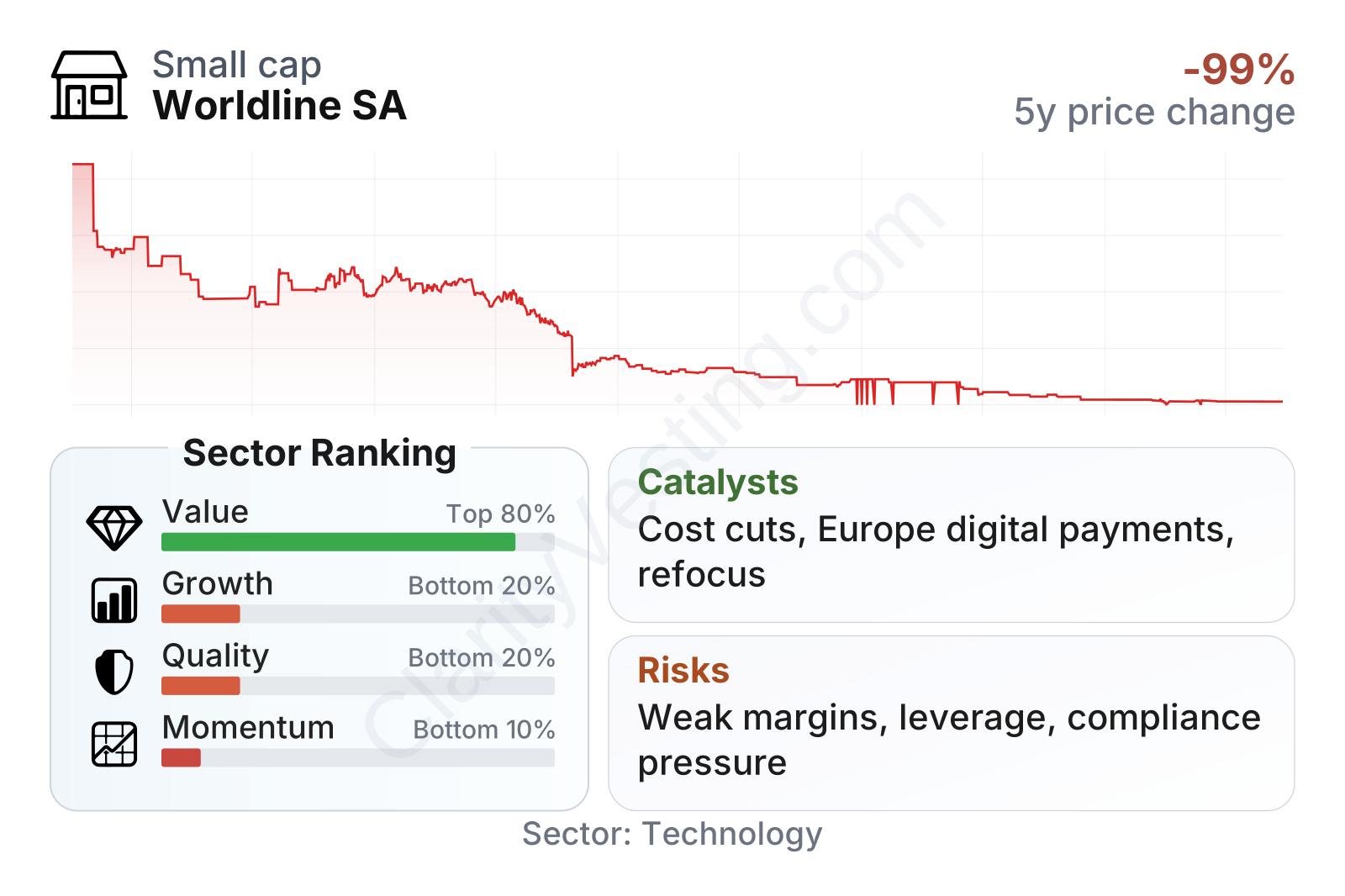
Worldline currently looks cheap on several valuation metrics, but that signal needs to be handled carefully. The low earnings multiple, high free cash flow yield, and low PEG ratio stand out against the broader technology sector. At the same time, the company ranks poorly on growth, quality, and momentum. In practice, that means the market is attaching a very low price to a business that still generates cash, but whose profitability, returns on capital, and recent operating trajectory have weakened sharply.
The stock’s long decline is also important context. Over the last several years, the share price has fallen dramatically, and recent trading has remained weak relative to the sector. With a beta near 1.8, the stock has also been more volatile than the market on average, so changes in sentiment can be amplified.
Growth
Worldline operates in a sector that still has favorable long-term demand drivers. Cash usage continues to decline in many markets, online commerce remains structurally important, and businesses keep outsourcing payment acceptance and transaction security to specialized platforms. Europe also remains more fragmented than the U.S. in payments, which creates room for scale players that can serve merchants across many countries.
On paper, Worldline’s strategy has a clear logic. The company has tried to build scale in merchant acquiring, strengthen omnichannel capabilities, and cross-sell services to banks and large merchants. A broad European footprint can be useful because merchants increasingly want one provider for in-store, online, and cross-border payments. If execution improves, that platform could support better operating leverage over time.
The challenge is that recent performance has not matched the industry backdrop. Organic growth has been weak, and some merchant categories have been more difficult than expected. The company has also been reshaping parts of its portfolio and tightening risk controls, which may improve the quality of revenue but can reduce short-term volume growth.
A potential catalyst is operational simplification. Management has been working on cost reduction, portfolio review, and tighter focus on core activities. If those actions stabilize merchant performance and protect margins, the gap between sector growth and Worldline’s recent results could narrow. Another possible opportunity is continued migration toward digital payments in continental Europe, where penetration still has room to increase in some markets and industries.
Recent company communications have also centered on restoring discipline after a period of disruption. That matters because payments businesses often improve noticeably once risk management, pricing, and sales focus are aligned. In other words, the sector itself remains supportive; the main question is whether Worldline can convert that tailwind into healthier execution.
Risks
This article is for informational purposes only and does not constitute financial advice. Some content is AI-generated. See Disclaimer


