Stock Analysis · Woodward Inc (WWD)
Overview
Woodward Inc is an industrial technology company focused on control systems and components used mainly in aerospace and energy-related applications. Its products help regulate fuel, air, combustion, motion, and electrical power in demanding environments where reliability matters. In simple terms, Woodward sells highly engineered parts and systems that help aircraft engines, turbines, and industrial equipment run safely and efficiently.
The business is organized around two main segments, and aerospace is the larger one. Based on the company’s latest annual reporting for fiscal 2025, revenue sources were approximately:
- Aerospace: about 64% of revenue. This includes fuel pumps, actuators, valves, propulsion controls, and other systems used on commercial aircraft, business jets, defense platforms, and aftermarket service work.
- Industrial: about 36% of revenue. This segment includes control systems and components for gas turbines, reciprocating engines, power generation, marine applications, and parts supporting the energy transition such as power management and hydrogen-related solutions.
Within those segments, Woodward also benefits from a mix of original equipment sales and aftermarket demand. That matters because aftermarket activity, especially in aerospace, tends to be steadier and often carries attractive margins once aircraft and engine platforms are already in service.
The business model is fairly straightforward: Woodward invests in engineering, wins positions on long-life platforms, then earns revenue for many years through production, replacement parts, repair, and support. That gives the company a combination of cyclical exposure and recurring follow-on demand.
The long-term financial picture has improved meaningfully in recent years. Revenue has climbed from roughly $2.2 billion in fiscal 2021 to about $3.6 billion in fiscal 2025, while operating income and net income have grown even faster. Margins have expanded as aerospace recovered and execution improved.
Over the last several years, the company has converted more of each sales dollar into operating profit and net income. Research and development spending has also remained material, which fits a business that competes through technical capability and long product cycles rather than commodity pricing.
Key Figures
| Metric | Value | Sector ⓘ |
|---|---|---|
| Date | Oct 24, 2026 | |
| Context | ||
| Sector | Industrials | |
| Industry | Aerospace & Defense | |
| Market Cap ⓘ | $19.13B | |
| Beta ⓘ | 0.86 | |
Value (Cheapness) | ||
| P/E Ratio ⓘ | 36.62 | 22.29 |
| P/B Ratio ⓘ | 8.06 | 1.98 |
| FCF Yield ⓘ | 1.97% | 6.26% |
| Dividend Yield ⓘ | 0.30% | 1.92% |
| EBIT / EV ⓘ | 3.66% | 4.83% |
| PEG ⓘ | 2.11 | |
Growth (Business expansion) | ||
| Revenue Growth ⓘ | 21.20% | 9.30% |
| RPS Growth (5Y CAGR) ⓘ | 14.09% | 7.76% |
| EPS Growth (5Y CAGR) ⓘ | 26.02% | -13.17% |
| BVPS Growth (5Y CAGR) ⓘ | 5.44% | 6.13% |
| Margin Growth (5Y Trend) ⓘ | 3.43% | 0.74% |
| FCF Growth (5Y CAGR) ⓘ | -5.51% | 10.79% |
| DPS Growth (5Y CAGR) ⓘ | 17.76% | 9.41% |
Quality (Business durability) | ||
| ROIC (Latest) ⓘ | 16.61% | 10.75% |
| ROA (Latest) ⓘ | 11.24% | 5.41% |
| ROIC (5Y Median) ⓘ | 21.87% | 9.37% |
| ROA (5Y Median) ⓘ | 5.95% | 4.95% |
| Net Debt / EBIT (Latest) ⓘ | 1.20 | 2.04 |
| Net Debt / EBIT (5Y Median) ⓘ | 1.22 | 2.27 |
| Net Debt / EBITDA (Latest) ⓘ | 1.03 | 1.39 |
| Net Debt / Assets ⓘ | 17.03% | 19.27% |
| EBITDA / Interest ⓘ | 18.08 | 9.58 |
| Operating Margin (Latest) ⓘ | 17.59% | 10.49% |
| Operating Margin (5Y Median) ⓘ | 12.47% | 10.30% |
| Debt to Equity (Latest) ⓘ | 54.98% | 64.82% |
| Profit Margin (Latest) ⓘ | 13.17% | 6.67% |
| Free Cash Flow (Latest) ⓘ | $376.53M | |
Momentum (Price trend) | ||
| 3Y Return ⓘ | +166.08% | +67.77% |
| 12M Return (excl. last month) ⓘ | +37.06% | +12.05% |
| 6M Return ⓘ | -14.34% | 0.00% |
| Price vs. 200-Day MA ⓘ | -10.84% | +0.67% |
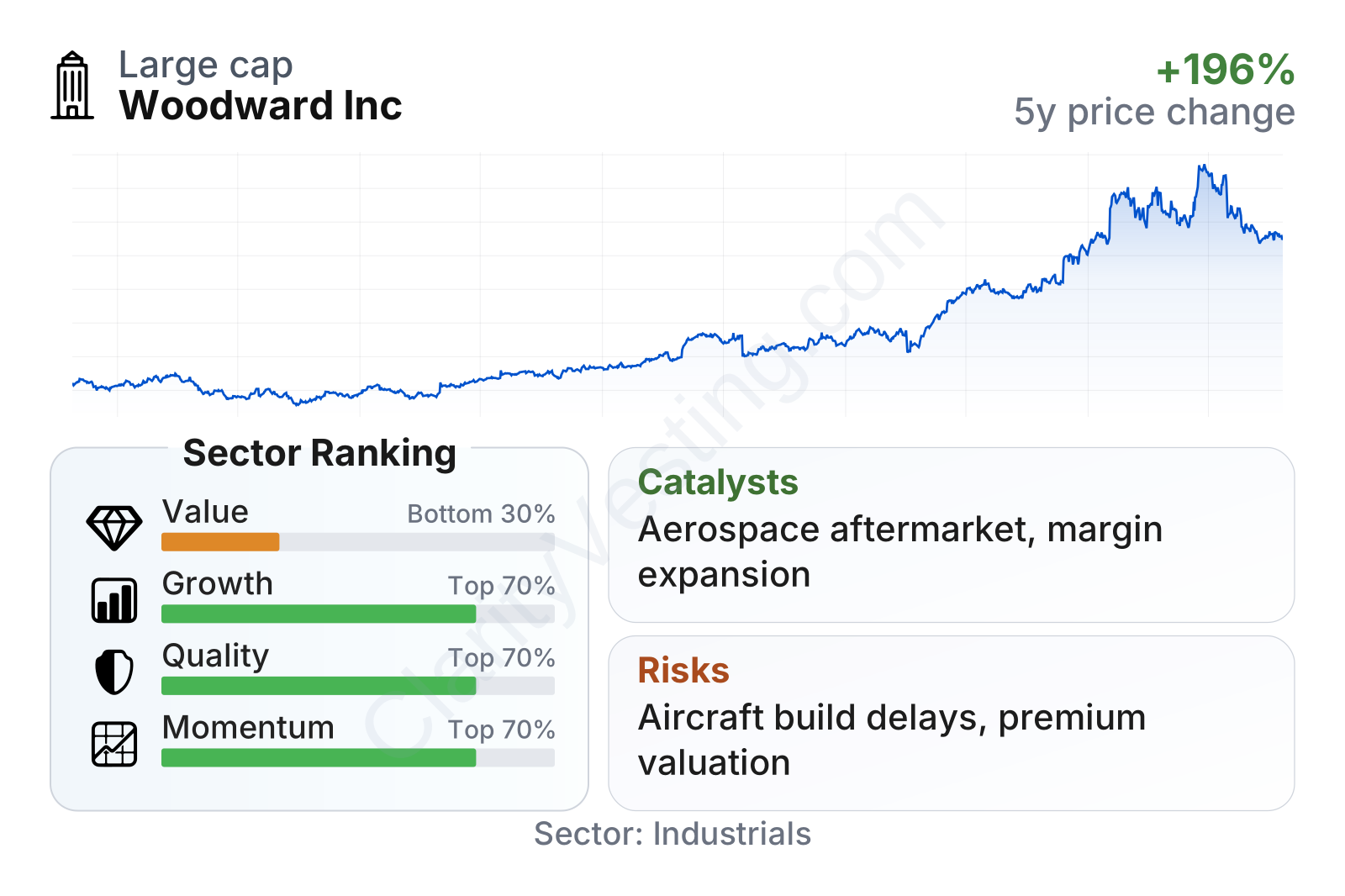
Woodward is now a large industrial company by market value, with a share price that has appreciated strongly over the last three years despite some recent volatility. The overall metric profile is mixed in an interesting way: growth, quality, and longer-term momentum rank above much of the sector, while valuation looks expensive relative to peers. Profitability is clearly strong, with returns on capital and operating margins well above sector medians, and leverage remains manageable. The weaker area is valuation, where the stock trades at noticeably richer multiples and offers a low cash flow yield and very small dividend yield.
Growth
Woodward operates in sectors that still have visible long-term demand drivers. In aerospace, commercial air travel continues to normalize, aircraft utilization remains healthy, and global fleets need more parts, repairs, and upgrades. Defense demand also provides support, although Woodward is not one of the giant prime contractors. In industrial markets, the company has exposure to power generation, grid support, gas turbines, marine systems, and cleaner-energy technologies, which can benefit from modernization and efficiency spending.
The company’s strategy also makes sense for future growth. Woodward focuses on niches where performance, certification, and reliability are critical. That creates long product lives and high switching costs once a platform is established. Its mix of original equipment content and aftermarket sales can create a compounding effect: each installed product base can generate additional revenue later through service and replacement demand.
Revenue growth has been strong over the last several quarters, generally running ahead of the broader sector. There has been some unevenness, which is normal in aerospace and industrial supply chains, but the recent pattern still points to a business that has moved well beyond the post-pandemic recovery phase and is now expanding from a higher base.
Cash generation has also recovered well. Free cash flow has improved sharply from the low point seen earlier in the cycle and is now materially higher than it was a few years ago. That supports flexibility for research spending, dividends, debt management, and share repurchases without making the balance sheet look stretched.
A major catalyst is continued aerospace aftermarket strength. Airlines and operators often keep older aircraft flying longer when new aircraft deliveries are delayed, which can support repair and replacement demand. Another catalyst is broader demand for fuel efficiency and emissions improvement. Woodward’s controls and optimization systems are tied directly to those needs. The industrial segment could also benefit if gas turbine demand, distributed power investments, and energy transition projects remain active.
Recent company updates through fiscal 2026 have pointed to strong sales growth and margin performance, especially with aerospace remaining a key driver. The combination of revenue expansion, better margins, and healthy free cash flow is the main reason the market has rewarded the stock so aggressively.
Risks
This article is for informational purposes only and does not constitute financial advice. Some content is AI-generated. See Disclaimer