Stock Analysis · WesBanco Inc (WSBC)
Overview
WesBanco, Inc. is a regional bank headquartered in West Virginia. It provides traditional banking services to consumers, businesses, and local communities across parts of the Midwest and Mid-Atlantic. Like many regional banks, its business is built around gathering deposits, making loans, earning interest income, and selling fee-based financial services.
The company operates through two main segments: community banking and trust and investment services. Community banking is by far the larger business and includes commercial real estate lending, commercial and industrial loans, residential mortgages, consumer lending, deposit accounts, and treasury management. Trust and investment services include wealth management, fiduciary services, brokerage-related activities, and investment management for individuals, institutions, and employee benefit plans.
Based on recent annual reporting, WesBanco’s revenue mix is still dominated by spread-based banking income, with a smaller but useful contribution from fees. Approximate sources of revenue are:
- Net interest income after provision for credit losses: about 75% to 85%. This is the core banking spread between what the bank earns on loans and securities and what it pays on deposits and borrowings, adjusted for credit-loss provisioning.
- Service charges on deposits: about 4% to 6%. This includes account-related fees paid by retail and business customers.
- Trust fees and investment services income: about 4% to 6%. This comes from wealth management, trust administration, and related advisory activity.
- Mortgage banking income: about 1% to 3%. This reflects mortgage origination and secondary market activity, which can fluctuate with interest rates and housing demand.
- Insurance commissions, bank-owned life insurance, securities gains, and other non-interest income: about 5% to 10%. These are smaller and more variable revenue streams.
That mix matters because it shows WesBanco is still primarily an old-fashioned spread lender. It is not a highly diversified financial company, but it does have some fee income that helps soften the pressure when lending margins tighten.
Over the last several years, total revenue has expanded meaningfully, but the path to profit has been less smooth. Interest expense and operating costs rose sharply as rates moved higher and funding became more expensive, which limited the benefit of stronger revenue growth. The business remains profitable, but earnings quality depends heavily on how well management protects deposit costs and credit performance.
Key Figures
| Metric | Value | Sector ⓘ |
|---|---|---|
| Date | Oct 24, 2026 | |
| Context | ||
| Sector | Financial Services | |
| Industry | Banks - Regional | |
| Market Cap ⓘ | $3.61B | |
| Beta ⓘ | 0.71 | |
Value (Cheapness) | ||
| P/E Ratio ⓘ | 10.85 | 12.46 |
| P/B Ratio ⓘ | 0.93 | 1.25 |
| FCF Yield ⓘ | 10.44% | 9.82% |
| Dividend Yield ⓘ | 4.01% | 2.94% |
| EBIT / EV ⓘ | N/A | 8.11% |
| PEG ⓘ | 1.23 | |
Growth (Business expansion) | ||
| Revenue Growth ⓘ | 3.50% | 9.10% |
| RPS Growth (5Y CAGR) ⓘ | 14.57% | 12.31% |
| EPS Growth (5Y CAGR) ⓘ | -3.09% | -6.97% |
| BVPS Growth (5Y CAGR) ⓘ | 3.73% | 5.02% |
| Margin Growth (5Y Trend) ⓘ | -29.85% | -4.00% |
| FCF Growth (5Y CAGR) ⓘ | -3.86% | 4.71% |
| DPS Growth (5Y CAGR) ⓘ | 1.53% | 8.92% |
Quality (Business durability) | ||
| ROIC (Latest) ⓘ | N/A | 9.18% |
| ROE (Latest) ⓘ | 8.92% | 13.93% |
| ROA (Latest) ⓘ | 1.29% | 1.57% |
| ROIC (5Y Median) ⓘ | 4.73% | 7.80% |
| ROE (5Y Median) ⓘ | 6.54% | 12.15% |
| ROA (5Y Median) ⓘ | 0.96% | 1.28% |
| Net Debt / EBIT (Latest) ⓘ | N/A | 1.02 |
| Net Debt / EBIT (5Y Median) ⓘ | 4.88 | 0.72 |
| Net Debt / EBITDA (Latest) ⓘ | 1.85 | 0.88 |
| Operating Margin (Latest) ⓘ | N/A | 22.30% |
| Operating Margin (5Y Median) ⓘ | 23.52% | 24.50% |
| Debt to Equity (Latest) ⓘ | 2.79% | 59.34% |
| Profit Margin (Latest) ⓘ | 34.01% | 26.42% |
| Free Cash Flow (Latest) ⓘ | $376.84M | |
Momentum (Price trend) | ||
| 3Y Return ⓘ | +90.30% | +95.73% |
| 12M Return (excl. last month) ⓘ | +25.34% | +17.30% |
| 6M Return ⓘ | +20.64% | +6.07% |
| Price vs. 200-Day MA ⓘ | +7.48% | +5.36% |
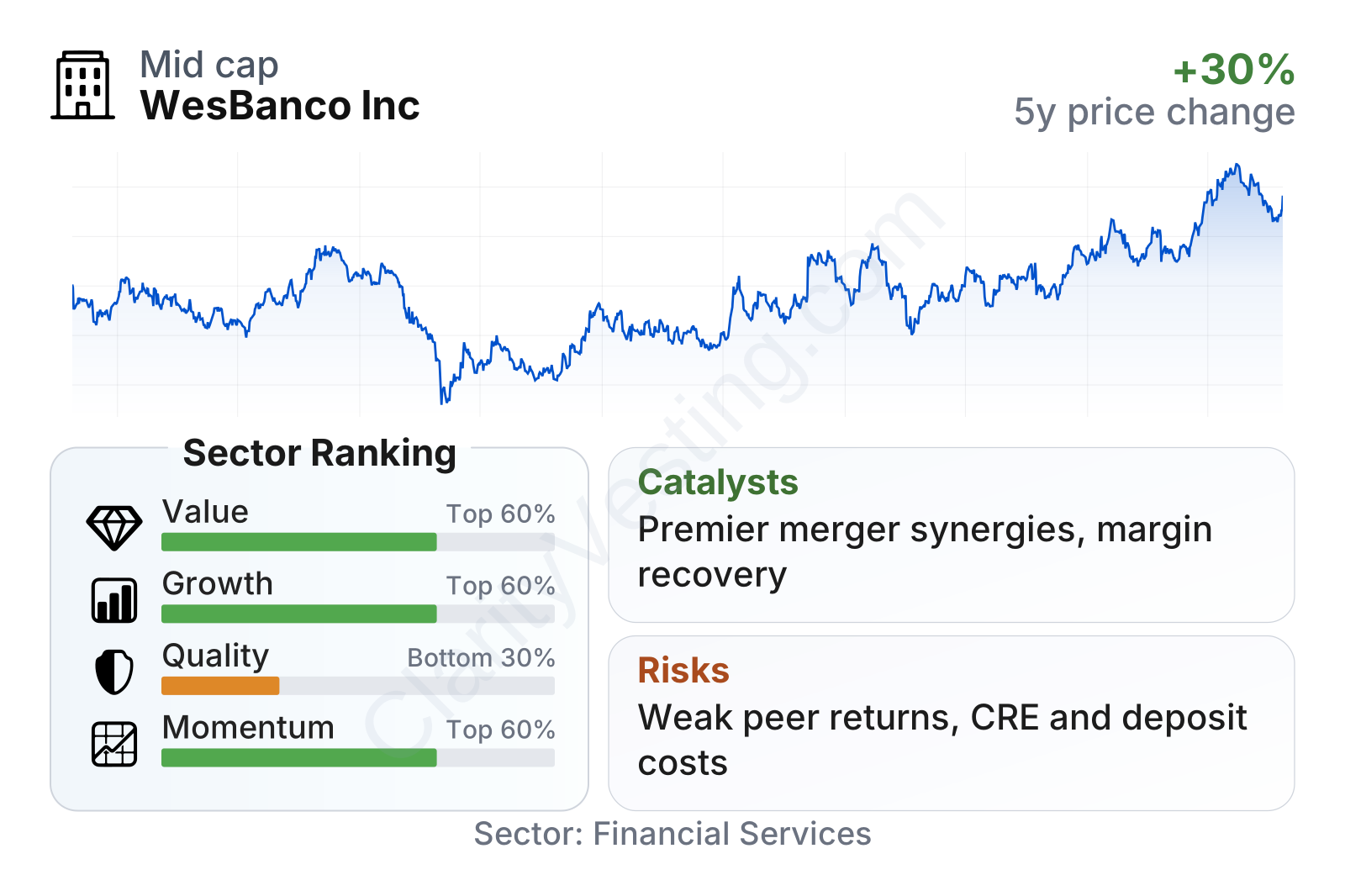
WesBanco sits in the mid-sized regional bank category, with a stock that has shown relatively low volatility compared with the broader market. The overall snapshot is mixed: valuation looks cheaper than the sector on earnings and book value, momentum has improved, but growth and quality measures remain below many peers. The dividend yield is above the sector median, which helps support total return, while profitability ratios suggest the company is still working to regain stronger operating efficiency.
The share price trend has recovered well from the 2023 regional bank stress period and has moved to new multi-year highs by mid-2026. That rebound suggests the market has become more comfortable with balance-sheet resilience, although the stock’s progress has been stronger than the company’s underlying profitability improvement so far.
Growth
Regional banking is not a fast-growth industry in the way software or semiconductors can be, but it remains an essential part of the financial system. Long-term growth usually comes from a combination of loan expansion, branch density in attractive markets, acquisitions, wealth management cross-selling, and disciplined control of funding costs. For WesBanco, that means the company’s future is tied less to disruption and more to steady execution.
Its strategy broadly makes sense for that environment. WesBanco has historically emphasized community banking relationships, commercial lending, and a fee income layer through trust and investment services. This model can work well when a bank has stable local market positions and the ability to deepen customer relationships across deposits, lending, and wealth products. The company also gained scale through its merger with Premier Financial, which closed in 2025, expanding its footprint and creating a larger platform for cost savings and revenue cross-selling.
The biggest near-term catalyst is integration execution after that merger. If management delivers expense synergies, retains deposits, and avoids meaningful credit deterioration, the larger combined franchise could improve earnings power beyond what the legacy bank produced on its own. In regional banking, scale can matter because a larger asset base can spread compliance, technology, and branch costs more efficiently.
Earnings per share show why that catalyst matters. Profitability declined from 2021 through 2024 before rebounding in 2025, which points to a business that has already been through margin pressure and is now trying to rebuild earnings capacity. A durable recovery would likely require both merger-related efficiencies and a more favorable balance between asset yields and funding costs.
Book value per share has risen steadily over the last five years, though the pace has been modest. That trend is important for a bank because book value reflects the capital base supporting future lending and loss absorption. Steady book value growth suggests the franchise has continued to build underlying balance-sheet value even while earnings were uneven.
Another possible tailwind is the interest-rate cycle. If deposit pricing pressure eases faster than loan yields reset downward, regional banks like WesBanco can see improved net interest margins. That is not guaranteed, but it is one of the main operating levers that could lift results without requiring rapid economic growth.
Risks
This article is for informational purposes only and does not constitute financial advice. Some content is AI-generated. See Disclaimer


