Stock Analysis · Terawulf Inc (WULF)
Overview
Terawulf is a digital infrastructure company best known for operating large-scale facilities that support Bitcoin mining and high-performance computing. In simple terms, it runs power-intensive data centers and uses that capacity either to mine Bitcoin or to host computing equipment for customers that need large amounts of electricity and processing power. The company has emphasized sites with access to low-cost power and a high share of zero-carbon energy, which is an important part of how it presents its business model.
For long-term analysis, the key point is that Terawulf is no longer just a pure Bitcoin miner. It is trying to build a broader business around energy-rich data center infrastructure, especially as demand rises for artificial intelligence and other high-density computing workloads. That strategic shift matters because Bitcoin mining revenue can be highly cyclical, while hosting and infrastructure contracts can potentially be more stable if executed well.
The company’s revenue still comes primarily from Bitcoin-related activity, but recent filings and company communications indicate a growing focus on colocation and high-performance computing services. Precise segment percentages are not always broken out in a way that allows a clean current split for every reporting period, so the best way to frame the business is as follows:
- Bitcoin mining revenue: currently the dominant source of sales. This includes self-mining, where the company operates miners and earns Bitcoin that is later converted into revenue.
- Data center and hosting / colocation revenue: a smaller but strategically important source. This includes providing powered space, cooling, and infrastructure for third-party computing customers.
- Other revenue: limited contribution, generally tied to ancillary energy or infrastructure-related activities when disclosed.
Operationally, the company’s financial path has been unusual: revenue has expanded sharply over the last several years, but profitability has remained weak because Terawulf has been investing heavily in facilities, equipment, and growth initiatives. Revenue rose from roughly $13 million in 2021 to about $168 million in 2025, showing that the business has scaled meaningfully even though earnings have not followed the same path.
The business mix over time shows a company that has grown sales rapidly, improved gross profit from early-stage losses to positive levels, but also seen operating expenses rise very quickly. That tells a fairly clear story: Terawulf has been successful at building scale, yet the cost of expansion and financing has so far outweighed the benefits at the bottom line.
Key Figures
Metric Value Sector ⓘ Date Oct 24, 2026 Context Sector Financial Services Industry Capital Markets Market Cap ⓘ $6.37B Beta ⓘ 4.25 P/E Ratio ⓘ N/A 12.46 P/B Ratio ⓘ 37.39 1.25 FCF Yield ⓘ -39.33% 9.82% Dividend Yield ⓘ N/A 2.94% EBIT / EV ⓘ -9.22% 8.11% PEG ⓘ N/A Revenue Growth ⓘ -6.00% 9.10% RPS Growth (5Y CAGR) ⓘ 29.73% 12.31% EPS Growth (5Y CAGR) ⓘ N/A -6.97% BVPS Growth (5Y CAGR) ⓘ -29.69% 5.02% Margin Growth (5Y Trend) ⓘ N/A -4.00% FCF Growth (5Y CAGR) ⓘ N/A 4.71% DPS Growth (5Y CAGR) ⓘ N/A 8.92% ROIC (Latest) ⓘ -18.04% 9.18% ROE (Latest) ⓘ -988.48% 13.93% ROA (Latest) ⓘ -37.12% 1.57% ROIC (5Y Median) ⓘ -13.24% 7.80% ROE (5Y Median) ⓘ -76.02% 12.15% ROA (5Y Median) ⓘ -21.10% 1.28% Net Debt / EBIT (Latest) ⓘ N/A 1.02 Net Debt / EBIT (5Y Median) ⓘ N/A 0.72 Net Debt / EBITDA (Latest) ⓘ N/A 0.88 Operating Margin (Latest) ⓘ -601.44% 22.30% Operating Margin (5Y Median) ⓘ -304.66% 24.50% Debt to Equity (Latest) ⓘ 3555.53% 59.34% Profit Margin (Latest) ⓘ N/A 26.42% Free Cash Flow (Latest) ⓘ -$2.50B 3Y Return ⓘ +843.33% +95.73% 12M Return (excl. last month) ⓘ +50.83% +17.30% 6M Return ⓘ -44.91% +6.07% Price vs. 200-Day MA ⓘ -37.52% +5.36%
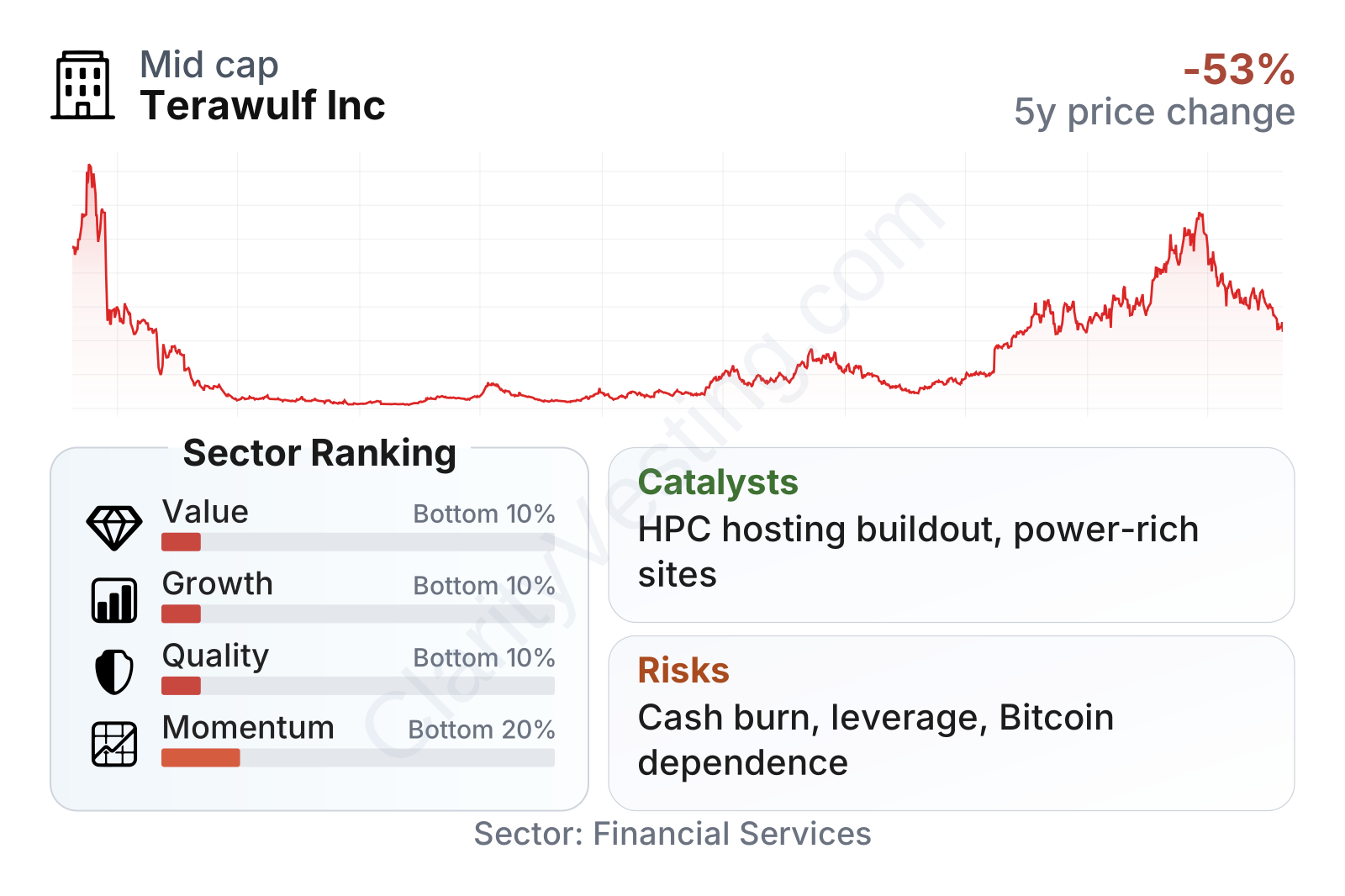
Terawulf is now a mid-sized public company by market value, but it behaves more like a high-volatility early-growth name than a mature infrastructure operator. The share price history shows extreme swings, from a collapse in 2022 to a powerful recovery afterward, which fits a business tied to Bitcoin economics and changing expectations around data center growth. Its beta above 4 also points to unusually large moves compared with the broader market.
The latest metrics paint a difficult picture on fundamentals. Relative to its sector, the company ranks in the bottom tier on value, growth, and quality measures. That weak positioning is mainly due to ongoing losses, negative free cash flow, very high leverage relative to equity, and returns on capital that remain far below sector norms. Momentum has been better over multi-year periods, but more recent trading has been mixed, showing that enthusiasm remains sensitive to execution and market sentiment.
Growth
Terawulf operates in two areas with very different long-term profiles. Bitcoin mining is a real and growing industry, but it is highly cyclical and depends on Bitcoin prices, network difficulty, and power costs. High-performance computing and AI-oriented data center infrastructure, by contrast, is one of the strongest growth themes in the market today. That makes Terawulf’s strategy logical on paper: use access to power and industrial-scale sites to serve demand that extends beyond cryptocurrency.
The company’s long-term revenue trend supports the idea that it has been building something larger. Five-year revenue per share growth has been much stronger than the sector median, even though recent year-over-year revenue slipped by about 6%. That combination suggests a business that has scaled rapidly but is now going through a transition period rather than moving in a straight line.
Earnings have improved substantially from the deep losses seen in 2021 through 2024, but that progress reversed in 2025 and remained under pressure into 2026. In plain English, Terawulf has not yet shown that rising revenue can reliably translate into sustainable profits. For a long-term view, that is one of the most important open questions.
Book value per share has moved down sharply over time, which usually means expansion has been funded in ways that have not yet created corresponding accounting value for shareholders. That decline matters because it helps explain why valuation measures tied to book value look stretched today.
The most important catalyst is the company’s push into high-performance computing hosting. If Terawulf can convert its power access, land, and existing digital infrastructure into contracted computing capacity for AI and enterprise workloads, the market may increasingly evaluate it as a data center platform rather than only as a Bitcoin miner. Company announcements around new hosting arrangements, site development, and power capacity are especially important because they could reshape how durable future revenue becomes.
Another favorable point is energy positioning. In both Bitcoin mining and AI infrastructure, access to reliable, lower-cost electricity is a major competitive factor. Terawulf has repeatedly highlighted its energy arrangements and zero-carbon focus, which can support unit economics and attract counterparties looking for cleaner power sourcing.
Risks
This article is for informational purposes only and does not constitute financial advice. Some content is AI-generated. See Disclaimer


