Stock Analysis · Western Union Co (WU)
Overview
Western Union is a global money movement company best known for person-to-person transfers. Its core business helps consumers and businesses send money across borders, pay bills, move funds into bank accounts or digital wallets, and convert currencies. The company operates in more than 200 countries and territories through a mix of digital channels and a large agent network, which remains one of its defining assets.
Western Union’s revenue base is still dominated by consumer money transfers. Based on recent annual reporting, the business can be understood through these main sources of revenue:
- Consumer Money Transfer: about 80% to 85% of revenue. This includes cross-border and domestic transfers made in retail locations, online, and through mobile apps.
- Consumer Services: about 10% to 15% of revenue. This mainly includes bill payments, money orders, and other consumer financial services.
- Business Solutions and other: about 3% to 7% of revenue. This includes foreign-exchange and cross-border payment services for businesses, plus smaller corporate items.
The revenue mix matters because it shows both Western Union’s strength and its challenge: the company has a very large installed network and a recognized brand, but it remains heavily tied to remittance activity, a category facing pricing pressure and digital disruption.
Over the last several years, total revenue has trended downward from a little above $5.0 billion in 2021 to close to $4.0 billion in 2025, while operating income and net income have been more volatile. Cost discipline has helped limit the damage, but the broad direction has been a shrinking top line rather than a clear expansion phase.
The long-term picture shows a business still producing meaningful profit and cash flow, but from a smaller revenue base than a few years ago. That makes execution on digital growth and customer retention especially important.
Key Figures
| Metric | Value | Sector ⓘ |
|---|---|---|
| Date | Oct 17, 2026 | |
| Context | ||
| Sector | Financial Services | |
| Industry | Credit Services | |
| Market Cap ⓘ | $1.89B | |
| Beta ⓘ | 0.55 | |
Value (Cheapness) | ||
| P/E Ratio ⓘ | 4.96 | 12.26 |
| P/B Ratio ⓘ | 2.14 | 1.23 |
| FCF Yield ⓘ | 21.34% | 10.40% |
| Dividend Yield ⓘ | 15.41% | 3.02% |
| EBIT / EV ⓘ | 36.25% | 8.14% |
| PEG ⓘ | 10.21 | |
Growth (Business expansion) | ||
| Revenue Growth ⓘ | -1.30% | 9.35% |
| RPS Growth (5Y CAGR) ⓘ | -0.13% | 12.19% |
| EPS Growth (5Y CAGR) ⓘ | -26.33% | -9.53% |
| BVPS Growth (5Y CAGR) ⓘ | 35.41% | 4.99% |
| Margin Growth (5Y Trend) ⓘ | -1.50% | -3.86% |
| FCF Growth (5Y CAGR) ⓘ | -17.07% | 4.81% |
| DPS Growth (5Y CAGR) ⓘ | 0.27% | 8.79% |
Quality (Business durability) | ||
| ROIC (Latest) ⓘ | 14.12% | 9.49% |
| ROE (Latest) ⓘ | 42.98% | 13.90% |
| ROA (Latest) ⓘ | 5.02% | 1.55% |
| ROIC (5Y Median) ⓘ | 27.10% | 7.86% |
| ROE (5Y Median) ⓘ | 130.85% | 12.17% |
| ROA (5Y Median) ⓘ | 8.80% | 1.30% |
| Net Debt / EBIT (Latest) ⓘ | 2.04 | 0.96 |
| Net Debt / EBIT (5Y Median) ⓘ | 1.51 | 0.73 |
| Net Debt / EBITDA (Latest) ⓘ | 1.60 | 0.92 |
| Operating Margin (Latest) ⓘ | 16.21% | 22.30% |
| Operating Margin (5Y Median) ⓘ | 19.03% | 24.63% |
| Debt to Equity (Latest) ⓘ | 294.87% | 58.56% |
| Profit Margin (Latest) ⓘ | 9.80% | 26.57% |
| Free Cash Flow (Latest) ⓘ | $402.60M | |
Momentum (Price trend) | ||
| 3Y Return ⓘ | -36.77% | +88.33% |
| 12M Return (excl. last month) ⓘ | -8.84% | +19.38% |
| 6M Return ⓘ | -27.29% | +4.75% |
| Price vs. 200-Day MA ⓘ | -19.86% | +3.50% |
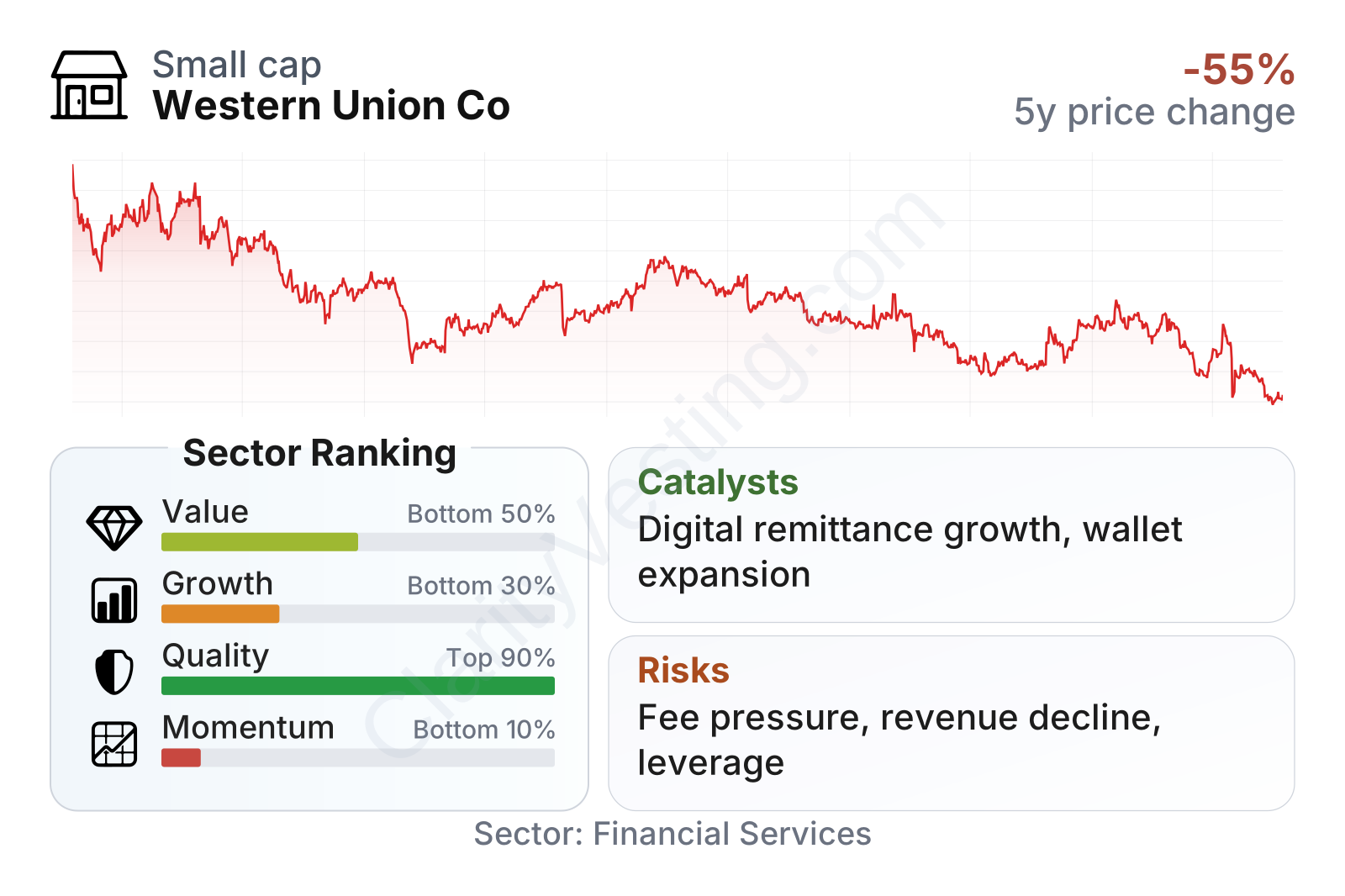
Western Union currently looks unusual on the surface: the stock trades on a very low earnings multiple, free-cash-flow yield is high, and the dividend yield is far above the sector median. At the same time, growth and price momentum are weak, with returns trailing much of the broader financial services group. Quality metrics are stronger than they may first appear, especially returns on capital and assets, which suggests the underlying franchise still has economic value even as growth has stalled.
The company is relatively small by public-market standards, with a beta well below 1.0, meaning the shares have historically moved less than the overall market. That lower volatility does not mean low risk here; instead, it reflects a mature business whose main debate is business durability rather than rapid expansion.
Growth
Western Union operates in a sector with durable structural demand. Cross-border money movement is supported by migration, remittances to families, small business international activity, and the ongoing shift from cash to digital financial tools. In that sense, the company participates in a market that should remain relevant for many years. The harder question is whether Western Union can capture enough of that growth while newer digital-first rivals push fees down and make transfers easier inside apps.
The company’s strategy has centered on expanding digital transfers, integrating its retail network with online and mobile channels, and improving the experience for account payouts and wallet-based transfers. That strategy is logical. Western Union’s brand, compliance capabilities, and global reach give it a foundation that many younger competitors lack. The strongest potential catalyst is successful digital conversion of customers who already know the brand but want faster, lower-friction, app-based service.
Earnings per share have been broadly flat to down compared with earlier years, which fits the picture of a company defending profitability rather than compounding at a high rate. That said, flat earnings in a pressured industry can still indicate resilience if the company protects margins and cash generation.
Book value per share has improved sharply over the last several years. Part of that reflects changes in the balance sheet and capital structure rather than pure operating expansion, so it should not be read as proof of strong business growth on its own. Still, it shows that the company has not been eroding its equity base in the way some declining financial businesses do.
A recent opportunity to watch is the company’s continued push toward digital and branded network partnerships. Western Union has also emphasized account-to-account and wallet capabilities, which are strategically important because that is where customer expectations are moving. If those channels grow faster than the legacy retail business declines, the company’s overall revenue trend could stabilize.
Risks
This article is for informational purposes only and does not constitute financial advice. Some content is AI-generated. See Disclaimer


