Stock Analysis · Watts Water Technologies Inc (WTS)
Overview
Watts Water Technologies is a manufacturer of products used to control, protect, and conserve the flow of water in residential, commercial, and industrial buildings. Its equipment is found in plumbing, heating, and water quality systems, with products such as valves, backflow preventers, drainage systems, leak detection devices, boilers and hydronic heating components, and water filtration and conditioning solutions. In simple terms, the company sells the hardware that helps buildings move water safely, efficiently, and in compliance with local codes.
The business is geographically diversified, and its revenue is primarily generated across the Americas, Europe, and Asia-Pacific. Based on the company’s latest annual reporting structure, the revenue mix is approximately:
- Americas: about 68% — plumbing and flow-control products, drainage, water quality, HVAC and hydronic solutions, and municipal or commercial water safety products.
- Europe: about 24% — heating, plumbing, and water regulation products, with meaningful exposure to energy-efficiency and hydronic applications.
- Asia-Pacific: about 8% — water quality, flow-control, and building water management products, with a smaller but growing footprint.
At the product level, Watts does not disclose a precise companywide revenue split for every category in one simple line item, but its business is centered on a few recurring needs: water safety, code compliance, energy efficiency, and water conservation. This gives the company exposure to both new construction and the large installed base of buildings that require maintenance, upgrades, and replacement parts.
The long-term financial picture also shows a favorable pattern: revenue has expanded steadily over the last several years, while operating income and net income have grown faster than sales. That suggests the company has not only become bigger, but also more efficient.
The progression over recent years points to improving profitability rather than growth driven only by volume. Gross profit has risen faster than cost of revenue, and operating income has increased materially, indicating better pricing, product mix, and execution.
Key Figures
| Metric | Value | Sector ⓘ |
|---|---|---|
| Date | Oct 24, 2026 | |
| Context | ||
| Sector | Industrials | |
| Industry | Specialty Industrial Machinery | |
| Market Cap ⓘ | $11.95B | |
| Beta ⓘ | 1.15 | |
Value (Cheapness) | ||
| P/E Ratio ⓘ | 31.28 | 22.29 |
| P/B Ratio ⓘ | 5.56 | 1.98 |
| FCF Yield ⓘ | 2.92% | 6.26% |
| Dividend Yield ⓘ | 0.61% | 1.92% |
| EBIT / EV ⓘ | 4.44% | 4.83% |
| PEG ⓘ | 3.16 | |
Growth (Business expansion) | ||
| Revenue Growth ⓘ | 18.60% | 9.30% |
| RPS Growth (5Y CAGR) ⓘ | 8.07% | 7.76% |
| EPS Growth (5Y CAGR) ⓘ | -1.65% | -13.17% |
| BVPS Growth (5Y CAGR) ⓘ | 15.00% | 6.13% |
| Margin Growth (5Y Trend) ⓘ | 5.44% | 0.74% |
| FCF Growth (5Y CAGR) ⓘ | 23.31% | 10.79% |
| DPS Growth (5Y CAGR) ⓘ | 18.53% | 9.41% |
Quality (Business durability) | ||
| ROIC (Latest) ⓘ | 17.38% | 10.75% |
| ROA (Latest) ⓘ | 13.52% | 5.41% |
| ROIC (5Y Median) ⓘ | 16.46% | 9.37% |
| ROA (5Y Median) ⓘ | 12.37% | 4.95% |
| Net Debt / EBIT (Latest) ⓘ | -0.46 | 2.04 |
| Net Debt / EBIT (5Y Median) ⓘ | -0.46 | 2.27 |
| Net Debt / EBITDA (Latest) ⓘ | -0.41 | 1.39 |
| Net Debt / Assets ⓘ | -8.13% | 19.27% |
| EBITDA / Interest ⓘ | 56.74 | 9.58 |
| Operating Margin (Latest) ⓘ | 19.33% | 10.49% |
| Operating Margin (5Y Median) ⓘ | 17.40% | 10.30% |
| Debt to Equity (Latest) ⓘ | 4.93% | 64.82% |
| Profit Margin (Latest) ⓘ | 14.34% | 6.67% |
| Free Cash Flow (Latest) ⓘ | $349.40M | |
Momentum (Price trend) | ||
| 3Y Return ⓘ | +115.92% | +67.77% |
| 12M Return (excl. last month) ⓘ | +25.71% | +12.05% |
| 6M Return ⓘ | +22.90% | 0.00% |
| Price vs. 200-Day MA ⓘ | +10.86% | +0.67% |
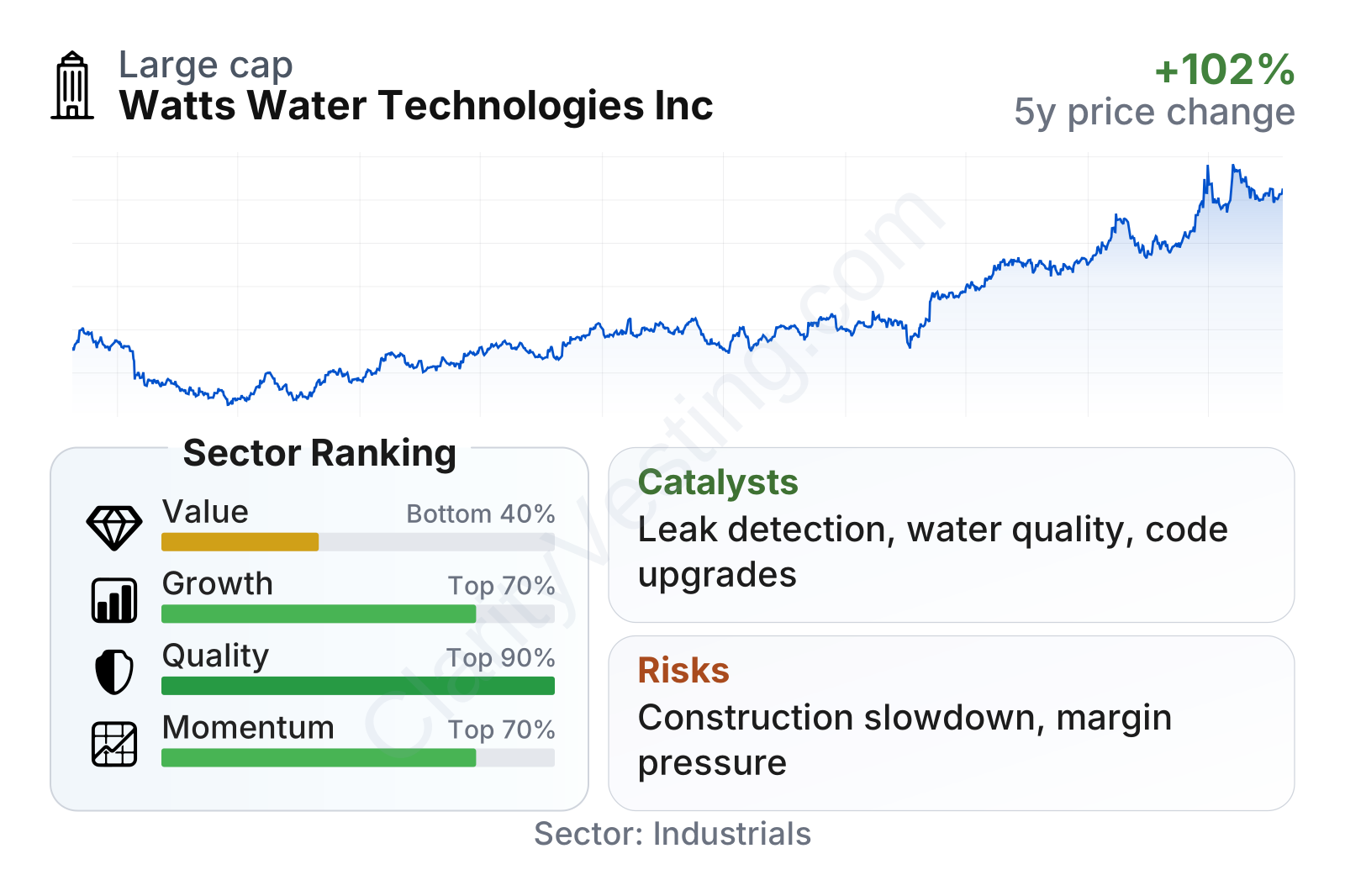
Watts stands out most clearly on business quality. Profitability ratios, returns on capital, and balance-sheet strength are notably better than the typical company in its sector. Growth metrics are generally solid as well, especially in free cash flow and margin expansion. The weaker area is valuation: the shares trade at higher earnings and book multiples than sector norms, so the market is already recognizing much of that quality.
The stock’s multi-year performance has also been strong. That momentum reflects a company that has delivered improving operating results, but it also means expectations embedded in the share price are no longer low.
Growth
Watts operates in a sector with durable long-term demand rather than explosive short-term expansion. Buildings always need safe water flow, pressure control, drainage, and treatment. On top of that, stricter building standards, aging infrastructure, water scarcity concerns, and the push for energy-efficient systems support continued demand for upgrades. These are attractive characteristics for a long-term industrial business because they are tied to necessity and regulation, not just discretionary spending.
The company’s strategy appears coherent for that environment. It has been expanding in higher-value categories such as water quality, smart monitoring, and leak detection, while continuing to strengthen its core valve and flow-control franchise. That mix matters because digital water monitoring and connected safety products can deepen customer relationships and support better margins than basic commodity-like hardware.
Recent revenue trends show that growth has not been perfectly smooth, which is typical for an industrial manufacturer exposed to construction and renovation cycles. Still, the broader direction remains positive, and the latest year-over-year readings indicate a meaningful reacceleration after a softer patch in late 2024 and early 2025. That suggests demand has remained resilient and that the company has been able to regain momentum.
Cash generation is another important support for the growth case. Free cash flow has risen sharply over the last several years, even with a modest dip from the most recent peak. That kind of cash profile gives Watts flexibility to fund product development, acquisitions, dividends, and operational improvements without relying heavily on debt.
A relevant catalyst is the continued modernization of building water systems. Property owners are paying more attention to leak prevention, water quality, and efficiency because the cost of water damage, compliance failures, and wasted energy can be significant. Watts is positioned where those needs overlap: safety, conservation, and system control. In addition, public attention to lead reduction, filtration, and water infrastructure quality can support demand for upgraded plumbing and treatment components over time.
The company has also used acquisitions over the years to add technologies and expand its channel reach. When done carefully, that can help Watts move from selling individual components toward broader system solutions, which usually strengthens pricing power and customer stickiness.
Risks
This article is for informational purposes only and does not constitute financial advice. Some content is AI-generated. See Disclaimer


