Stock Analysis · Essential Utilities Inc (WTRG)
Overview
Essential Utilities Inc. is a regulated utility company focused mainly on water and wastewater service, with a smaller natural gas distribution business. The company operates under long-lived local franchises and serves residential, commercial, industrial, and public-sector customers. Its best-known operating brands are Aqua for water and wastewater and Peoples for natural gas. The core investment case is relatively simple: these are essential household services, demand is usually steady, and a large part of the company’s earnings depends on regulated rate structures rather than highly cyclical end markets.
Revenue comes from two main operating segments. Based on the company’s recent annual reporting, the mix is approximately:
- Regulated water services: about 50% to 55% — drinking water operations, customer billing, infrastructure maintenance, and related regulated activities.
- Regulated natural gas services: about 40% to 45% — gas distribution to homes and businesses, including weather-sensitive delivery revenue and regulated recovery mechanisms.
- Wastewater and other utility services: about 5% to 10% — wastewater collection and treatment, plus smaller support and ancillary activities.
The business mix matters because water and wastewater tend to offer very stable, infrastructure-driven growth, while natural gas adds scale but also introduces weather exposure, commodity-cost pass-through complexity, and longer-term policy uncertainty around fossil fuels. Even so, both businesses operate in heavily regulated environments that generally allow utilities to seek rate increases to recover capital spending over time.
The company’s earnings profile has improved over the past several years. Revenue has moved upward overall, and operating profit has expanded faster than sales, suggesting that rate recovery and operating discipline have supported margins. Interest expense has also risen, which is typical for a utility investing heavily in infrastructure and relying on debt financing.
At a high level, the company has turned a little over $2 billion of annual revenue into a meaningfully larger operating and net income base than it produced a few years ago. That margin strength is notable for a utility and helps offset some concerns around financing costs and capital intensity.
Key Figures
| Metric | Value | Sector ⓘ |
|---|---|---|
| Date | Oct 17, 2026 | |
| Context | ||
| Sector | Utilities | |
| Industry | Utilities - Regulated Water | |
| Market Cap ⓘ | $11.14B | |
| Beta ⓘ | 0.62 | |
Value (Cheapness) | ||
| P/E Ratio ⓘ | 20.05 | 17.28 |
| P/B Ratio ⓘ | 1.61 | 1.51 |
| FCF Yield ⓘ | -4.38% | 0.65% |
| Dividend Yield ⓘ | 3.50% | 3.77% |
| EBIT / EV ⓘ | 4.61% | 5.01% |
| PEG ⓘ | 3.58 | |
Growth (Business expansion) | ||
| Revenue Growth ⓘ | 3.10% | 6.10% |
| RPS Growth (5Y CAGR) ⓘ | 4.93% | 3.87% |
| EPS Growth (5Y CAGR) ⓘ | -9.65% | -11.30% |
| BVPS Growth (5Y CAGR) ⓘ | 5.03% | 4.23% |
| Margin Growth (5Y Trend) ⓘ | 4.82% | 3.57% |
| FCF Growth (5Y CAGR) ⓘ | N/A | -8.84% |
| DPS Growth (5Y CAGR) ⓘ | 7.38% | 4.84% |
Quality (Business durability) | ||
| ROIC (Latest) ⓘ | 5.74% | 6.53% |
| ROA (Latest) ⓘ | 2.86% | 3.20% |
| ROIC (5Y Median) ⓘ | 7.87% | 5.95% |
| ROA (5Y Median) ⓘ | 3.06% | 2.75% |
| Net Debt / EBIT (Latest) ⓘ | 9.27 | 7.13 |
| Net Debt / EBIT (5Y Median) ⓘ | 9.55 | 7.23 |
| Net Debt / EBITDA (Latest) ⓘ | 6.27 | 4.31 |
| Net Debt / Assets ⓘ | 42.70% | 38.42% |
| EBITDA / Interest ⓘ | 3.95 | 4.58 |
| Operating Margin (Latest) ⓘ | 35.75% | 20.83% |
| Operating Margin (5Y Median) ⓘ | 34.82% | 20.08% |
| Debt to Equity (Latest) ⓘ | 121.44% | 137.69% |
| Profit Margin (Latest) ⓘ | 21.60% | 11.37% |
| Free Cash Flow (Latest) ⓘ | -$488.38M | |
Momentum (Price trend) | ||
| 3Y Return ⓘ | +32.19% | +52.37% |
| 12M Return (excl. last month) ⓘ | +12.63% | +8.84% |
| 6M Return ⓘ | +2.83% | -3.95% |
| Price vs. 200-Day MA ⓘ | +2.91% | -0.79% |
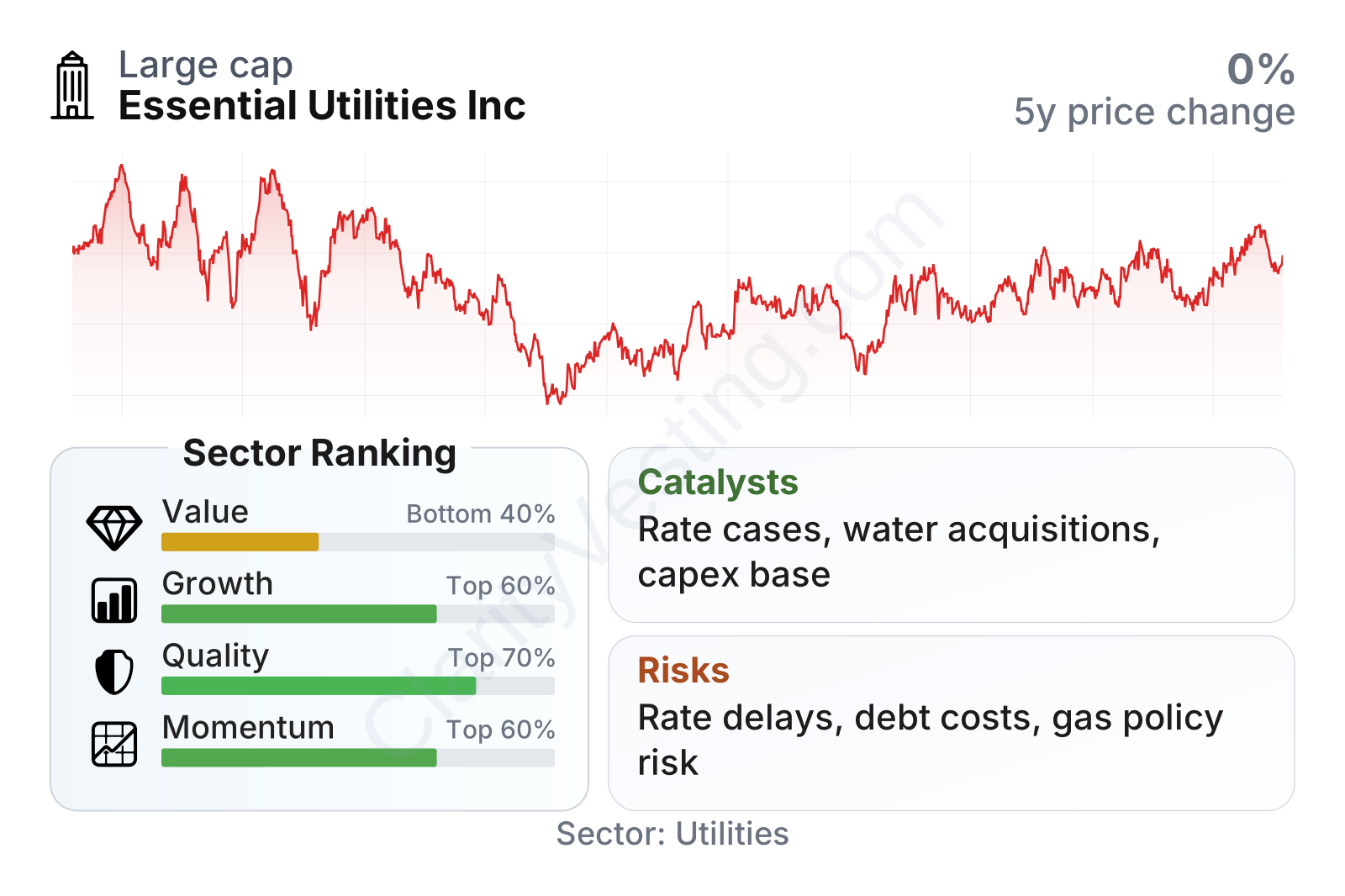
Essential Utilities is a mid-sized regulated utility with a relatively low share-price volatility profile, reflected in a beta well below 1. In the broader utility group, quality metrics look better than average, especially margins and long-term profitability, while value metrics appear less favorable because the stock trades around or above sector norms on several measures despite negative free cash flow. Growth is mixed: long-term revenue per share and dividend growth have been solid, but recent year-over-year revenue growth has been slower than the sector median. Share-price momentum has also been moderate rather than strong.
Growth
Essential Utilities operates in a sector with durable long-term demand. Water systems in the United States need large ongoing investment because many pipes, treatment facilities, and wastewater networks are old and require replacement. That creates a favorable backdrop for regulated water operators that can invest capital and then seek rate recovery through the regulatory process. In that sense, the company is in a growing need-based market even if customer volume growth itself is usually modest.
The company’s strategy is centered on infrastructure replacement, regulatory rate cases, and selective acquisitions of municipal or smaller systems. That approach is logical for this industry. Water utilities often grow not by selling dramatically more water, but by expanding their customer base, improving systems, and earning returns on new capital deployed into regulated assets. Essential Utilities has long presented consolidation as part of its water growth model, and the U.S. water sector remains fragmented enough for that to remain relevant.
Revenue per share has generally trended upward over the last five years, even with some year-to-year variation. That is an encouraging sign because it suggests growth has not depended only on issuing more shares. Over a five-year period, revenue per share growth has been slightly ahead of the sector median, while book value per share has also compounded at a steady pace.
One important nuance is that free cash flow remains negative. For a utility, that does not automatically signal weakness, because these businesses regularly spend heavily on pipes, treatment plants, and network upgrades before recovering those investments through rates over time. Still, persistent negative free cash flow means growth depends heavily on access to debt and equity capital. The underlying business can be sound while cash generation looks weak in the near term because regulated utility economics reward long-asset investment over many years rather than immediate cash surpluses.
As for catalysts, the most important ones are continued rate relief, execution of capital programs, and additional water and wastewater acquisitions. A supportive interest-rate environment could also help by easing financing pressure and improving the relative appeal of utility stocks. In public company communications during 2026, management has continued emphasizing infrastructure investment and the regulated capital plan, which is the clearest path to future earnings expansion.
Risks
This article is for informational purposes only and does not constitute financial advice. Some content is AI-generated. See Disclaimer


