Stock Analysis · Wintrust Financial Corporation (WTFC)
Overview
Wintrust Financial Corporation is a regional banking company based in the Chicago area with a broad community-banking model. It operates local banks, serves small and mid-sized businesses, provides commercial and consumer lending, gathers deposits, and also runs fee-based businesses such as wealth management, mortgage banking, and insurance-related activities. In simple terms, Wintrust makes money both from traditional banking spreads and from service fees.
The business is still led primarily by lending and deposit-taking, but its model is more diversified than a plain-vanilla regional bank. Based on recent company reporting, the main revenue sources can be summarized approximately as follows:
- Net interest income: about 70% to 75% of total revenue. This is the difference between what Wintrust earns on loans and securities and what it pays on deposits and other funding.
- Wealth management and trust fees: about 6% to 8%. This includes asset management, trust, and related advisory services.
- Mortgage banking and related fees: about 4% to 7%. This covers mortgage origination, servicing-related income, and secondary-market activity.
- Card, treasury management, service charges, and other banking fees: about 8% to 12%. This includes deposit account fees, interchange income, treasury services, and other customer service charges.
- Insurance commissions and other noninterest income: low single-digit share. These are smaller but still useful earnings contributors outside core lending.
That mix matters for long-term analysis because it shows Wintrust is not relying on one narrow product. The company is still fundamentally a spread-based bank, but fee businesses help reduce dependence on interest rates alone.
Over the last several years, revenue and net income have moved higher overall, even though the path has not been perfectly smooth. Operating expenses have also risen, which is common for growing banks that keep investing in staff, branches, technology, and new business lines. The broad picture is that Wintrust has become a larger and more profitable institution than it was a few years ago.
The flow of revenue and costs points to a bank that has expanded meaningfully since 2021. Revenue has grown strongly, and net income has also improved, although the cost base has moved up as well. That combination suggests growth has been real, but it has required continued spending to support the franchise.
Key Figures
| Metric | Value | Sector ⓘ |
|---|---|---|
| Date | Oct 31, 2026 | |
| Context | ||
| Sector | Financial Services | |
| Industry | Banks - Regional | |
| Market Cap ⓘ | $10.14B | |
| Beta ⓘ | 0.89 | |
Value (Cheapness) | ||
| P/E Ratio ⓘ | 11.52 | 12.20 |
| P/B Ratio ⓘ | 1.45 | 1.26 |
| FCF Yield ⓘ | 15.76% | 9.87% |
| Dividend Yield ⓘ | 1.43% | 2.87% |
| EBIT / EV ⓘ | 12.09% | 8.17% |
| PEG ⓘ | 1.17 | |
Growth (Business expansion) | ||
| Revenue Growth ⓘ | 8.20% | 8.40% |
| RPS Growth (5Y CAGR) ⓘ | 18.03% | 12.31% |
| EPS Growth (5Y CAGR) ⓘ | 5.82% | -4.03% |
| BVPS Growth (5Y CAGR) ⓘ | 10.99% | 4.96% |
| Margin Growth (5Y Trend) ⓘ | -7.83% | -4.14% |
| FCF Growth (5Y CAGR) ⓘ | -5.39% | 4.70% |
| DPS Growth (5Y CAGR) ⓘ | 10.06% | 8.85% |
Quality (Business durability) | ||
| ROIC (Latest) ⓘ | 8.07% | 9.35% |
| ROE (Latest) ⓘ | 12.69% | 13.95% |
| ROA (Latest) ⓘ | 1.26% | 1.57% |
| ROIC (5Y Median) ⓘ | 7.37% | 7.78% |
| ROE (5Y Median) ⓘ | 11.84% | 12.12% |
| ROA (5Y Median) ⓘ | 1.14% | 1.28% |
| Net Debt / EBIT (Latest) ⓘ | 0.17 | 0.99 |
| Net Debt / EBIT (5Y Median) ⓘ | 1.60 | 0.73 |
| Net Debt / EBITDA (Latest) ⓘ | 0.12 | 0.79 |
| Operating Margin (Latest) ⓘ | 28.24% | 22.61% |
| Operating Margin (5Y Median) ⓘ | 26.43% | 24.52% |
| Debt to Equity (Latest) ⓘ | 59.79% | 58.76% |
| Profit Margin (Latest) ⓘ | 32.81% | 26.18% |
| Free Cash Flow (Latest) ⓘ | $1.60B | |
Momentum (Price trend) | ||
| 3Y Return ⓘ | +116.64% | +95.34% |
| 12M Return (excl. last month) ⓘ | +9.83% | +16.22% |
| 6M Return ⓘ | +4.86% | +7.41% |
| Price vs. 200-Day MA ⓘ | +3.05% | +5.48% |
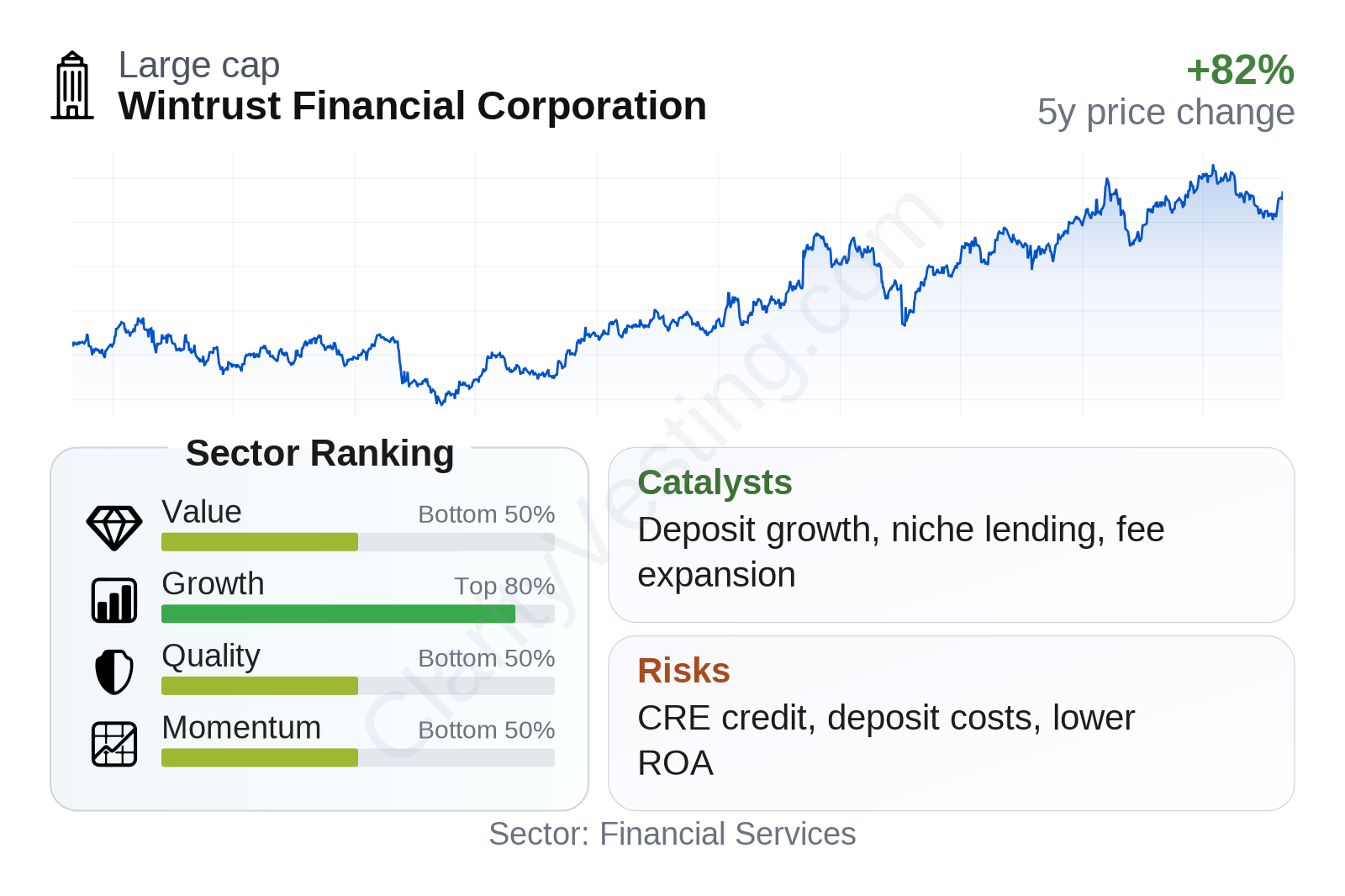
Wintrust is a mid-sized regional bank with a stock that has recovered sharply from the 2023 regional banking stress and has reached much higher levels since then. On valuation, the earnings multiple sits a bit below the sector median, while the price-to-book ratio is slightly above the sector median. That usually points to a market view that sees decent business quality and growth, but not at an extreme premium.
The factor profile is mixed. Growth metrics are one of the stronger areas, helped by solid five-year expansion in revenue per share, earnings per share, and book value per share. Profitability is respectable, with margins above many peers, but return ratios are closer to the middle of the pack. Momentum has cooled recently even after a strong multi-year share price run, which suggests the stock is no longer in an early rebound phase.
Growth
Wintrust operates in a mature industry, but not a stagnant one. Regional banking can still grow through market share gains, commercial lending, niche products, and expansion in wealthy suburban markets. Wintrust’s footprint around Chicago and other attractive local markets gives it access to business formation, real estate activity, and household wealth that can support steady balance-sheet growth over time.
The company’s strategy appears coherent for long-term expansion. It combines community banking with specialized lines such as premium finance, equipment finance, mortgage banking, and wealth management. That gives Wintrust more than one engine of growth. It can deepen relationships with local businesses, cross-sell treasury and wealth services, and keep adding deposits that support future lending.
Earnings per share have trended upward over the last several years, which supports the idea that growth has not been only balance-sheet inflation. The pace has not been explosive, but it has been durable enough to compare favorably with much of the regional bank group over a five-year period.
Book value per share has also advanced steadily, which is especially important for banks. It indicates that the company has been adding capital and intrinsic balance-sheet value over time rather than merely producing short-lived revenue gains. In Wintrust’s case, book value growth over five years has clearly outpaced the sector median, which strengthens the long-term compounding profile.
A meaningful catalyst is continued deposit gathering through its community banking network and customer relationships. For regional banks, low-cost and stable deposits are a strategic asset because they support lending margins and reduce reliance on wholesale funding. Another catalyst is normalization after the banking turmoil of 2023: institutions that kept customer confidence and retained funding flexibility can benefit if competitive pressure eases and weaker rivals pull back.
Recent company updates in 2026 have also pointed to continued lending activity, healthy capital, and ongoing franchise expansion rather than retrenchment. That does not guarantee fast growth, but it supports the case that Wintrust is still in build-out mode rather than simply harvesting a mature footprint.
Risks
This article is for informational purposes only and does not constitute financial advice. Some content is AI-generated. See Disclaimer