Stock Analysis · West Pharmaceutical Services Inc (WST)
Overview
West Pharmaceutical Services is a healthcare supply company focused on the packaging, containment, and delivery of injectable medicines. In simple terms, it makes the components that help drugmakers safely store and administer medicines in vials, syringes, cartridges, and wearable injector systems. Its products are typically small compared with the value of the drug inside, but they are critical because failures in sealing, purity, or delivery can disrupt treatment, delay production, or create safety issues.
The business is mainly tied to biologics, generics, vaccines, and other injectable therapies. That makes West more of a “picks and shovels” supplier to the pharmaceutical industry than a drug developer itself. This is important for long-term analysis because demand tends to be linked to broad growth in injectable medicines rather than to the success of one specific therapy.
Based on recent company reporting, revenue is concentrated in two operating segments, with the core pharmaceutical packaging business clearly dominant.
- Proprietary Products: about 80% to 85% of revenue — high-value components such as elastomer stoppers, seals, plungers, ready-to-use containment products, self-injection and wearable delivery systems, and products sold under premium brands including high-purity solutions used in biologics and sensitive drugs.
- Contract-Manufactured Products: about 15% to 20% of revenue — custom manufacturing of components and devices for healthcare and pharmaceutical customers, generally with lower margins than the proprietary portfolio.
Geographically, West serves global pharmaceutical customers across North America, Europe, and Asia-Pacific, with a customer base that includes many of the largest drug companies. The financial flow over the last several years shows a business that has remained highly profitable, although margins stepped down from the extraordinary levels reached earlier in the decade and have only partly recovered.
Key Figures
| Metric | Value | Sector ⓘ |
|---|---|---|
| Date | Oct 24, 2026 | |
| Context | ||
| Sector | Healthcare | |
| Industry | Medical Instruments & Supplies | |
| Market Cap ⓘ | $27.69B | |
| Beta ⓘ | 1.12 | |
Value (Cheapness) | ||
| P/E Ratio ⓘ | 50.38 | 25.42 |
| P/B Ratio ⓘ | 9.40 | 3.08 |
| FCF Yield ⓘ | 1.58% | 3.12% |
| Dividend Yield ⓘ | 0.22% | 1.85% |
| EBIT / EV ⓘ | 3.55% | 0.56% |
| PEG ⓘ | 3.43 | |
Growth (Business expansion) | ||
| Revenue Growth ⓘ | 13.80% | 7.50% |
| RPS Growth (5Y CAGR) ⓘ | 3.32% | 8.60% |
| EPS Growth (5Y CAGR) ⓘ | -15.79% | -17.73% |
| BVPS Growth (5Y CAGR) ⓘ | 9.30% | 3.72% |
| Margin Growth (5Y Trend) ⓘ | -7.26% | -0.57% |
| FCF Growth (5Y CAGR) ⓘ | 9.13% | 0.96% |
| DPS Growth (5Y CAGR) ⓘ | 5.88% | 6.69% |
Quality (Business durability) | ||
| ROIC (Latest) ⓘ | 16.83% | 3.17% |
| ROA (Latest) ⓘ | 13.81% | 2.98% |
| ROIC (5Y Median) ⓘ | 19.59% | 4.56% |
| ROA (5Y Median) ⓘ | 15.94% | 1.87% |
| Net Debt / EBIT (Latest) ⓘ | -0.18 | 1.34 |
| Net Debt / EBIT (5Y Median) ⓘ | -0.63 | 1.86 |
| Net Debt / EBITDA (Latest) ⓘ | -0.14 | 1.00 |
| Net Debt / Assets ⓘ | -3.03% | 5.06% |
| EBITDA / Interest ⓘ | 87.92 | 9.55 |
| Operating Margin (Latest) ⓘ | 20.73% | 9.25% |
| Operating Margin (5Y Median) ⓘ | 23.83% | 7.33% |
| Debt to Equity (Latest) ⓘ | 10.44% | 26.68% |
| Profit Margin (Latest) ⓘ | 16.98% | 3.34% |
| Free Cash Flow (Latest) ⓘ | $436.90M | |
Momentum (Price trend) | ||
| 3Y Return ⓘ | +7.25% | +51.61% |
| 12M Return (excl. last month) ⓘ | +47.59% | +19.90% |
| 6M Return ⓘ | +43.79% | +10.10% |
| Price vs. 200-Day MA ⓘ | +27.39% | +6.44% |
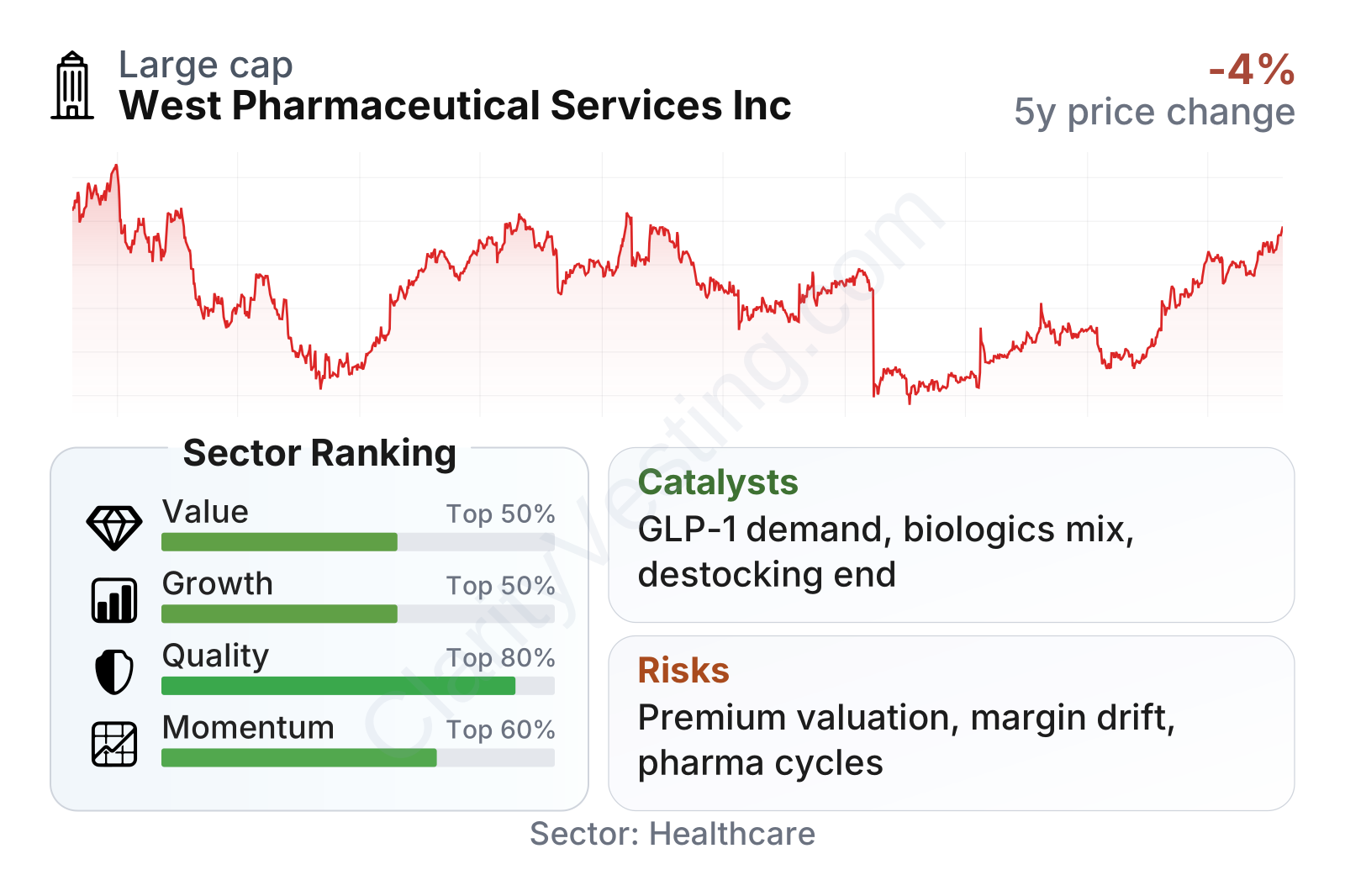
West stands out for business quality more than for cheapness. Profitability, returns on assets, and balance sheet strength rank well above much of the healthcare equipment universe, while valuation multiples remain well above sector norms. Growth indicators are mixed: recent sales growth has reaccelerated, but the longer five-year revenue pace has been more moderate and margin trends have been softer than earlier in the cycle. Share price momentum has improved sharply in recent months after a volatile multiyear stretch.
Growth
West operates in a part of healthcare that benefits from durable long-term demand drivers. Pharmaceutical companies continue to expand production of biologics, GLP-1 treatments, vaccines, and other injectable drugs that need sterile and highly reliable packaging. As therapies become more complex, packaging quality matters more, which can support demand for premium components rather than only commodity parts.
The company’s strategy also fits that trend. Management has long emphasized high-value products, especially containment solutions for sensitive drugs and delivery systems that can improve ease of use for self-injection. That approach makes strategic sense because premium products usually carry stronger margins, tighter customer relationships, and higher switching costs than basic components.
Recent revenue momentum looks better than the uneven pattern seen in 2022 through 2024. After a period of customer destocking and normalization following earlier pandemic-related demand distortions, year-over-year growth turned positive again and then accelerated into 2026. The latest pace is ahead of the sector median, suggesting that the business is currently moving through a healthier part of the cycle.
Cash generation adds support to the growth case. Free cash flow dipped during the slowdown, then recovered to a higher level in the latest period. That matters because West needs capital spending to expand specialized manufacturing, but it also needs flexibility to fund innovation, capacity, and shareholder returns without straining the balance sheet.
One of the clearest catalysts is the company’s exposure to high-growth injectable categories, especially biologics and GLP-1 related therapies, where delivery and containment requirements are demanding. Another favorable element is the gradual shift toward self-administration, which can increase the relevance of plungers, syringe components, and wearable or device-based systems. In recent company updates, management has also pointed to improving order patterns after prior inventory corrections, which supports the view that recent demand strength is not only a short-term bounce.
Risks
This article is for informational purposes only and does not constitute financial advice. Some content is AI-generated. See Disclaimer


