Stock Analysis · Watsco Inc (WSO)
Overview
Watsco is the largest distributor of heating, air conditioning, and refrigeration equipment and related parts in North America. In simple terms, it does not mainly manufacture the products it sells. Instead, it acts as the link between equipment makers and the contractors and technicians who install and service systems in homes and commercial buildings. Its network of branches, inventory, delivery capabilities, and digital tools are central to its business model.
The company’s revenue is largely tied to replacement demand rather than only new construction. That matters because air conditioners and heating systems eventually wear out, creating recurring demand even when the broader economy slows. Watsco also benefits from selling repair parts, supplies, and controls that technicians need for ongoing service work.
Based on company disclosures, the main sources of revenue are approximately:
- HVAC equipment – about 67%: Central air conditioners, heat pumps, gas furnaces, air handlers, ductless systems, packaged units, and related equipment used in residential and light commercial projects.
- Other HVAC products – about 29%: Parts, supplies, accessories, thermostats, controls, indoor air quality products, tools, and components used in repairs and maintenance.
- Commercial refrigeration products – about 4%: Equipment and parts used in refrigeration applications for businesses.
Geographically, the business is concentrated in the United States, with additional operations in Canada, Mexico, and Puerto Rico. The company’s footprint is especially relevant in Sun Belt markets, where population growth and hotter climates tend to support HVAC demand over time.
Over the last several years, revenue expanded from roughly $6.3 billion in 2021 to more than $7.2 billion in 2025, while gross profit stayed around the $2.0 billion level. That points to a business that has grown in scale but is also exposed to demand swings, product mix changes, and pricing cycles.
The overall picture is that Watsco is a large-scale, asset-light distributor with steady end-market relevance, but one whose sales and earnings can still move up and down with weather, housing activity, repair trends, and equipment replacement cycles.
Key Figures
| Metric | Value | Sector ⓘ |
|---|---|---|
| Date | Oct 17, 2026 | |
| Context | ||
| Sector | Industrials | |
| Industry | Industrial Distribution | |
| Market Cap ⓘ | $12.17B | |
| Beta ⓘ | 1.04 | |
Value (Cheapness) | ||
| P/E Ratio ⓘ | 25.29 | 22.10 |
| P/B Ratio ⓘ | 4.47 | 1.97 |
| FCF Yield ⓘ | 5.73% | 6.38% |
| Dividend Yield ⓘ | 4.22% | 1.94% |
| EBIT / EV ⓘ | 5.41% | 4.79% |
| PEG ⓘ | 1.20 | |
Growth (Business expansion) | ||
| Revenue Growth ⓘ | 2.10% | 9.30% |
| RPS Growth (5Y CAGR) ⓘ | 1.88% | 7.81% |
| EPS Growth (5Y CAGR) ⓘ | -22.70% | -13.06% |
| BVPS Growth (5Y CAGR) ⓘ | 7.07% | 6.14% |
| Margin Growth (5Y Trend) ⓘ | 0.18% | 0.88% |
| FCF Growth (5Y CAGR) ⓘ | 13.23% | 11.01% |
| DPS Growth (5Y CAGR) ⓘ | 10.73% | 9.48% |
Quality (Business durability) | ||
| ROIC (Latest) ⓘ | 19.75% | 10.84% |
| ROA (Latest) ⓘ | 9.87% | 5.41% |
| ROIC (5Y Median) ⓘ | 28.17% | 9.38% |
| ROA (5Y Median) ⓘ | 14.86% | 4.95% |
| Net Debt / EBIT (Latest) ⓘ | 0.24 | 2.08 |
| Net Debt / EBIT (5Y Median) ⓘ | 0.25 | 2.27 |
| Net Debt / EBITDA (Latest) ⓘ | 0.23 | 1.39 |
| Net Debt / Assets ⓘ | 3.36% | 19.28% |
| EBITDA / Interest ⓘ | N/A | 9.58 |
| Operating Margin (Latest) ⓘ | 9.67% | 10.50% |
| Operating Margin (5Y Median) ⓘ | 10.19% | 10.29% |
| Debt to Equity (Latest) ⓘ | 17.88% | 65.48% |
| Profit Margin (Latest) ⓘ | 6.53% | 6.67% |
| Free Cash Flow (Latest) ⓘ | $698.02M | |
Momentum (Price trend) | ||
| 3Y Return ⓘ | -16.43% | +61.68% |
| 12M Return (excl. last month) ⓘ | -15.70% | +12.58% |
| 6M Return ⓘ | -26.94% | 0.00% |
| Price vs. 200-Day MA ⓘ | -19.33% | +0.02% |
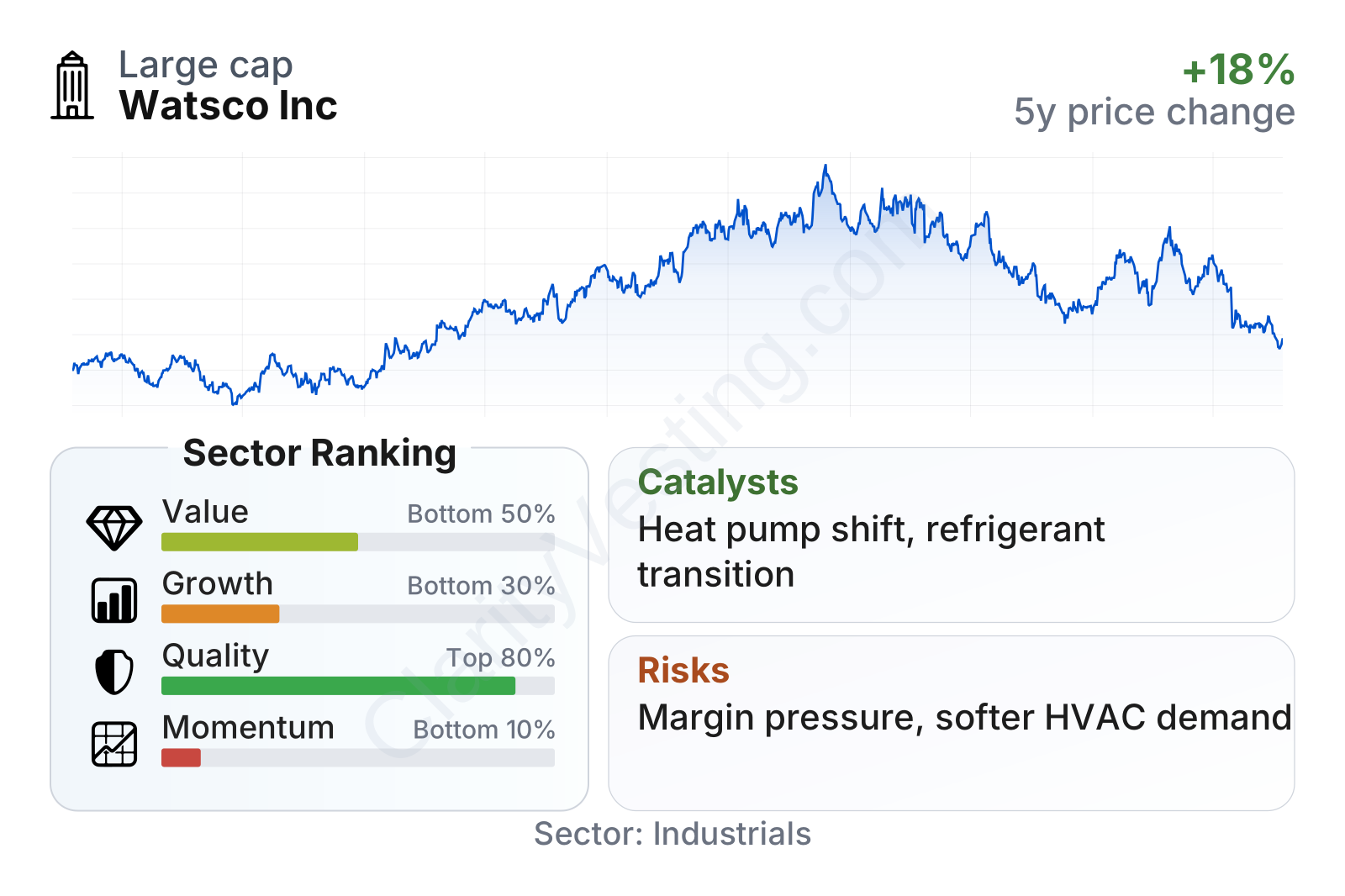
Watsco stands out more for business quality than for rapid expansion. Profitability on invested capital remains well above the sector median, and leverage is low, which gives the company unusual balance sheet flexibility for an industrial distributor. At the same time, recent growth and share price momentum have been weaker than much of the sector, while valuation measures still sit somewhat above average. In other words, the profile looks like a financially solid company with slower near-term growth and a market price that still reflects a premium for quality.
The stock’s path over the last few years has also been volatile rather than smooth. After a strong run into 2024 and parts of 2025, the shares pulled back meaningfully. That cooling in sentiment helps explain why the dividend yield is now relatively elevated, at a little above 4%, compared with much lower sector norms.
Growth
Watsco operates in a sector with durable long-term demand drivers. HVAC systems are essential products, not optional purchases, and the installed base across North America needs regular maintenance and eventual replacement. On top of that, stricter efficiency standards, refrigerant transitions, electrification trends, and demand for heat pumps can all encourage system upgrades. These are helpful structural supports even when short-term volumes are uneven.
The company’s strategy is also logical for future growth. Scale matters in distribution because contractors value local inventory, fast delivery, broad product availability, and dependable service. Watsco has built a very large branch network and pairs that with digital ordering, analytics, and mobile tools for contractors. That combination can deepen customer relationships and make the platform more efficient over time.
Recent growth, however, has been modest. Revenue growth was very strong in 2021 and 2022, then slowed sharply, turned negative through much of 2025, and has only recently returned to low positive territory in 2026. That pattern suggests the company is moving through a softer part of its cycle rather than enjoying broad-based acceleration right now. Relative to the wider industrial sector, current top-line growth is on the weak side.
A more encouraging sign is cash generation. Free cash flow has remained strong despite uneven sales growth, recovering to roughly the high-$600 million range on a trailing basis. That matters because cash generation supports dividends, acquisitions, technology investments, and balance sheet resilience. Over five years, free cash flow growth has been stronger than the sector median, even though earnings growth has been less impressive.
A significant catalyst comes from the ongoing shift toward higher-efficiency systems and newer refrigerants. Industry regulation can create replacement activity as contractors and homeowners adapt to new equipment standards. Watsco does not need to invent the technology itself to benefit; it mainly needs to be the distributor with the inventory, relationships, and logistics to move product efficiently. Its large installed contractor base gives it a practical way to capture that demand when transition activity picks up.
Another supportive factor is the company’s acquisition history. Distribution remains fragmented in many local markets, and Watsco has a long record of expanding through partnerships and acquisitions. With low leverage, it has room to continue using that playbook if attractive targets become available.
Risks
This article is for informational purposes only and does not constitute financial advice. Some content is AI-generated. See Disclaimer


