Stock Analysis · Watsco Inc (WSO-B)
Overview
Watsco Inc is the largest distributor of heating, air conditioning, and refrigeration equipment and parts in North America. In simple terms, it sits between manufacturers such as HVAC equipment makers and the contractors, technicians, and commercial customers who install and service these systems. The company operates a large branch network and digital ordering tools that help customers get equipment, replacement parts, and related supplies quickly.
Its business is closely tied to replacement demand. Air conditioners and heating systems eventually wear out, and when they fail, replacement is often urgent. That gives Watsco a steadier demand base than many industrial distributors that depend more heavily on discretionary spending. The company also benefits from new construction, renovation activity, and sales of higher-efficiency systems.
Based on company disclosures, Watsco’s revenue mix is heavily concentrated in HVAC equipment, with the rest coming from parts and related supplies. A practical breakdown is:
- HVAC equipment: approximately 68% of sales. This includes central air conditioners, heat pumps, furnaces, and related core systems.
- Other HVAC products: approximately 29% of sales. This category includes parts, supplies, accessories, and aftermarket items used in repair and maintenance.
- Commercial refrigeration products: approximately 3% of sales. This includes equipment and components for refrigeration applications.
Geographically, the company is primarily exposed to the United States, with additional operations in Canada, Mexico, and Puerto Rico. Revenue is also influenced by weather, energy efficiency standards, refrigerant transitions, and the health of residential and light commercial construction markets.
Over the last several years, the business has shown a pattern common to strong distributors: very large revenue flowing through a relatively modest net margin, but with solid cash generation and disciplined expenses. Gross profit has remained above $2 billion in recent years even as revenue moved through a cyclical period, which points to a resilient installed-base replacement market rather than a one-time spike.
The business model is straightforward but effective: high-volume distribution, local availability, contractor relationships, and increasingly digital ordering. That combination is one reason Watsco has built a scale advantage in a fragmented market.
Key Figures
| Metric | Value | Sector ⓘ |
|---|---|---|
| Date | Oct 10, 2026 | |
| Context | ||
| Sector | Industrials | |
| Industry | Industrial Distribution | |
| Market Cap ⓘ | $12.83B | |
| Beta ⓘ | 1.04 | |
Value (Cheapness) | ||
| P/E Ratio ⓘ | 26.66 | 22.32 |
| P/B Ratio ⓘ | 4.71 | 1.98 |
| FCF Yield ⓘ | 5.44% | 6.34% |
| Dividend Yield ⓘ | 3.96% | 1.95% |
| EBIT / EV ⓘ | 5.19% | 4.71% |
| PEG ⓘ | 1.20 | |
Growth (Business expansion) | ||
| Revenue Growth ⓘ | 2.10% | 9.25% |
| RPS Growth (5Y CAGR) ⓘ | 1.88% | 7.75% |
| EPS Growth (5Y CAGR) ⓘ | N/A | -13.37% |
| BVPS Growth (5Y CAGR) ⓘ | 7.07% | 6.12% |
| Margin Growth (5Y Trend) ⓘ | 0.18% | 0.81% |
| FCF Growth (5Y CAGR) ⓘ | 13.23% | 11.01% |
| DPS Growth (5Y CAGR) ⓘ | 10.73% | 9.48% |
Quality (Business durability) | ||
| ROIC (Latest) ⓘ | 19.65% | 10.70% |
| ROA (Latest) ⓘ | 9.87% | 5.38% |
| ROIC (5Y Median) ⓘ | 28.17% | 9.26% |
| ROA (5Y Median) ⓘ | 14.86% | 4.94% |
| Net Debt / EBIT (Latest) ⓘ | 0.24 | 2.08 |
| Net Debt / EBIT (5Y Median) ⓘ | 0.25 | 2.29 |
| Net Debt / EBITDA (Latest) ⓘ | 0.23 | 1.43 |
| Net Debt / Assets ⓘ | 3.36% | 19.34% |
| EBITDA / Interest ⓘ | N/A | 9.54 |
| Operating Margin (Latest) ⓘ | 9.62% | 10.34% |
| Operating Margin (5Y Median) ⓘ | 10.19% | 10.29% |
| Debt to Equity (Latest) ⓘ | 17.88% | 65.52% |
| Profit Margin (Latest) ⓘ | 6.53% | 6.63% |
| Free Cash Flow (Latest) ⓘ | $698.02M | |
Momentum (Price trend) | ||
| 3Y Return ⓘ | -7.35% | +61.33% |
| 12M Return (excl. last month) ⓘ | -24.92% | +14.82% |
| 6M Return ⓘ | -14.19% | +3.53% |
| Price vs. 200-Day MA ⓘ | -1.28% | +0.88% |
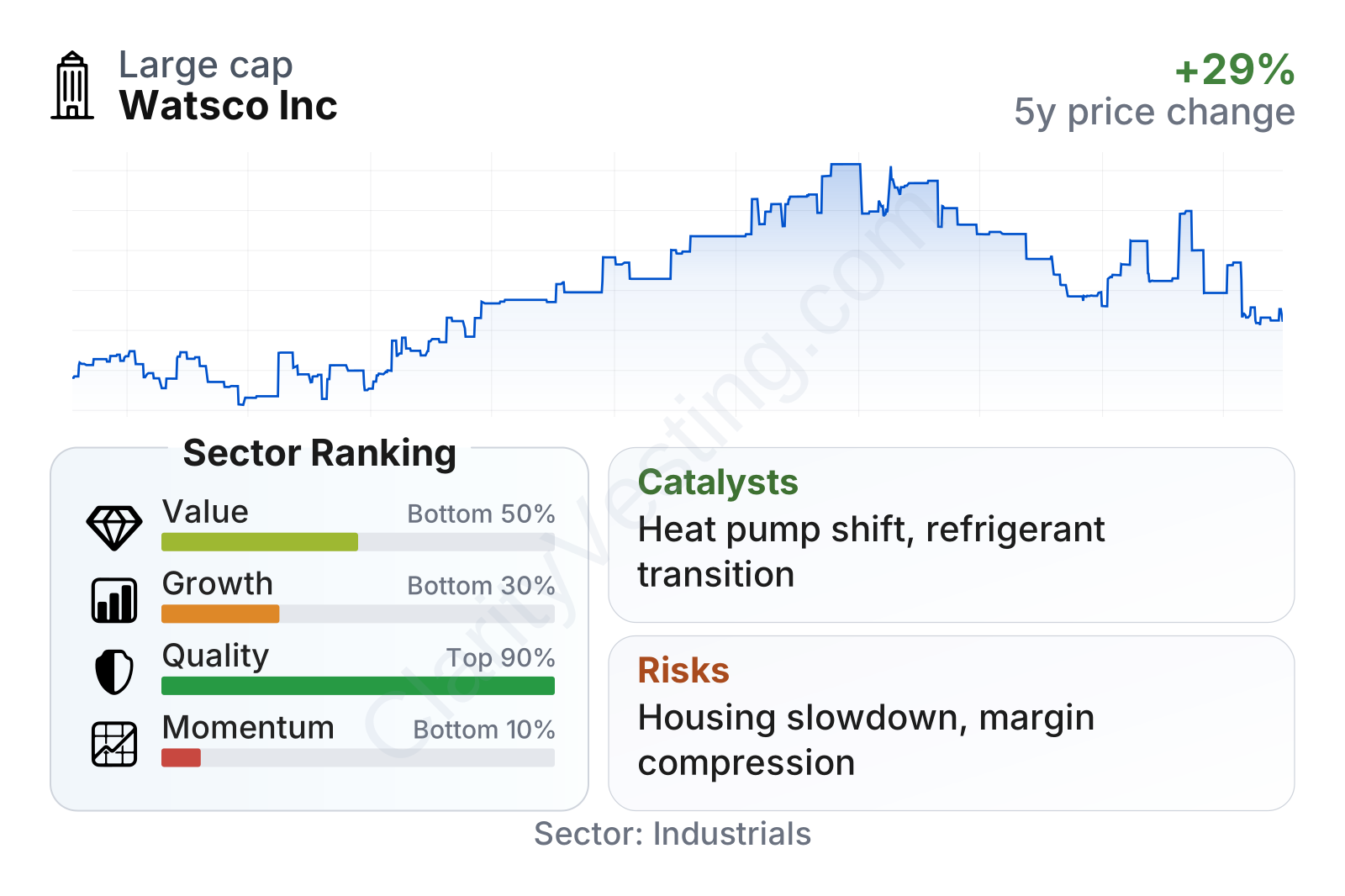
Watsco stands out more for quality than for fast recent growth. Profitability on invested capital is well above the sector median, while leverage is notably low. The company’s debt-to-equity is far below most industrial peers, and free cash flow remains healthy for a distributor of its size. On the other hand, growth and share-price momentum rank weakly versus the broader industrial sector, which helps explain why the stock’s valuation is no longer at the most extreme levels seen in 2024 and early 2025.
The stock’s path has also been volatile. After a strong run through 2023 and 2024, the shares corrected sharply before partially recovering in 2026. That pattern suggests the market has shifted from rewarding peak-cycle optimism to scrutinizing whether Watsco can return to steadier organic growth.
Growth
Watsco operates in a market with attractive long-term drivers. HVAC systems are essential products, and the installed base across North America creates ongoing replacement demand. Over time, tighter energy-efficiency standards, the shift toward heat pumps, population migration to warmer states, and aging housing stock can all support industry activity. The company is therefore in a sector that is cyclical in the short run but structurally relevant over the long run.
Its strategy also makes sense. Watsco combines scale in distribution with local contractor relationships and digital tools that simplify ordering, inventory visibility, and jobsite delivery. In distribution, convenience matters. Contractors often need parts or units immediately, which favors companies with broad inventory, many branches, and reliable logistics. That is an area where Watsco is difficult to match at smaller scale.
Recent growth has been uneven. Revenue growth surged in 2021 and 2022, then cooled materially as the market normalized. Parts of 2025 showed year-over-year declines, and the latest reading points to only minimal improvement. That does not necessarily undermine the long-term case, but it does show that Watsco is not currently in a strong expansion phase relative to many industrial peers.
Cash generation is a more encouraging signal. Free cash flow rebounded to roughly the same high range reached in prior stronger periods, showing that the business still converts earnings into cash effectively even when sales growth is soft. That matters because it supports dividends, acquisitions, working capital needs, and strategic investment without placing pressure on the balance sheet.
A notable catalyst is the ongoing transition toward higher-efficiency HVAC systems and newer refrigerants. Regulatory changes often force upgrades across the installed base and can raise average selling prices. Watsco does not manufacture the equipment, but as a leading distributor it can benefit when contractors need help navigating product changes, availability, and system matching. The company has also continued to emphasize technology platforms for contractors, which can deepen customer loyalty and improve order frequency.
Another potential growth lever is consolidation. HVAC distribution remains fragmented despite Watsco’s leadership position, so acquisitions and share gains in local markets remain plausible avenues for expansion. Even if end-market growth stays moderate, market share gains can still move the business forward.
Risks
This article is for informational purposes only and does not constitute financial advice. Some content is AI-generated. See Disclaimer


