Stock Analysis · Willscot Mobile Mini Holdings Corp A (WSC)
Overview
WillScot Mobile Mini Holdings Corp. operates a specialty rental business focused on temporary and flexible space. In simple terms, it provides portable offices, modular buildings, classrooms, storage containers, and related site services to customers that need space quickly without committing to permanent construction. Its clients span construction, industrial projects, education, commercial businesses, and government-related uses.
The business model is built around renting out a large fleet of units and then adding higher-margin services around those units. That matters because the company is not only collecting recurring rental income, but also earning from delivery, installation, maintenance, and site add-ons that can raise revenue per customer location.
Based on the company’s recent reporting structure, revenue is mainly generated from the following sources:
- Modular space and portable office rentals: approximately 45% to 55% of revenue. This includes mobile offices, modular classrooms, and larger temporary workspace solutions.
- Storage and tank rentals: approximately 30% to 40% of revenue. This includes portable storage containers and other jobsite storage products.
- Delivery, installation, sales, and other services: approximately 10% to 20% of revenue. This typically includes transport, setup, site-related services, and product sales tied to rentals.
Over the last several years, the company expanded revenue meaningfully, but the more recent pattern shows pressure on operating profit and net income. Gross profit remained substantial, yet interest expense and a heavier cost structure reduced how much of that revenue reached the bottom line. This helps explain why the company can still produce strong cash flow while reported earnings have become much weaker.
The overall picture is a business with resilient recurring rental revenue, but one that has recently seen a much larger share of sales absorbed by operating costs and financing costs.
Key Figures
| Metric | Value | Sector ⓘ |
|---|---|---|
| Date | Oct 17, 2026 | |
| Context | ||
| Sector | Industrials | |
| Industry | Rental & Leasing Services | |
| Market Cap ⓘ | $3.13B | |
| Beta ⓘ | 1.40 | |
Value (Cheapness) | ||
| P/E Ratio ⓘ | N/A | 22.10 |
| P/B Ratio ⓘ | 3.23 | 1.97 |
| FCF Yield ⓘ | 17.16% | 6.38% |
| Dividend Yield ⓘ | 1.61% | 1.94% |
| EBIT / EV ⓘ | 1.82% | 4.79% |
| PEG ⓘ | 0.94 | |
Growth (Business expansion) | ||
| Revenue Growth ⓘ | 3.90% | 9.30% |
| RPS Growth (5Y CAGR) ⓘ | 14.86% | 7.81% |
| EPS Growth (5Y CAGR) ⓘ | -24.85% | -13.06% |
| BVPS Growth (5Y CAGR) ⓘ | -13.99% | 6.14% |
| Margin Growth (5Y Trend) ⓘ | -8.67% | 0.88% |
| FCF Growth (5Y CAGR) ⓘ | 33.69% | 11.01% |
| DPS Growth (5Y CAGR) ⓘ | -45.30% | 9.48% |
Quality (Business durability) | ||
| ROIC (Latest) ⓘ | 1.67% | 10.84% |
| ROA (Latest) ⓘ | -1.15% | 5.41% |
| ROIC (5Y Median) ⓘ | 4.36% | 9.38% |
| ROA (5Y Median) ⓘ | 2.82% | 4.95% |
| Net Debt / EBIT (Latest) ⓘ | 29.56 | 2.08 |
| Net Debt / EBIT (5Y Median) ⓘ | 10.81 | 2.27 |
| Net Debt / EBITDA (Latest) ⓘ | 7.05 | 1.39 |
| Net Debt / Assets ⓘ | 64.38% | 19.28% |
| EBITDA / Interest ⓘ | 2.61 | 9.58 |
| Operating Margin (Latest) ⓘ | 5.57% | 10.50% |
| Operating Margin (5Y Median) ⓘ | 16.01% | 10.29% |
| Debt to Equity (Latest) ⓘ | 416.65% | 65.48% |
| Profit Margin (Latest) ⓘ | -3.00% | 6.67% |
| Free Cash Flow (Latest) ⓘ | $537.44M | |
Momentum (Price trend) | ||
| 3Y Return ⓘ | -60.58% | +61.68% |
| 12M Return (excl. last month) ⓘ | -18.62% | +12.58% |
| 6M Return ⓘ | -14.65% | 0.00% |
| Price vs. 200-Day MA ⓘ | -26.40% | +0.02% |
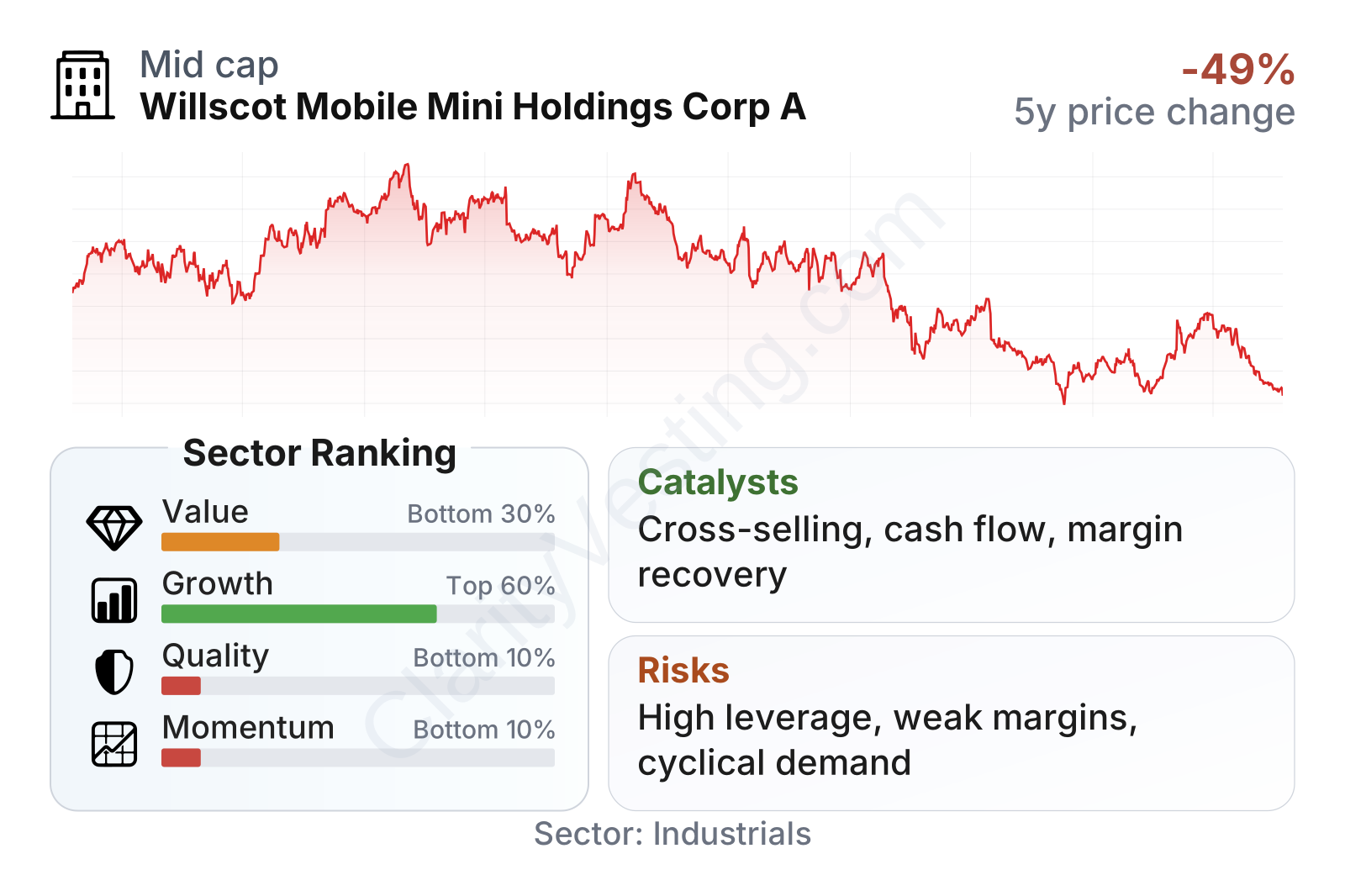
WillScot sits in the mid-cap range and its share price has been notably volatile, with a beta above 1.0 and a stock performance that has lagged much of the industrial sector over the last few years. The metrics table shows a mixed profile: growth is around the middle of the pack, valuation signals are uneven, while quality and momentum rank near the bottom of the sector.
The most favorable element is cash generation. Free cash flow yield stands well above the sector median, suggesting the business is still converting a meaningful amount of revenue into cash despite weak accounting earnings. At the same time, profitability and balance-sheet measures are clearly strained, which makes the headline valuation less straightforward than a low growth-adjusted multiple might suggest.
Growth
WillScot operates in a part of the market that benefits from long-term demand for flexible infrastructure. Many customers want faster and lower-commitment alternatives to permanent buildings, especially for construction sites, school capacity needs, industrial projects, disaster response, and temporary business expansion. That broad demand backdrop is supportive because modular and portable space can often be deployed faster and at lower upfront cost than traditional construction.
The company’s strategy also makes economic sense. It has been trying to increase revenue per unit through value-added products and services rather than relying only on fleet expansion. This is important because add-on items such as power, access systems, furnishings, climate solutions, storage-related accessories, and site services can improve customer retention and lift margins when executed well.
Recent growth, however, has been less consistent than earlier in the cycle. Revenue growth was strong in 2022 and 2023, slowed materially in 2024, turned negative for much of 2025, and then returned to modest positive territory in the latest period. That suggests the company is no longer enjoying the same easy tailwinds from pricing and post-merger optimization that supported earlier expansion.
Cash flow is a more encouraging part of the growth picture. Free cash flow has risen strongly over a multiyear period, even though it has been uneven from one period to the next. A trailing figure above $500 million is substantial relative to the company’s current size, and it gives management room to fund fleet investments, reduce debt, repurchase shares, or support selective expansion if demand improves.
A meaningful catalyst is the company’s ability to cross-sell more products into its installed customer base. Another is eventual easing in financing pressure if interest costs moderate or leverage comes down. If non-residential activity, public infrastructure work, and institutional demand remain healthy, WillScot’s fleet utilization and ancillary revenue could improve without requiring extreme capital intensity.
Recent company updates have also emphasized operational simplification, cost discipline, and focus on return-based capital allocation. In the current environment, that may be more important than rapid top-line growth because the next phase of value creation likely depends on stabilizing margins and turning cash generation into stronger per-share results.
Risks
This article is for informational purposes only and does not constitute financial advice. Some content is AI-generated. See Disclaimer


